How Much of a Cost Saving to Give Back: The Case of Chocolate
A full cost breakdown supports a much smaller cut than the fall in cocoa suggests.
The short version
- Retailers want price cuts because cocoa is cheaper, but other costs rose, several by a larger percentage. In the third quarter of 2026 cocoa was about a fifth cheaper than a year earlier, while crude oil and wheat rose by about two-fifths and European gas almost doubled.1
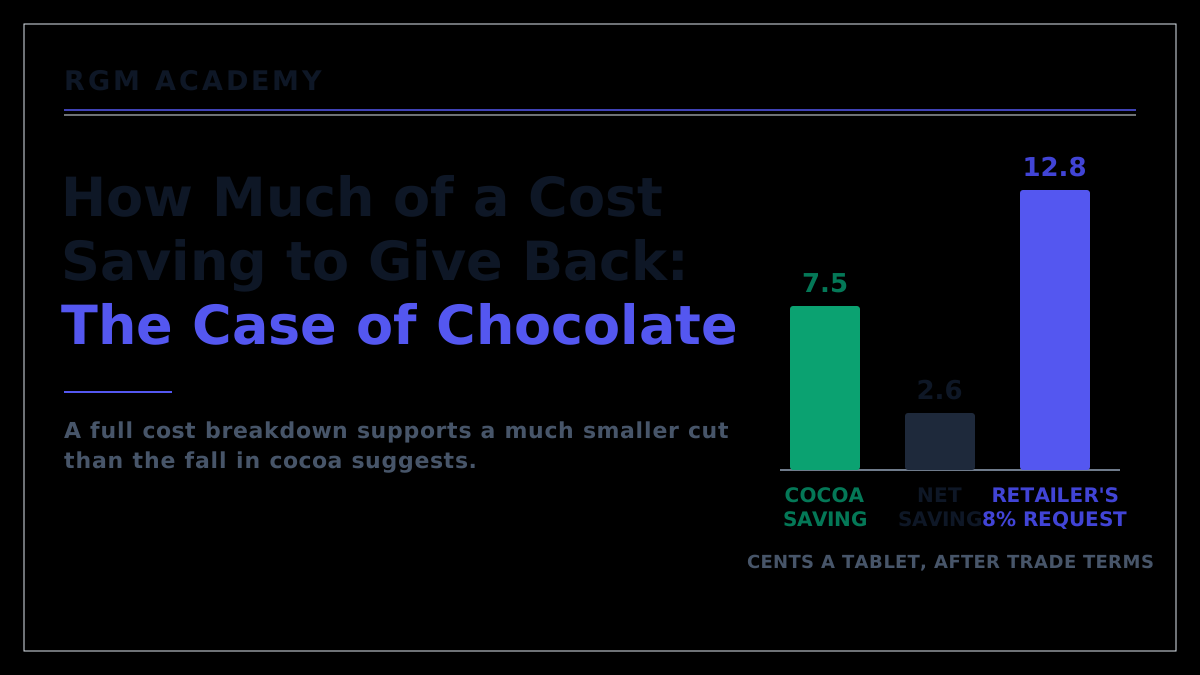
- The net saving is much smaller than the saving on cocoa. In the worked example, cheaper cocoa saves a chocolate manufacturer 7.5 cents a tablet, but its other costs rise by 4.9 cents. The net saving of 2.6 cents supports a list price cut of about 1.6 percent, a fifth of the 8 percent a retailer might ask for.
- A lower list price reaches shoppers as a smaller cut, if at all. The shelf price is the retailer's decision, and even a retailer that passes on every cent lowers its shelf price by a smaller percentage. In Finland, a 1 percent fall in the price grocers paid for meat lowered shelf prices by about 0.7 percent.2
- How the saving is returned matters as much as how much is returned. A permanent cut in the list price is usually the most expensive form. A manufacturer does better to bring its full cost breakdown to the negotiation and return part of the net saving in payments tied to a condition, with an end date.
Which costs fell in 2026, and which rose?
Cocoa cost almost $11 a kilo in January 2025. By March 2026 the price had fallen to just over $3, according to the World Bank, before recovering to about $6 in September 2026.1 Coffee has also become cheaper.
At a hearing in the French Senate in February 2026, Carrefour said some chocolate manufacturers were asking for price increases of 8 to more than 10 percent while cocoa prices were falling.3 Many retailers are likely to open the 2027 negotiations by asking manufacturers to give the cocoa saving back.
The costs that fell are only part of what a manufacturer pays, however. In the third quarter of 2026, the World Bank's figures show crude oil and wheat about two-fifths more expensive than a year earlier. Soybean oil was about a third more expensive, and European gas cost almost twice as much.1 In September 2026 the Bank of England's contacts in British business reported double-digit increases in the price of plastics. In mid-2026 wages were rising by about 3 percent a year in the euro area and America.4
Both sides can point to real figures, and neither list is complete. What matters is the net change across all of a manufacturer's costs.
Why do manufacturers see the saving later than retailers do?
Large food manufacturers fix the price of many ingredients well in advance, through contracts known as hedges. Lindt and its rivals are usually hedged well into the future. That slowed the rise in their costs while cocoa prices rose, and it delays the benefit now that prices have fallen.5 "With our hedging strategy, we did not benefit in a big way from lower cocoa prices this year," Adalbert Lechner, Lindt's chief executive, said in September 2026, "but we will see a positive impact next year that allows us to do lower price points."5
Retailers look at the current market price, so the two sides start the negotiation with different numbers for the same input, and both are correct.
When the saving arrives, retailers can read it in published results. Hershey's North American confectionery margin reached 32.5 percent in the second quarter of 2026, 8.3 percentage points higher than a year earlier. The company credited higher prices, productivity and "lower net commodity costs".6
A fall in market prices reaches a manufacturer's costs months later, once its hedges run out. The manufacturer should show the retailer when that happens.
Should a manufacturer keep all of the saving?
Keeping all of it carries risks to a manufacturer's reputation and to its sales. In a 1986 study by Daniel Kahneman, Jack Knetsch and Richard Thaler, about four in five people thought it acceptable for a firm whose costs fell to share half of the saving with its customers. When a firm kept all of it, opinion split almost evenly.7 The paper also predicted that price cuts would often take the form of discounts, which are easier to withdraw than a lower list price.
Sales are the second risk, because high prices are already costing sales. Hershey shipped about 10 percent less confectionery in North America in the second quarter of 2026, as its prices rose by about 14 percent. The company attributed the fall partly to price and partly to the timing of shipments.6
Keeping all of the saving puts goodwill and sales at risk. The questions that remain are how much to return, and in what form.
What does a cut in the list price cost the manufacturer?
Take an invented chocolate tablet. Its manufacturer sells it to retailers at a list price of 2.00 euros and pays them trade terms, the discounts and allowances written into the supply agreement, worth 20 percent of that price, or 40 cents. It therefore receives 1.60 euros a tablet, its pocket price. Because trade terms are a share of the list price, a cut of a given percentage in the list price cuts the pocket price by the same percentage. The tablet costs 1.00 euro to make, of which cocoa is 30 cents, so the manufacturer earns 60 cents a tablet.
Suppose cocoa falls by 25 percent once the manufacturer's hedges run out. That saves 7.5 cents a tablet (a quarter of 30 cents), and the tablet now costs 92.5 cents to make. The manufacturer has three broad choices.
- Hold its price. It earns 67.5 cents a tablet (1.60 euros minus 92.5 cents), 12.5 percent more than before.
- Return the full cocoa saving. Its pocket price falls by 7.5 cents, or 4.7 percent (7.5 divided by 160), to 1.525 euros, and its profit returns to 60 cents a tablet.
- Use a cost-plus formula, which keeps its margin as a percentage of the price. Before cocoa fell it earned 60 cents on 1.60 euros, a margin of 37.5 percent, so its cost was 62.5 percent of its price. Keeping that ratio at a cost of 92.5 cents means a price of 1.48 euros (92.5 divided by 0.625). That is a cut of 12 cents, or 7.5 percent, in the pocket price. Its profit falls to 55.5 cents a tablet (1.48 euros minus 92.5 cents), less than the 60 cents it earned before cocoa fell.
Prices are set on value
Cost-plus pricing ignores what shoppers will pay. It overprices a weak brand, underprices a strong one and, as the example shows, gives away profit when costs fall. Prices that last are set on value, meaning what shoppers are willing to pay compared with the alternatives on the shelf, with costs as the floor. Cheaper cocoa does not change that value. The reasons to return part of the saving are fairness, competitors' prices and the negotiation.
Break-even against holding the price
Break-even is usually measured against last year's profit. The better test is against holding the price at the new, lower cost. Holding earns 67.5 cents a tablet and a cut leaves 60. The cut must therefore sell 12.5 percent more tablets (67.5 divided by 60 is 1.125) to pay for itself.
A cut in the list price is also hard to reverse. If costs rise again, the manufacturer has to ask for a price increase, and cocoa has already risen by more than 80 percent since March 2026.1
Returning the full cocoa saving needs 12.5 percent more sales just to match holding the price, and a cut in the list price is hard to reverse.
Will a lower list price reach the shelf?
The list price is the manufacturer's price to the retailer, before trade terms. The shelf price is what shoppers pay, and it is the retailer's decision. A cut in the list price therefore goes to the retailer first. It brings the manufacturer extra sales only if the retailer lowers its shelf price. The share of a change in the retailer's purchase price that reaches the shelf is called pass-through. If the retailer's cost falls by 4.7 percent and its shelf price also falls by 4.7 percent, pass-through is 100 percent.
Even a retailer that passes on every cent of a cut lowers its shelf price by a smaller percentage, because its purchase price is only part of the shelf price. Finland's competition authority studied the country's three largest grocers from 2017 to 2023. In meat, a 1 percent fall in the price they paid lowered shelf prices by about 0.68 percent in the long run. Across eight food categories the figure for falls ran from about 0.6 to just over 1.2
In the worked example, suppose the retailer sells the tablet at 2.40 euros before tax, so it earns 80 cents on each tablet it buys for 1.60 euros. Its choice decides what the manufacturer's cut achieves.
- If the retailer keeps the same profit in cents on each tablet, it passes on the 7.5 cents and its shelf price falls by just over 3.1 percent (7.5 divided by 240), to 2.325 euros. That is a pass-through of about two-thirds (3.1 divided by 4.7), close to the Finnish figure for meat. Suppose shoppers buy 1.2 percent more for every 1 percent fall in price (a price elasticity of minus 1.2). Sales then rise by about 3.75 percent, far short of the 12.5 percent the manufacturer needs. Reaching that would take an elasticity of about minus 4 (12.5 divided by 3.1).
- If the retailer keeps its percentage margin of one-third, pass-through is 100 percent: its shelf price falls by about 4.7 percent, to about 2.29 euros. An elasticity of about minus 2.7 (12.5 divided by 4.7) would then be enough. A 2005 review of 81 studies found an average price elasticity of about minus 2.6.8
- If the retailer keeps the saving, nothing changes on the shelf, and the manufacturer has given up 7.5 cents a tablet for nothing.
A cut in the list price is a payment to the retailer, and whether shoppers see it is the retailer's decision. In the example, even if the retailer passes all of it on, the cut pays for itself only if shoppers are more sensitive to price than the average in that review.
What does the full cost breakdown support?
So far the example counts only cocoa, which is 30 cents of each euro of cost. A full cost breakdown, which lists the cost of goods sold (COGS) line by line, shows the rest: sugar 10 cents, fats and oils 10, packaging 15, energy 7, labor 18, and freight and other costs 10. In the example all of them rise from 2026 to 2027. The increases in the chart below are invented, and no larger than the 2026 rises in world prices and wages, because contracts and hedges soften rises as well as falls.
The other costs rise by 4.9 cents, which leaves a net saving of 2.6 cents a tablet. In accounting terms it is the net fall in COGS per tablet, and it is about a third of the 7.5 cents saved on cocoa. Returning 2.6 cents, about 1.6 percent of the pocket price, leaves the manufacturer's profit per tablet where it was. A retailer that asks for 8 percent off the list price because cocoa fell is asking for 12.8 cents a tablet, about five times the net saving. (An 8 percent cut in the list price takes the same 8 percent, or 12.8 cents, off the pocket price of 1.60 euros.)
Only the net saving, 2.6 cents a tablet here, can be returned without lowering the manufacturer's profit. Anything more comes out of its margin.
How should a manufacturer prepare for the negotiation?
Retailers will arrive with the costs that fell. A manufacturer's sales team, the key account managers who negotiate with each retailer, needs the full figures to answer them. Five items matter most.
- A one-page cost breakdown that shows the change in each cost line from 2026 to 2027, in cents per unit and hedges included, with public price series such as the World Bank's as evidence. It should not also give each line's share of total cost. With both, a retailer can work out the full cost per unit and, from the price it pays, the manufacturer's margin.
- When the lower cocoa price reaches the manufacturer's costs, quarter by quarter, as hedges run out. The hedge contracts themselves stay private.
- The starting point: the cocoa cost built into the current list price, rather than the peak market price. In September 2026 cocoa was 45 percent below its January 2025 level but about 80 percent above its 2023 average.1
- The net saving per unit, and the cut in the list price it would pay for (1.6 percent in the example), set against what the retailer is asking for.
- The offers, prepared in advance, from the most the manufacturer will ask for to the least it will accept, with the cost of each and a walk-away point agreed with finance before the meeting.
Showing costs has a price. A retailer that has seen them once will expect them every year, and one that sells its own-label chocolate also competes with the brand. The page should carry no more detail than the request needs.
France now asks retailers for evidence too. Under a law passed in August 2026, a retailer that asks for a price cut in the 2027 negotiations must support the request with objective evidence.9 A full cost breakdown lets the manufacturer answer with evidence of its own.
A sales team that brings the full cost breakdown can move the negotiation from the one cost that fell to the net change across all costs.
How should a manufacturer return part of the saving?
The first decision is how much. Unless competitors' prices or the retailer's likely answer to a refusal justify more, the answer is no more than the net saving. The second is the form the money takes, and there are three main options.
One is a payment the manufacturer can withdraw. It is paid separately from the invoice (off invoice, in the trade's term) and linked to something the retailer does, such as a display, a slot in its leaflet or a new listing. It has an end date. Unlike a cut in the list price, it buys something the manufacturer can check, and the shelf price stays the retailer's decision. A discount on the invoice with no condition attached works like a cut in the list price and is just as hard to take back.
Another is an index clause, under which the list price moves up and down, cent for cent, with the cost of cocoa in each unit. The clause shows the retailer that one cost, but not the rest of the breakdown. It should start from the cost the manufacturer actually carries and move with the delay of its hedges. On cocoa alone it would return all 7.5 cents while the other costs add 4.9, so it should cover the other main inputs as well.
The third is a new pack size with a lower list price, which gives the retailer room to sell the brand under a price point shoppers look for, without changing the price of the main pack.
Stretch, recommended and safe offers
Negotiators often prepare three offers. Here the stretch offer, the opening position, holds the list price and pays about half the net saving, 1.3 cents a tablet, as off-invoice money for displays or leaflet slots over two seasons. The recommended offer is the two-way index described above, covering the main inputs, which on the example's figures returns the full 2.6 cents. The safe offer, the manufacturer's floor, is a 1.6 percent cut in the list price, the same 2.6 cents, tied to a review date and commitments on the range the retailer stocks.
Return no more than the net saving unless competitors force more, and return it in a form that can be withdrawn.
When is a larger cut justified?
Some conditions would justify a larger cut, or a permanent one. If competitors cut their prices, the price shoppers expect falls with them, and matching may cost less than losing share. Lindt's plan to cut prices across its range from January 2027, announced as it lowered its sales forecast, will test that for its rivals.5 If the fall in costs proves broad and lasting, a straight cut becomes the sensible response. A manufacturer also has to weigh how a retailer may answer a refusal, because less shelf space, or fewer of its products in the retailer's range, costs money that a margin calculation does not show.
Outside those cases, a fall in one input rarely justifies a matching cut in the list price. Manufacturers that bring the full cost breakdown to the negotiation, and return a measured share of the net saving in payments they can withdraw, keep room to respond if costs rise again.
References
- World Bank, Commodity Markets "Pink Sheet", March 2025, April 2026 and October 2026 editions (cocoa is the International Cocoa Organization price). Cocoa 10.75 dollars a kilo in January 2025 (March 2025 edition), 3.24 in March 2026 (April 2026 edition), 5.92 in September 2026 and a 2023 average of 3.28 (October 2026 edition). Third quarter 2026 against third quarter 2025: cocoa down 20.5 percent, robusta coffee down 7.5, arabica coffee down 4.0, soybean oil up 32.4, Brent crude up 40.7, US hard red winter wheat up 41.0, European natural gas up 90.7, from 11.29 to 21.53 dollars per million British thermal units (October 2026 edition). October 2026, April 2026, March 2025
- Lasse Poyry, "Price transmissions in the Finnish food chain: A nonlinear ARDL analysis for 8 COICOP categories", Finnish Competition and Consumer Authority (KKV), Working Papers 4/2025, May 2025. Monthly purchase and shelf prices from Kesko, S Group and Lidl (about 92 percent of the Finnish market), January 2017 to April 2023. Long-run transmission elasticities for meat: 0.653 for rises, the lowest rise figure of the eight categories, and -0.682 for falls; for falls, from -0.599 (fruit and berries) to -1.064 (fish); meat adjusted within four months. The paper concludes that "retailers are generally able to pass changes in their purchase prices through to consumer prices". kkv.fi
- Public Senat, 17 February 2026: at a French Senate hearing, Carrefour said some suppliers were seeking chocolate price increases of 8 to more than 10 percent while cocoa prices fell; the joint buying office of Intermarche, Auchan and Casino called such requests abusive. publicsenat.fr
- Bank of England, Agents' summary of business conditions, September 2026: contacts report double-digit increases in plastics, fertilizer and other petrochemical derivatives, and higher energy prices pushing input costs up. bankofengland.co.uk. Eurostat, 16 September 2026: hourly labor costs up 3.1 percent in the euro area in the second quarter of 2026, wages up 3.0 percent. ec.europa.eu. US Bureau of Labor Statistics, Employment Cost Index, 31 July 2026: wages and salaries up 3.1 percent for private industry and 3.2 percent for civilian workers in the year to June 2026. bls.gov
- Bloomberg via Swissinfo, 29 September 2026: Lindt and Spruengli cuts its growth outlook to 0 to 2 percent, cuts Christmas prices and plans lower prices across the board from January 2027; Lindt and its rivals are usually hedged well into the future; cocoa prices have been rising again since February 2026; quotes from chief executive Adalbert Lechner. swissinfo.ch
- The Hershey Company, second-quarter 2026 results, 30 July 2026: North America Confectionery net price realization of about 14 points and volume down about 10 points, attributed to price elasticity and normal quarter-to-quarter shipment variability; segment margin 32.5 percent, up 830 basis points, "driven by net price realization, lower net commodity costs". barchart.com (PR Newswire)
- Daniel Kahneman, Jack Knetsch and Richard Thaler, "Fairness as a Constraint on Profit Seeking: Entitlements in the Market", American Economic Review 76(4), 1986. Telephone surveys: when a factory's cost falls by 40 dollars and it cuts its price by 20, 79 percent call it acceptable; when its cost falls by 20 dollars and it keeps its price, 53 percent call it acceptable and 47 percent unfair. Proposition 4 on price decreases taking the form of discounts. berkeley.edu
- Bijmolt, van Heerde and Pieters, "New Empirical Generalizations on the Determinants of Price Elasticity", Journal of Marketing Research, 2005: "Across a set of 1851 price elasticities based on 81 studies, the average price elasticity is -2.62." sagepub.com
- French law no. 2026-796 of 18 August 2026, as summarized for the 2027 negotiations: a distributor requesting a price reduction must support it with objective elements justifying the request. avocat.fr
Keep going
The playbook and the lessons that teach the calculations behind this article.
Playbook
On-invoice or off-invoice. Which form of trade money you can take back, and which turns into a price cut for good. The choice behind each option in this article.
More from the blog
Eating the tariff. The same decision on the way up: how to answer a cost increase line by line instead of with a blanket price rise.
On-invoice versus off-invoice trade money. Why money with no condition attached tends to build retailer margin rather than shopper price.
Why one percent of price beats five of volume. The profit math that makes a permanent cut so expensive to win back.