On-Invoice or Off-Invoice: Where the Trade Dollar Actually Lands
Why on-invoice trade dollars often build retailer margin, not shopper price
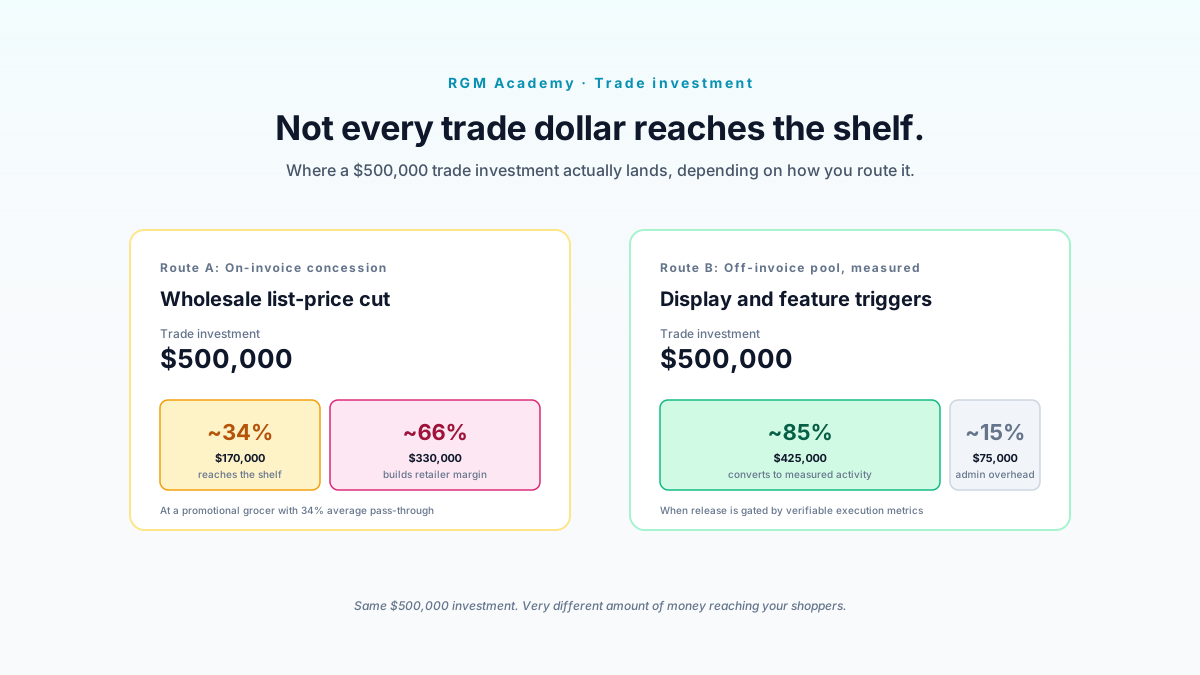
The short version
- The choice between on-invoice and off-invoice trade money is not a matter of structural preference. It is a question of where the dollar lands and who controls it.
- An on-invoice wholesale concession flows mostly into retailer margin. On average, only about 40 percent reaches the shelf as a lower price in mainstream grocery, so most of the money never gets to the shopper.2
- Procter and Gamble ran this experiment at scale in 1991. It cut off-invoice promotional spend, moved the money into lower list prices, took two years of share pressure, and came out with its trade-spend ratio compressed by roughly nine percentage points.1
- Off-invoice money can be steered, but only if an accountability metric is written into the contract before the funds are released. A pool with no activity attached is a donation. A pool tied to a photo-audited display or a verified volume threshold is an investment.
- The real question before a Joint Business Plan is not "on-invoice or off-invoice?" It is "does this retailer pass concessions to the shelf, and will they agree to a metric I can check?"
- Loyalty programmes at Tesco, Sainsbury's, and their equivalents add a third route. They send a targeted off-invoice offer to the shopper most likely to respond, which a blanket concession cannot do.
A two percent wholesale concession and a 500,000 dollar off-invoice pool look identical on a Finance slide. They behave nothing alike. The choice is not about the number on the slide. It is about where the dollar lands, and who decides.
The analysis that retired a reflex
In 1991, inside Procter and Gamble's commercial leadership, an internal review landed that was uncomfortable enough to reset the company's trade strategy for a decade. Procter and Gamble (P&G) had spent years pushing money into off-invoice promotional programmes: coupons, bonus packs, retailer-controlled rebate pools, display allowances. The total had grown quietly through the 1980s until it rivalled, then passed, the company's above-the-line advertising budget.
The review asked one question. What share of those trade dollars could be shown to have produced incremental sales? The answer came back low. A large part of the off-invoice spend could not be tied to any incremental volume at all, and a meaningful part had simply paid for retailer margin that no shopper ever saw on the shelf.
Chief Executive Edwin Artzt took that result and launched a programme P&G called Value Pricing. The idea was radical for its time. Cut off-invoice promotional spend hard, move the money into lower wholesale list prices, and pursue Everyday Low Pricing (EDLP) alongside Walmart, which was building the same model from the retail side. Grocers that had built their margins on off-invoice cash reacted badly, and some cut P&G ranges in retaliation. The company lost meaningful share across several categories through 1992 and 1993. Then it converted. By the mid-1990s share had recovered, and the trade-spend-to-net-sales ratio had stepped down by roughly nine percentage points and stayed there.1
Everyday Low Pricing (EDLP)
Everyday Low Pricing, or EDLP, is a retail model built on steady low shelf prices rather than a cycle of high prices interrupted by deep promotions. A retailer running this model keeps its margin thin and its prices stable, so when you give it an on-invoice concession, most of that money flows to the shelf by design. That is why on-invoice usually works well with these retailers and pass-through tends to be high. P&G pursued this model from 1991 alongside Walmart, which was building the same approach from the retail side.
Thirty-five years on, every Joint Business Plan (JBP) negotiation in Fast-Moving Consumer Goods (FMCG) still runs on the distinction Value Pricing forced into the open. A trade dollar that pays for something you can measure is a different animal from a trade dollar that vanishes into retailer margin. The question facing a commercial director in 2026 is the one Artzt was asking in 1991, with better data and sharper tools.
On-invoice: the retailer keeps most of it
An on-invoice concession is what most people picture when they say "trade investment". A two percent list-price reduction across your range at a retailer. A volume rebate paid once an invoice threshold clears. A cash-discount term. Each one shows up on the invoice and lowers the net price the retailer pays per unit.
The theory is tidy. The retailer passes the lower cost through to the shelf, the lower shelf price lifts volume at the category's elasticity, and the extra volume pays the concession back. The reality is quieter. On average, on-invoice pass-through in mainstream grocery sits around 40 percent, and it varies widely by retailer and category.2 A two percent concession at 40 percent pass-through moves the shelf price by about 0.8 percent, small enough that most shoppers never notice.
What pass-through means
Pass-through is the share of a trade concession that a retailer actually moves into a lower shelf price, rather than keeping as extra margin. When you cut your list price by two percent, the retailer decides how much of that saving the shopper sees. In mainstream grocery the average is around 40 percent, so a two percent concession lifts the shelf price by only about 0.8 percent. The rest stays with the retailer. Pass-through is set by the retailer's own pricing model, and you cannot force it, which is why it has to be measured rather than assumed.
So for a 500,000 dollar wholesale concession at a typical grocer, roughly 200,000 dollars reaches the shopper as a lower price. The other 300,000 dollars builds retailer gross margin directly, with no mechanism for you to claw it back and no promise to return it if the category does not respond. The retailer has not cheated you. They have done exactly what their operating model is built to do.
The catch is that pass-through is hard to audit. Ask the retailer what they did with the concession and you will hear that they reinvested in shelf activity across the estate. Pull the scan data yourself and the shelf price moved for a dozen reasons that quarter, so isolating your concession's effect is a serious piece of analyst work. Most teams do not have the spare analyst time to do it, so the pass-through number stays a figure nobody writes down.
Off-invoice: the clause is the whole game
Off-invoice money is the other route. A pool negotiated into the JBP and tied to specific retailer activities: a photo-audited end-of-aisle display, a feature-ad slot the retailer publishes and confirms, a shelf-share threshold, a volume rebate paid against a measured target.
The mechanism that makes off-invoice powerful is conditionality. Release the money only when the activity is verified, and the money buys the activity by definition. Pay 200 dollars for a four-week display that a photo audit confirms, and you have bought a display. You define what the dollar is for, and you can check that it happened.
The failure mode is the opposite. The industry calls it a slush fund: a lump sum, a vague "preferred partner" label, and no metric attached. Money with no activity gate behaves worse than an on-invoice concession, because it does not even buy the partial shelf-price move that pass-through gives you. The difference between a powerful off-invoice pool and a wasteful one is not the size. It is the accountability clause, and every modern JBP lives or dies on it.
The accountability clause
An accountability clause is the line in the contract that says the retailer only receives the money once an agreed activity is verified. The activity might be a display that a photo audit confirms, a feature-ad slot the retailer publishes, or a volume target you can check in the data. The clause is what turns a payment into an investment, because the dollar now buys the specific thing you defined. Without it, an off-invoice pool becomes what the industry calls a slush fund: a lump sum with no activity gate, which performs worse than an on-invoice concession because it does not even move the shelf price.
Three things changed since 1991
Value Pricing solved one version of the problem. Three shifts since make a blanket "move everything on-invoice" the wrong universal answer today.
Retailer concentration kept rising. In most large European markets, a small number of grocers now accounts for the bulk of grocery sales. A concession to a concentrated retailer is a bigger slice of your total trade spend than it was in 1991, so the pass-through question matters more, not less.
Loyalty programmes opened a third route. Tesco Clubcard Prices, Sainsbury's Nectar Prices, and their equivalents now deliver personalised offers that no blanket on-invoice concession can match.3 A dollar routed through a loyalty engine reaches the shopper most likely to respond, rather than every shopper already standing at the shelf.
And pass-through got harder to see, not easier. Shared scan data exists at most large grocers, but the resolution and timing are uneven, and attributing one shelf-price move to one concession is still a quarter of dedicated analyst time. The visibility problem Artzt diagnosed has not gone away. For most teams, the tools to fix it have not arrived.
The five questions before your next JBP
The paired playbook walks this as a decision tree. In your head, five questions do the job, each one gating the next.
First, is the dollar paying for a specific activity or for a baseline price position? An activity has a natural home for accountability. A pure list-price stance does not.
Second, can you measure the activity cleanly? If the retailer will give you compliance reports and point-of-sale visibility, you are in off-invoice territory. If they resist measurement, you are looking at a slush fund.
Third, what is this retailer's pass-through history on similar allowances? Pull three years of concessions against shelf-price moves on the same products. Above 50 percent, on-invoice can work. Below it, on-invoice is increasingly a gift to their margin.
Fourth, is the spend short-term or structural? A campaign or seasonal push fits an off-invoice pool that opens and closes with the window. A year-round term belongs on-invoice, or it turns into an unmeasured subsidy.
Fifth, what metric will the retailer actually sign? This is where the negotiation happens. A retailer who will commit to no metric is asking you to fund a slush fund. The move is to design the smallest metric you can both verify, or to shift the dollar to a retailer where accountability is on the table.
What to do Monday morning
Pull the on-invoice pass-through history for your three largest retailers. If your analytics team does not have it, commission it as one project before the next JBP cycle, because it decides whether the next 500,000 dollars you commit builds shelf price or builds someone else's margin.
Where pass-through is below 40 percent, move the next increment of trade money to off-invoice with a metric attached. A photo-audit display programme costs less to run than the slice of an on-invoice concession that was never reaching the shelf. Where the retailer runs an EDLP model, on-invoice is usually right, because their operating model pushes most of the concession to the shelf by design. For the middle band, do the case-by-case work. A 45 percent pass-through retailer in a responsive category can still make on-invoice pay. The same retailer in a flat category cannot.
What you should stop doing is routing trade money on-invoice by default because that is how the JBP has always been built. P&G retired that reflex in 1991. It is worth checking whether your own calendar has caught up.
References
- Procter and Gamble launched its Value Pricing programme, a shift toward Everyday Low Pricing, under Chairman and Chief Executive Edwin Artzt from 1991, cutting off-invoice trade promotion in favour of lower wholesale list prices. Several grocers retaliated and the company lost share before recovering by the mid-1990s. The episode is documented in Harvard Business School case studies and in Richard Tedlow, New and Improved: The Story of Mass Marketing in America. Company history: company-histories.com
- Nijs, Misra, Anderson, Hansen, and Krishnamurthi found a mean wholesaler-to-consumer trade-promotion pass-through of 0.41: a 10 percent cut in the manufacturer price lowered the consumer price by about 4.1 percent on average, with wide variation by retailer and category. "Channel Pass-Through of Trade Promotions", Marketing Science, 29(2), 2010. pubsonline.informs.org
- Sainsbury's launched Nectar Prices, personalised member discounts, in April 2023, joining Tesco Clubcard Prices and a wider wave of supermarket loyalty-pricing schemes. Sainsbury's, 11 April 2023. about.sainsburys.co.uk
Keep going
Pair this with the decision guide and the lessons that build the muscle behind each question above.
More from the blog
On-Invoice or Off-Invoice (playbook). The same five questions as an interactive decision tree, with a worked example at a retailer running a 34 percent three-year pass-through.
Why BOGO Is Dying. The promotional-mechanic decision that sits one level below the routing choice here. Once a dollar is off-invoice, this is what to fund with it.
Why CPG Promotions Destroy Value. The incrementality and ROI measurement that decides which off-invoice pools actually pay back.
When Matching a Competitor's Price Cut Destroys Value. The pricing-side counterpart. An on-invoice concession behaves a lot like a price cut, so the same pass-through logic applies.