Why BOGO Is Dying, and What Works Instead
Three forces retired BOGO between 2014 and 2026. Better mechanics are available.
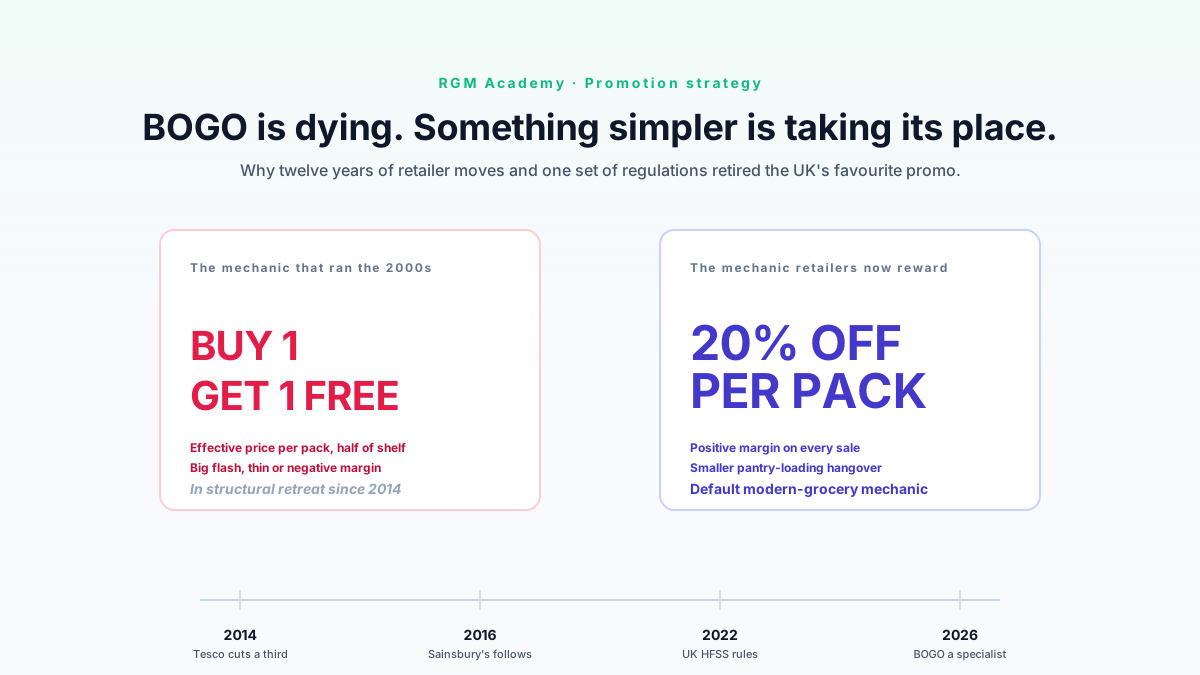
The short version
- For twenty years the buy-one-get-one (BOGO) was the default promotional mechanic in packaged goods. Three forces retired it between 2014 and 2026, and most commercial calendars have not caught up.
- Force one was better data. Loyalty-panel work kept showing that most of a BOGO's extra sales come from loyal shoppers buying earlier, not from new demand. McKinsey puts 59 percent of consumer-goods promotions as money-losing globally, and 72 percent in the United States.7
- Force two was retailer strategy. Tesco started cutting promotions in 2014 under a programme it called Project Reset. Sainsbury's dropped most multibuys in 2016, then moved to personalised Nectar Prices in 2023. Loyalty targeting now does the old BOGO job better.
- Force three was regulation. The United Kingdom restricted where high-fat, sugar, and salt (HFSS) products sit in store from October 2022, and banned volume-price multibuys on those categories from October 2025. A repeal was announced in July 2025 but has not become law, so the rules still stand.
- The replacement toolkit is straightforward. A straight percentage cut keeps positive margin on every sale and loads the pantry less. A loyalty-personalised offer sends the discount only to shoppers who respond. Everyday-lower pricing builds the baseline over years.
- The Monday read: count how many slots in next quarter's plan still default to BOGO, and swap the ones that are not a clear stock-up category with high margin and a retailer that still rewards flash.
For twenty years the buy-one-get-one was the default promotional mechanic in packaged goods. Three forces retired it between 2014 and 2026. Most commercial teams have not fully updated the calendar.
The slide that retired a default
Dave Lewis joined Tesco as Chief Executive on 1 September 2014. Within weeks the business disclosed a profit overstatement that would reach 263 million pounds, and the share price had already fallen hard that summer.1 The new CEO needed a plan that put Tesco back on firmer ground with shoppers and with its own Profit and Loss (P&L).
One slide in his commercial reset said something the room had not heard a Tesco CEO say in two decades. Cut roughly a third of the promotional calendar, pull most buy-one-get-one offers off the shelves, and replace them with everyday lower prices and simpler targeted cuts. Lewis called the turnaround Project Reset, and trade press reported the number of products on multibuy promotions slashed by about 27 percent year on year.2
Twelve years on, the consequences are still working through European grocery. Buy-one-get-one (BOGO), the default Fast-Moving Consumer Goods (FMCG) promotional format for roughly two decades, has been in steady retreat since 2014. Yet the calendar has not caught up. BOGO is still pitched as the default in brand plans and "what should we run next quarter" conversations. It won for good reasons. A "buy one, get one free" flash was the loudest signal an aisle could carry, a shopper understood it without doing arithmetic, and the promoted week sold two-and-a-half to four times the baseline, so it looked great before anybody ran the incrementality math. This article is about why that stopped working, and what to put in its place.
Three forces that broke the math
Between 2014 and 2026, three forces, none of them acting in concert, progressively broke the BOGO case.
The first was better incrementality data. Shopper loyalty-card panels and store-level data kept pointing at the same uncomfortable finding. Most of a BOGO's uplift was shoppers who were going to buy that brand anyway, just earlier or in larger quantity. Practitioner consensus from loyalty-panel analysis puts the truly incremental share at around a third, with the rest pulled forward from future weeks. That ratio is where BOGOs fall apart, because pulling demand forward depresses the baseline for weeks after the window. The pattern is not specific to one mechanic. McKinsey's analysis of consumer-goods trade promotions found that 59 percent of promotions lose money globally, and 72 percent in the United States.7
Incrementality and pull-forward
Incrementality is the share of a promotion's extra sales that you would not have made without it. The rest is pull-forward, which means loyal shoppers buying earlier or in bigger quantity than they otherwise would. When a deal pulls demand forward, those shoppers do not come back on their normal schedule, so the baseline sags for several weeks afterward. The real measure of a promotion is the truly new volume rather than the headline spike, because the pulled-forward part largely cancels itself out once the pantry runs down.
The second force was retailer strategy. Tesco in 2014 was the catalyst. Sainsbury's followed in 2016 under Mike Coupe, cutting multibuy frequency and shifting toward straight price reductions and a simpler range.3 By 2023 it had gone further, launching Nectar Prices to deliver personalised discounts to cardholders rather than blanket shelf offers.4 By the end of the 2010s, trade press and industry estimates pointed consistently to a sharp decline in BOGO's share of the UK calendar from its early-decade peak.
The third force was regulation. The Food (Promotion and Placement) (England) Regulations 2021 took effect in two phases.5 Location restrictions, limiting where HFSS products could sit at checkouts, end-of-aisle displays, and store entrances, came into force on 1 October 2022. Volume-price promotion restrictions, covering BOGO-style multibuy deals on biscuits, crisps, soft drinks, and most confectionery, came into force on 1 October 2025 after three years of delays. Wales brought in comparable rules in March 2026, and Scotland is scheduled to follow in October 2026.
What HFSS means and what the UK rules do
HFSS stands for high in fat, sugar, or salt, the category that covers products like biscuits, crisps, soft drinks, and most confectionery under UK food rules. From October 2022 the rules limited where these products can sit in a store, keeping them off checkouts, aisle ends, and entrances. From October 2025 they also banned volume-price deals such as buy-one-get-one on these categories. A repeal was announced in July 2025 but has not passed into law, so the restrictions still apply in England today.
Then in July 2025 the government announced its intention to repeal the volume-price and placement restrictions in favour of mandatory health sales reporting for large grocers.6 As of mid-2026 that repeal had not been legislated. The restrictions remain in force in England, but the direction of travel has shifted. What started as a hard regulatory push is now an uncertainty that makes a retailer reluctant to build long-term BOGO architecture even where the rules permit it. Whether the ban survives or is repealed, the commercial logic against BOGO on HFSS categories is now structural, not just regulatory.
The incrementality problem, in practitioner terms
The finding is worth sitting with, because it is the single most important reason to stop defaulting to BOGO. Walk through it on one pack.
Imagine you run a BOGO on your 300g hero pack over two weeks. Your normal weekly baseline at a top retailer is 1,000 packs, so the two-week baseline is 2,000. During the BOGO window you sell 6,000 packs, a three-times lift. On paper that looks like 4,000 extra packs sold.
Take the practitioner split as an illustration. Of those 4,000 extra packs, roughly 2,600 (about 65 percent) would have sold in the following six to eight weeks anyway, from shoppers who stocked up early and took the free pack home. Only around 1,400 (about 35 percent) are genuinely incremental: new shoppers, a new occasion for an existing one, or a switcher choosing you over the competitor.
The stocked-up shoppers then do not re-buy on schedule. Your baseline for the next six to eight weeks drops as their pantry runs down, and that dip largely cancels the extra packs you appeared to sell. Fold in the promo cost on all 6,000 promoted packs, where half the per-pack revenue effectively goes to the shopper, and the net incremental profit lands between a small loss and a small gain. That is the picture behind McKinsey's finding that most promotions lose money: the average BOGO frequently breaks even at best once pull-forward is netted out.7
A straight percentage cut does better on this ratio. The smaller stock-up signal loads the pantry less, so closer to half the uplift is incremental, and the margin hit stays proportional rather than dropping to zero on the second unit.
Why the second pack carries no margin
In a buy-one-get-one deal the shopper pays full price for one pack and takes a second for free, so across the two packs you collect roughly half your normal price per unit. The free pack still costs you to make, which means almost none of its revenue lands as profit. A straight percentage cut works differently, because every pack sold keeps a positive margin, just a smaller one. This is why a BOGO needs a high enough margin to absorb that near-free second unit, and why on thinner-margin lines it loses money on every pair.
What works instead
BOGO's retreat has not left a vacuum. Three mechanics have taken most of the ground.
Straight percentage cuts, 10 to 30 percent off shelf price for two to four weeks, are the new default across UK grocery. They work for the same reasons BOGO worked, visible, simple, retailer-friendly, but without the zero-margin second unit and with a smaller baseline hangover. Retailers like them because they fit the simpler-pricing strategies Tesco and Sainsbury's adopted. Brands like them because Finance can model them.
Loyalty-personalised offers are where most of the old BOGO budget has quietly moved. Tesco Clubcard Prices, Sainsbury's Nectar Prices (launched in 2023), Lidl Plus, and the Boots Advantage Card each deliver shopper-specific discounts. The targeting beats a blanket BOGO: the discount reaches shoppers whose patterns suggest they will respond, not every loyalist already at the shelf.
Everyday lower pricing answers the same question differently. Aldi and Lidl built their proposition around fewer promotions and lower shelf prices every week. The trade investment shows up as a lower wholesale rate, compounding into baseline share over years rather than spiking in a single week.
The five questions to walk before you default to BOGO
The paired decision guide walks this as a full decision tree. You can carry the practical version in your head. Ask five short questions before committing your next promotional slot.
Is this a stock-up-able category? Biscuits, frozen, detergent, soft drinks, pet food: yes. Fresh, chilled, products shoppers only buy one of: no. If no, a BOGO is almost certainly wrong, because the shopper cannot use or store the second pack.
Does your market or retailer allow multibuy on this Stock Keeping Unit (SKU)? If the SKU sits in a regulated HFSS category in the UK, or on a retailer's simpler-pricing exclusion list, the question stops here.
How much of the uplift will be truly incremental? If your category's loyalty data says less than 40 percent of BOGO uplift is genuinely new volume, the math will not work. This is the question that kills most BOGOs on paper.
Is the SKU margin high enough to absorb a near-zero-margin second unit? Below roughly 35 percent contribution margin, you lose money on every second pack. A straight cut protects positive margin on every sale.
Does your retailer mix still reward flash with premium display? Some do, most have moved on. Size your answer to the retailer, not the brand.
If any of the first four answers is no, use a straight cut. If all four pass and the retailer still rewards flash, BOGO can still be right. It is a specialist tool now, not a default.
What to do Monday morning
BOGO's retreat is one of the cleaner signals that the promotional default has shifted. A retailer with more data than any single brand concluded it was destroying its own P&L. A national government legislated it out of several categories. And loyalty-card targeting now does most of the old BOGO job better.
Monday morning, look at next quarter's promotional plan and count how many slots still default to BOGO. For any slot where the category is not a clear stock-up winner with above-35-percent margin and a retailer that still rewards flash, swap the BOGO for a straight cut, or a loyalty-personalised offer if your top retailers have that surface. The likely return on investment (ROI) gain on each swap runs into the high single digits to low double digits. Across a full calendar, that is worth the meeting.
References
- Dave Lewis became Group Chief Executive of Tesco on 1 September 2014; within weeks an accounting overstatement was disclosed, confirmed at 263 million pounds in October 2014. Bloomberg, 23 October 2014. bloomberg.com; The Guardian, 29 September 2014. theguardian.com
- Lewis launched the Tesco turnaround as "Project Reset", cutting promotions and multibuys; trade press reported multibuy lines down about 27 percent year on year. Fortune, January 2015. fortune.com; The Grocer. thegrocer.co.uk
- Sainsbury's, under Mike Coupe, phased out multibuy promotions in favour of straight price cuts and a simpler range from 2016. Marketing Week, May 2016. marketingweek.com
- Sainsbury's launched Nectar Prices, personalised discounts for cardholders, in April 2023. Sainsbury's press release, 11 April 2023. about.sainsburys.co.uk
- The Food (Promotion and Placement) (England) Regulations 2021 (SI 2021/1368): location restrictions took effect 1 October 2022; volume-price promotion restrictions on HFSS categories took effect 1 October 2025 after delays; Wales followed in March 2026 and Scotland is scheduled for October 2026. Legislation: legislation.gov.uk; Sustain on the October 2025 effective date. sustainweb.org
- The government announced its intention in July 2025 to repeal the volume-price and placement restrictions in favour of mandatory health sales reporting; the repeal had not been legislated as of mid-2026 and the restrictions remain in force. Grocery Gazette, 9 July 2025. grocerygazette.co.uk
- "59 percent [of consumer-goods promotions] lose money globally. In the United States, it's 72 percent." McKinsey & Company, How analytics can drive growth in consumer packaged goods trade promotions. mckinsey.com
Keep going
Pair this with the decision guide and the lessons that build the muscle behind each question above.
More from the blog
BOGO or Price Cut (playbook). The same five questions as an interactive decision tree, with the biscuit-brand worked example from this article at the bottom.
Why CPG Promotions Destroy Value. Goes deeper on the incrementality question that quietly killed the BOGO default, through three metrics that separate real lift from volume you would have sold anyway.
When Matching a Competitor's Price Cut Destroys Value. The sister decision on the pricing side of the same portfolio, with the same narrative-plus-decision structure.
What Is RGM? Where promotion sits inside the six-lever map, for readers who want the territory before the tactic.