What Waiting for a Price Increase Costs: The Case of Woolworths and Coles
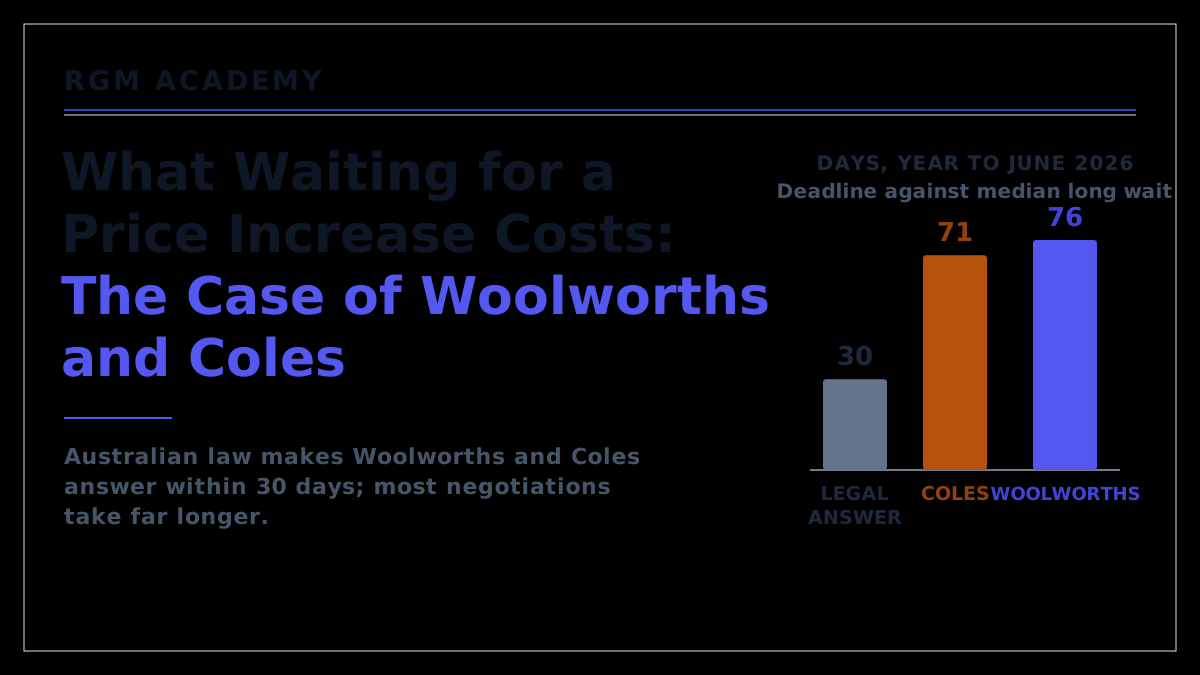
Australian law makes Woolworths and Coles answer within 30 days; most negotiations take far longer.
The short version
- Australian law makes a large grocery retailer answer a manufacturer's price increase within 30 days, but it does not make the negotiation short, and the long wait is predictable. In the year to 30 June 2026, 73.5 percent of Woolworths' negotiations and 88.3 percent of Coles' ran past 30 days.123
- Each day of waiting costs the manufacturer the increase's annual value divided by 365. In the worked example, a 4 percent increase is worth 400,000 euros a year to the manufacturer at its pocket price if volume holds. Each day costs it up to 1,095.89 euros, and 76 days cost 83,287.67 euros.
- A delay is paid once, while percentage points taken off the increase are paid every year. Starting the full increase 90 days later costs 98,630.14 euros once; taking a quarter off it costs 100,000 euros a year.
- The decision to ask should rest on the manufacturer's own break‑even, tested against absorbing the cost and kept in‑house, and the case put to the retailer on what the product is worth to shoppers, because a case built on costs alone invites a cut when costs fall.
How long does a price increase take in Australia?
Since 1 April 2025, Australia's Food and Grocery Code has bound the largest grocery businesses. When a manufacturer asks to raise its list price (retailers call this a cost price increase), the retailer must reply in writing within 30 days: it can accept the increase, accept a smaller one or refuse. The manufacturer may then ask to negotiate, and a retailer that negotiates must do so in good faith and "take all reasonable steps to conclude its position on the negotiations without delay".1 The list price is the manufacturer's decision, and the shelf price is the retailer's.
In the year to 30 June 2026, Woolworths told its Code Mediator that it gave 2,395 answers and missed the deadline four times; Coles gave 4,050, all on time.23
Concluding the negotiations took much longer. Woolworths negotiated 867 requests, 36.2 percent of its answers (867 divided by 2,395). Of those, 637 ran past 30 days, or 73.5 percent. Coles negotiated fewer, 779 or 19.2 percent of its answers (779 divided by 4,050). Yet 688 of them, 88.3 percent, ran past 30 days. The other answers at both retailers led to no negotiation; neither report says how many were accepted in full. About one request in four at Woolworths (637 of 2,395) and one in six at Coles (688 of 4,050) ended in a negotiation that ran past 30 days.
Some were still open when the retailers reported: 113 at Woolworths and, at 30 June 2026, 149 at Coles. Of the negotiations past 30 days that had finished, half took 76 days or more at Woolworths and 71 or more at Coles. The count stops when the retailer concludes its position; the new price may take effect later still.
A legal deadline can make a retailer answer quickly, yet a negotiation that runs past the deadline in Australia typically takes ten to eleven weeks, so a manufacturer should plan for the wait.
What does the wait cost the manufacturer?
Take an invented manufacturer that sells 5 million units a year of one product to one retailer at a list price of 2.50 euros, its own decision. The retailer receives trade terms (discounts and allowances off the list price) of 20 percent, 0.50 euros a unit. The manufacturer's pocket price, the amount it keeps, is therefore 2.00 euros (2.50 less 0.50). Its net sales are 10 million euros a year (2.00 times 5 million).
Its cost of goods sold (COGS) has risen from 1.20 to 1.28 euros a unit, and it asks for a 4 percent increase in its list price, to 2.60 euros. With terms still at 20 percent, the pocket price rises to 2.08 euros. The extra 0.08 euros a unit recovers the cost rise exactly and is worth 400,000 euros a year (0.08 times 5 million).
Until the new list price takes effect, the manufacturer pays the new COGS but collects the old pocket price. The 0.08 euros a unit then comes out of its own gross profit, 1,095.89 euros a day (400,000 divided by 365). Over 76 days, the Woolworths median for negotiations that ran past 30 days, that comes to 83,287.67 euros (76 divided by 365, times 400,000).
The cost of delay, in one line
Cost of delay = (days of delay divided by 365) times the size of the increase times annual net sales. It adapts the Academy's gross-to-net formula for the cost of extended terms (giving the retailer longer to pay): the extra days divided by 365, times the manufacturer's annual cost of capital (what tying up the money costs it), times the annual invoice value (a year's invoiced sales to that retailer). The size of the increase takes the place of the cost of capital, and net sales at the pocket price take the place of the invoice value: 4 percent of 10 million euros is the 400,000 a year above. Longer payment terms delay money that still arrives, and cost again every year the terms stand, while a delayed increase loses the money outright and costs once. The formula holds volume at today's level, so it gives the most the wait can cost.
The manufacturer decides when the 30 days start, because the Code counts them from the day it informs the retailer of the increase.1 Retailers told Australia's grocery code supervisor that long negotiations come partly from "waiting on further input or response from the supplier".4 A complete case on the first day shortens the part of the wait that belongs to the manufacturer.
Each day a price increase waits costs the manufacturer its annual value divided by 365, so the manufacturer should ask early and, on the first day, bring its case on what the product is worth to shoppers.
Is a later start cheaper than a smaller increase?
A retailer that resists may accept only part of the increase and so ask the manufacturer to give up a point or two, meaning percentage points off the increase. In the example, a quarter off means 3 percent instead of 4. The pocket price then rises to 2.06 euros (2.50 times 1.03, less 20 percent terms). The manufacturer collects 300,000 euros a year (0.06 times 5 million) instead of 400,000. The concession costs it 100,000 euros in the first year and again every year after. The Academy's gross-to-net lesson says the same of a point of price given away in trade terms: "you pay it or collect it again every year the terms stay where they land".
The other option is to keep the full increase and start it 90 days later, a one-time cost of 98,630.14 euros (90 divided by 365, times 400,000). After one year the two cost about the same; after three, the later start has still cost 98,630.14 euros and the smaller increase 300,000.
The retailer gains what the manufacturer gives up, so one judged on the current year's figures has little reason to prefer either concession, and that is the retailer to offer the later start to. It works only if the full increase and its start date are agreed together; winning back a point later takes a fresh request, which in Australia restarts the 30-day clock.
In Australia the typical negotiation that runs past 30 days already lasts almost as long as the example's 90-day later start, so a manufacturer that waits ten weeks and then gives up points as well pays twice, once in time and again every year in price.
A delay is paid once and a smaller increase is paid every year, so a manufacturer should offer the delay first and decide in advance how much of each it can afford.
Is the increase worth asking for?
Before the first meeting, the manufacturer needs to know how much volume the increase can lose and still add profit. The Academy's lesson on break-even sales analysis calls this the break-even sales change (BESC): minus the price change, divided by the contribution margin plus the price change, both as percentages of the price. Absorbing the cost rise would leave the pocket price at 2.00 euros and cut the margin to 0.72 euros (2.00 less 1.28), or 36 percent of the pocket price (0.72 divided by 2.00). COGS is the only cost here that moves with volume, so this is the contribution margin. The increase adds 4 percent to the price, so the BESC is minus 4 divided by 40 (36 plus 4), or minus 10 percent.
As a check, absorbing the cost earns 3.6 million euros of gross profit (0.72 times 5 million). After the increase the margin is 0.80 euros a unit (2.08 less 1.28). The same profit then needs 4.5 million units (3.6 million divided by 0.80), 10 percent fewer.
Against the year before the cost rise, the increase can afford no loss of volume. The lesson's extended formula, for when cost moves too, uses the price change less the cost change in place of the price change; both rose by 4 percent of the pocket price, so the BESC is zero. The increase restores the old margin of 0.80 euros a unit, but it restores the old profit only if volume does not fall at all. The old position is no longer available, so the alternative to test against is absorbing the cost.
The lesson then compares the BESC with the expected change in volume and calls the difference the safety margin: how much worse than forecast volume can turn out before the increase stops adding profit. Suppose the retailer raised its shelf price by the same 4 percent, which is its decision (the Academy's elasticity lesson shows it can move by more). With a price elasticity of -1.5, meaning volume falls 1.5 percent for each 1 percent of price, volume would fall 6 percent (1.5 times 4). That leaves a safety margin of 4 points: the 10 percent the increase can lose, less the 6 percent expected. Gross profit would be 3.76 million euros (0.80 times 4.7 million units), 160,000 more than absorbing the cost.
On this planning case the increase is worth 160,000 euros a year rather than 400,000, so a 76-day wait costs about 33,315 euros (76 divided by 365, times 160,000). The order of the two concessions holds. A quarter off leaves a margin of 0.78 euros (2.06 less 1.28). If the retailer raised its shelf price by 3 percent, volume would fall 4.5 percent (1.5 times 3). Gross profit would then be 3,724,500 euros (0.78 times 4,775,000 units), 35,500 euros a year less than with the full increase. A 90-day later start costs 39,452.05 euros once (90 divided by 365, times 160,000). It is still the cheaper concession from about the fourteenth month (39,452.05 divided by 35,500 is 1.1 years).
An increase should be tested against absorbing the cost rather than against the year before, and the manufacturer should know how much volume it can lose before the first meeting.
What evidence should the case rest on?
The rules on evidence now point the same way in three markets. Australia's Code says a retailer "must not require the supplier to disclose commercially sensitive information" about an increase or its negotiation.1 In the UK, the fourth Golden Rule for cost price increases, guidance from the Groceries Code Adjudicator, asks retailers to request only the information "needed to make a CPI decision", a decision on a cost price increase.5 In France, according to legal commentaries on a law of 18 August 2026, a retailer that asks a manufacturer to lower the price it has proposed for the food products the law covers must give objective evidence for the request.6
A case built only on a cost breakdown is cost-plus pricing. The Academy's lesson on willingness to pay gives the test: "when raw material costs fall, does your price fall? If yes, you are doing cost-plus." A manufacturer that justifies its increase line by line with COGS hands the retailer the argument for a cut when those costs fall.
The same lesson's alternative starts from what the product is worth to the shopper. In the example, a rival product sells at 3.40 euros on the retailer's shelf. The manufacturer's shopper research puts the value of the brand's differences at 0.60 euros, so the brand's total economic value is 4.00 euros (3.40 plus 0.60). The retailer sells the brand at 3.50 euros, so shoppers get 0.50 euros more value than they pay (4.00 less 3.50). The safety margin tells the manufacturer the increase is worth asking for and stays in-house; the 0.50 euros is evidence the manufacturer can share. Whether, and how much of, the increase reaches the shelf stays the retailer's decision.
Total economic value, in one line
Total economic value = reference value plus differentiation value. The reference value is the price of the shopper's next best alternative; the differentiation value is what the product's differences are worth to the shopper, above or below it. Total economic value less the shelf price measures the room left before the price stops being defensible, as long as shoppers recognize what the differences are worth. The Academy calls pricing that starts here value first, with cost only a check that the price is viable.
The risk continues after the retailer accepts the list price. Suppliers told Australia's grocery code supervisor of cases in which a retailer accepted an increase but kept its shelf price, then used its lower margin to cancel promotions or flag the product for delisting.4 The shelf price is the retailer's decision. A case that shows what the product is worth to shoppers, and what it brings to the category, protects its place in the range after the increase as well as during the negotiation.
The rules in Australia, the UK and France can speed up the first answer and limit what a retailer may ask, but none of them sets the price or the length of the negotiation. The manufacturer controls when it asks, what evidence it brings on the first day and what it is prepared to give.
The decision to ask should rest on the manufacturer's own break-even, which stays in-house, and the case put to the retailer on what the product is worth to shoppers, because a case built on costs alone invites a cut when costs fall.
References
- Competition and Consumer (Industry Codes-Food and Grocery) Regulations 2024 (the Food and Grocery Code), in force from 1 April 2025, section 40: "Within 30 days of being informed by the supplier of the price increase, the large grocery business must notify the supplier, in writing, whether the large grocery business: (a) accepts the price increase; or (b) accepts an increase in the price of the grocery products supplied under the agreement but does not accept the amount of the price increase; or (c) does not accept the price increase."; "must engage in the negotiations in good faith and take all reasonable steps to conclude its position on the negotiations without delay."; "The large grocery business must not require the supplier to disclose commercially sensitive information"; "Nothing in this section affects the rights of a supplier to determine the price of grocery products that the supplier supplies." A large grocery business is one whose revenue "exceeds $5 billion for the previous financial year". legislation.gov.au
- Woolworths Code Mediator, report for the year to 30 June 2026, with Woolworths' section 41 report dated 11 August 2026: "There were a total of 2395 reportable notifications given in FY26."; "There were 4 instances where initial responses were not given within the 30 day period"; "867 of the 2395 requests required further negotiations following the initial response."; "637 of those 867 negotiations took longer than 30 days to conclude."; "113 remain under negotiation and 524 have been finalised", with a table of days for each finished negotiation. woolworthsgroup.com.au
- Coles Code Mediator (Jenny Linsten), Annual Report 2025-26, signed 7 August 2026, with the section 41 information Coles provided on 8 July 2026: notifications under subsection 40(2), "4,050"; notifications not given within 30 days, "0"; negotiations, "779"; negotiations not concluded within 30 days, "688"; "(149 negotiations had yet to be concluded by 30 June 2026)"; "section 40(4) does not require Coles to conclude its position within 30 days but does require Coles to take all reasonable steps to conclude its position on the negotiations without delay." The table of days is an image; the counts used here are transcribed from it and sum to 539. coles.com.au
- Food and Grocery Code Supervisor, Annual Report 2024-25: "ALDI reported that none of its price negotiations exceeded 30 days, while others noted extended timeframes can arise from the time it takes both large grocery businesses and suppliers to consider any issues or reasons that have arisen during a negotiation or waiting on further input or response from the supplier."; "Another example includes where supplier price increase requests are accepted but the supermarket elects to maintain its existing retail price. In time, the supermarket uses its reduced margin as justification to cancel planned promotions and/or flag de-listing due to poor performance against the average category margin." grocerycodesupervisor.gov.au
- Groceries Code Adjudicator, "7 Golden Rules", published on GOV.UK on 5 October 2026: "In January 2022, the Groceries Code Adjudicator (GCA) published the 7 Golden Rules"; "The outcome of cost price negotiations is a commercial matter rather than a Code issue."; "Only asking for the specific information from suppliers that is needed to make a CPI decision"; "The GCA also expects the principles of the 7 Golden Rules to apply to Cost Price Decrease (CPD) discussions." gov.uk
- Capucine David-Pastre, commentary on French law no. 2026-796 of 18 August 2026, 31 August 2026: "lorsque le distributeur demande une baisse du tarif, il doit fournir des elements objectifs justifiant cette demande" (when the retailer asks for a lower price, it must provide objective evidence justifying the request). CMS, 27 July 2026, on the same reform. avocat.fr; cms.law
Keep going
Pair this with the playbook and the lessons that teach the methods behind it.
Playbook
Shrinkflation or a price increase. Which way to recover a cost rise, and what each one asks of the retailer and the shopper. It is the decision that comes before the request whose cost this article works out.
More from the blog
Why 1 percent more in price beats 5 percent in volume. Why a point of price is worth so much to profit, and what giving one away every year adds up to.
Eating the tariff. A cost shock, and why a blanket price rise is the most expensive answer to it.
Shrinkflation or price rises in 2026. The other way to recover a cost rise, and what retailers and regulators did about it.
Lessons inside the course
Gross-to-net and value split →The cost of extended terms, whose formula this article's cost of delay borrows, why a point given away is paid every year, and how to agree a floor with finance before the meeting.Start the lesson → Break-even sales analysis →The break-even sales change, the extended formula for when cost moves too, and the safety margin, the three numbers in the test this article runs.Start the lesson → Willingness to pay and consumer value →Total economic value, and the difference between cost-plus and value-first pricing that turns a request to recover costs into a case on value.Start the lesson → Price elasticity →How much of a list price move reaches the shelf, the retailer's decision, and what that does to volume: the planning case behind the safety margin.Start the lesson →Try it free
Break-Even Calculator. Opens on this article's increase, 4 percent on a 36 percent margin with an elasticity of -1.5, and shows the 10 percent of volume it can lose, the 6 percent it is expected to lose and the safety margin of 4 points. Free and without sign-up.
Willingness-to-Pay Calculator. Score three drivers of a product's value to shoppers to estimate the most they would pay, and see how much room sits above today's price before a list price increase. Free and without sign-up.