Eating the Tariff
Tariffs hit the cost line, and a blanket price rise is the costliest way to answer.
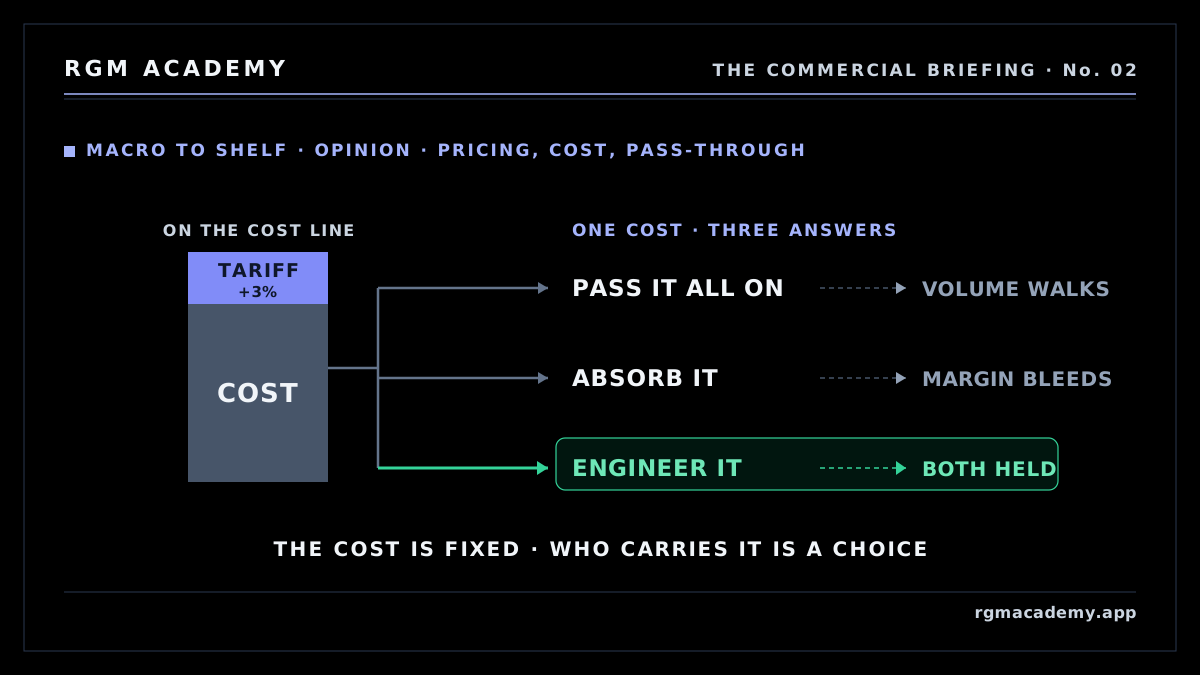
The short version
- A tariff is a cost-line shock, not a demand shock. Conagra, one of the largest packaged-food makers, told investors that this year's tariffs would add about 3 percent to the cost of making its food, taking its total cost inflation to about 7 percent.1
- The reflex is to pass it on in full, a blanket price rise across the range. That is the move that quietly bleeds the most volume, because the same value-seeking shopper who is already trading down punishes a broad increase hardest.
- Across the economy the cost did reach the shelf. Federal Reserve researchers found tariffs had lifted the price of core goods by 3.1 percent, with pass-through effectively complete inside about seven months.2 But the average hides a choice: a survey of 300 consumer-goods leaders found 43 percent had taken a one-to-five-point hit to gross margin rather than pass it all on.3
- In the worked example below, the blanket rise gives up six points of volume to recover the cost and still lands below where it started. The surgical answer recovers the same cost while giving up one.
- My position: a tariff is a pricing test, not an accounting event. Decide absorb-versus-pass one line at a time, recover most of the cost through pack and mix rather than the shelf price, and protect the few packs shoppers price-check the hardest.
What does a tariff actually do to your costs?
It lands on the cost line, the money you spend making and packing each unit, and nowhere near the demand for it. That sounds obvious until you watch how companies respond, because most treat it as a reason to reprice the whole range when it is really a hole in one part of the cost stack.
Take Conagra, which put real numbers on it. This year's tariffs, it told investors, would add about 3 percent to its cost of goods, the all-in cost of making its products, lifting total cost inflation for the year to about 7 percent.1 The driver is narrow. When the tariff on imported steel and aluminium doubled to 50 percent in June 2025,4 the can got dearer, not the tomatoes inside it. The steel can itself can cost up to 12 percent more at the new rate,6 but a can is only part of what a tin of food costs to make, so the blend lands nearer 3 percent.
So the cost is real but contained. The question a tariff actually asks is not "how much do we raise prices", it is "where does this cost go, and who carries it". And that is a choice, not a law of physics.
Why is the first instinct the wrong one?
The instinct is to pass it straight through, a list-price rise across the range that matches the cost. It feels responsible. It is usually the most expensive answer you can pick.
Across the economy the cost did reach the shelf. Federal Reserve researchers tracking tariff effects in real time found they had raised the price of core goods by 3.1 percent, enough to explain the entire excess in goods inflation, with pass-through effectively complete inside about seven months.2 Read quickly, that says everyone passed it on. Read properly, "effectively complete" is an average, and an average hides who did what. A survey of 300 consumer-goods leaders found 43 percent had taken a one-to-five-point hit to gross margin, and 77 percent had passed no more than half the tariff cost on.3 Plenty of that cost never reached the shelf. Somebody ate it.
There is a reason the blanket rise hurts. The shopper you are raising prices on is the same one from the last two years of trading down, already reaching for private label and the cheaper pack next door. A broad increase widens the gap to that cheaper pack, and the volume walks. Even the retailers feel the ceiling. Pressed to absorb the tariffs rather than raise prices, Walmart's finance chief was blunt: "there's a limit to what we can bear, or any retailer for that matter."5 When your biggest customer is saying the shelf price cannot keep climbing, a blanket pass-through is a fight you start on the back foot.
What does the maths actually say?
Take an invented product with deliberately simple numbers. They are made up, but they add up, and you can recompute every figure yourself.
You sell 100 units of a canned line at 2.00 each. It costs 1.30 to make, so you earn 0.70 a unit, a 35 percent margin: 200.00 of revenue, 70.00 of gross profit. The tariff adds 3 percent to that cost, about four cents, taking it to 1.34.
Absorb it and hold your price, and nothing moves on the shelf but plenty moves in the accounts: 200.00 of revenue, costs of 134.00, gross profit down to 66.00. A 3 percent cost rise has just taken nearly 6 percent of your gross profit. That is the quiet option that looks like doing nothing and is not.
Pass it on as a blanket 3 percent rise instead, and your shelf price goes to 2.06. At an illustrative price elasticity of minus 2, fairly typical for a mainstream branded line, you lose 6 percent of your volume, down to 94 units. Revenue is 193.64, costs are 125.96, and gross profit is 67.68. You have your 35 percent margin back, but gross profit is still below where you started, and you have handed six units of volume to the cheaper packs around you. You traded six points of volume for a profit that is lower than when you began.
Now do it surgically. Hold the shelf price at 2.00, the number the shopper actually checks, and take the cost back through the pack instead, trimming the contents about 3 percent. A pack change of that size moves far less volume than the same change on the price tag, so you lose roughly 1 percent, down to 99 units, while your unit cost eases back to about 1.31. Revenue is 198.00, costs are 129.69, and gross profit is 68.31. Same cost recovered as the blanket rise, more gross profit at the end of it, and you kept five of the six volume points the blanket rise threw away.
How much price actually covers the cost
A 3 percent cost rise does not need a 3 percent price rise to stay whole. To hold the same cash profit per unit you only need to recover the cost itself, about four cents on a two-dollar price, which is a rise of under 2 percent. The full 3 percent only buys back the margin percentage, the ratio, and that last point of price is pure volume risk for a number that flatters a slide and changes nothing in the bank. Recover the cash, not the ratio.
Pass-through, in plain words
Pass-through is the share of a cost increase that reaches the shelf price. Across the whole economy tariff pass-through ran almost complete inside about seven months, but that figure is an average laid over very different choices. The strong brands passed more, the contract-bound and the price-sensitive passed less and absorbed the rest. Your pass-through is decided one line at a time, by how much room each product has, not handed to you by the market.
So what is the surgical alternative?
Treat the tariff as a pricing test and answer it line by line. Three moves do most of the work.
First, split the range by how much pricing room each line has. On the products a shopper rarely price-checks, and on anything genuinely premium, pass the cost on and it will mostly stick. On your known value items, the few packs whose price the shopper carries in their head, hold the line, because a visible rise there does the most damage for the least cost recovered.
Second, recover the held cost through pack and mix, not the price tag. A modest pack change, a smaller count or a format swap, moves far less volume than the same money on the shelf price, as the worked example showed. It is not free, and shoppers do eventually notice, which is why the pack lever is a scalpel and not a default. Use it where the shelf price is the thing you must protect.
Third, steer the mix. A tariff that hits one input harder than another quietly changes which products earn their keep. Tilt promotion and range toward the lines the cost shock left cheaper to make, and you recover margin without touching a single shelf price.
The warning sits in numbers the industry already knows. Conagra's chief executive reminded investors that the sector has absorbed 40 to 45 percent cost inflation over five years, and that when the shopper is this stretched, the unrecovered cost "tends to show up in the volume line."7 Pass too much too bluntly and you do not lose margin, you lose the volume that keeps the factory full.
What would make me wrong?
If your category is genuinely inelastic, a true premium where the buyer barely flinches at a higher price, then pass the cost straight through and stop reading, because the surgery is wasted effort. If your portfolio is already mostly premium, the same answer holds. And the tariff picture itself can move. The steel and aluminium duties driving the can cost sit on national-security grounds that have held, but other tariff lines have been challenged in court, so part of this cost could ease on a ruling rather than a negotiation.8 The pack lever has a limit too. Lean on it once and shoppers shrug; lean on it every year and you earn the shrinkflation backlash that turns a quiet cost recovery into a noisy trust problem.
What would I do on Monday?
Three moves, in order. First, find your real exposure: which inputs the tariff actually hits, and what share of each product's cost they are, so you stop repricing lines the shock barely touched. Second, sort the range into pass, hold, and absorb by how much pricing room each line has, then price the pass list properly and protect the hold list with pack and mix. Third, set your absorb budget on purpose. Some cost should be eaten, and most of the field ate some, but eat it where it buys you volume and a retailer's goodwill, not by accident across the whole range.
A tariff feels like something done to you, and the cost is. What you do next is not. The blanket rise is the answer that looks decisive and quietly costs the most. The surgical one is slower, less satisfying to announce, and leaves you with more of your business at the end of the year.
References
- Conagra Brands fourth-quarter and full-year fiscal 2025 results, July 2025: previously announced tariffs expected to increase cost of goods sold by approximately 3 percent annually, with total fiscal 2026 cost-of-goods inflation of approximately 7 percent (about 4 percent core plus about 3 percent tariffs). conagrabrands.com
- Federal Reserve Board, FEDS Notes, April 2026: tariffs implemented through November 2025 raised core goods consumer prices by 3.1 percent through February 2026, explaining the entirety of excess core-goods inflation, with cumulative effects at seven months consistent with full pass-through. federalreserve.gov
- Survey of 300 consumer-goods C-suite leaders, May 2025: 43 percent reported a one-to-five-percentage-point decline in gross margin; 77 percent had passed up to half of tariff costs to consumers; 57 percent planned further price increases. kpmg.com
- Section 232 tariffs on imported steel and aluminium raised from 25 to 50 percent, effective 4 June 2025 (Proclamation 10947). whitecase.com
- Walmart chief financial officer John David Rainey, to the Associated Press, May 2025: "there's a limit to what we can bear, or any retailer for that matter." pbs.org
- Analysis of steel and aluminium tariffs on canned food, July 2025: at the 50 percent rate, can-makers' total production costs could rise by up to 12 percent. americanactionforum.org
- Conagra chief executive Sean Connolly, investor forum remarks, November 2025: the industry has seen roughly 40 to 45 percent cost-of-goods inflation over five-plus years, and when the consumer is strained it "tends to show up in the volume line." foodnavigator-usa.com
- Federal Reserve Bank of Dallas, May 2026: estimated tariff impacts on core inflation peaked in February 2026 at a level consistent with full pass-through; some tariff authorities faced legal challenge over the same period. dallasfed.org
Keep going
Pair this with the decision guide and the lessons that drill the moves behind it.
Playbook
Price rise or pack shrink. The same money per pack, two very different outcomes on volume, trust, and how easily you can walk it back. The exact choice this piece turns on.
More from the blog
Shrinkflation versus price rises. When taking the cost out of the pack beats taking it off the shelf price, and when it backfires.
Why one percent of price beats five of volume. The profit arithmetic behind protecting your shelf price rather than chasing the margin ratio.
The squeezed middle. Why the value-seeking shopper who punishes a blanket rise is not going away.