The Squeezed Middle
Shoppers are trading down and trading up at the same time, and the bill lands on the brands parked in the middle of the shelf.
The short version
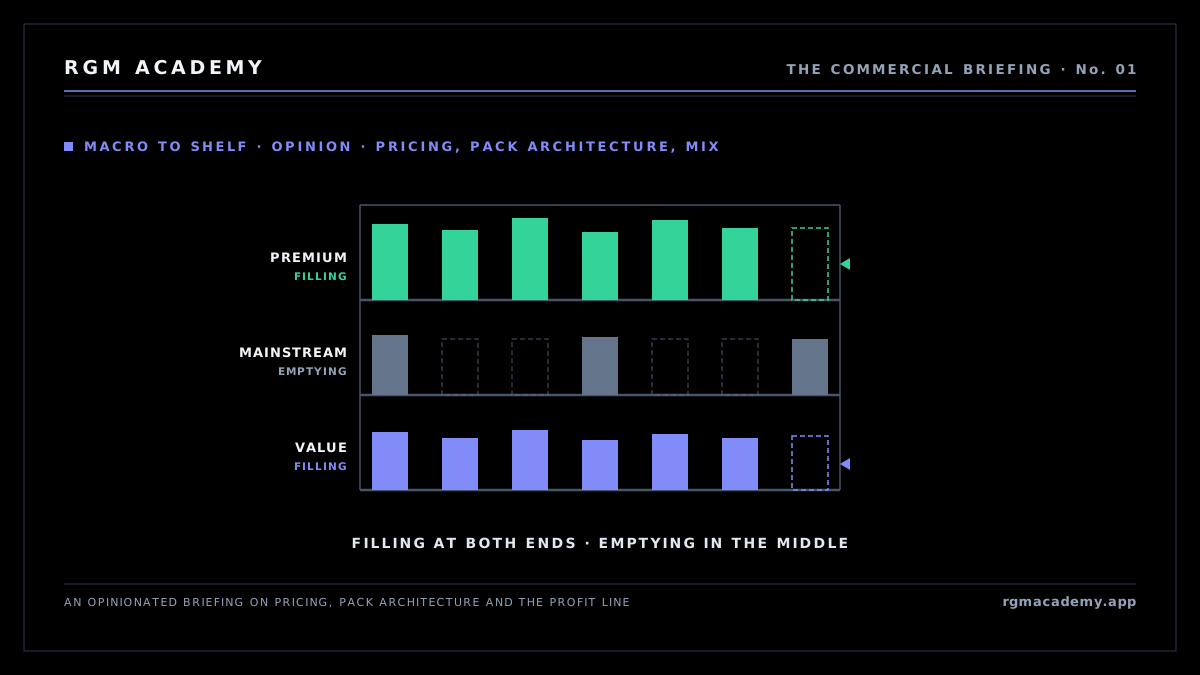
- Private label just crossed half of all grocery units sold across Europe's six biggest markets, and in the same season a major retail study reported consumers trading up again.12 Both are true, because demand is polarising, and the money funding both ends leaves the same place: the mainstream middle of the shelf, where most established portfolios still hold most of their volume.
- The squeeze is structural, not an inflation hangover. Private label has gained share for years, through cooling inflation as much as the spikes, and value-seeking now behaves more like a learned habit than a budget.
- A brand concentrated in the middle loses twice. Shoppers stop compromising toward it once cheaper and better options reset the shelf, and retailers stop protecting its space at the next range review.
- My position: stop defending the middle with promotion, and rebuild the portfolio as a barbell, a real entry role and a real premium role, anchoring the middle instead of subsidising it.
- In the worked example below, the rebuilt portfolio earns 19 percent more gross profit than the one that stands still, while defending with promotion is the only branch that destroys profit outright.
- The blocker is rarely analytical. In most organisations nobody owns the portfolio's architecture, so give one owner the mix line and put tier exposure in front of the board the way you would put currency exposure there.
Why are shoppers trading down and up at once?
Two headlines crossed in the same season, and at first glance they cannot both be true. Private label passed 50 percent of units sold across Europe's six largest grocery markets, the first time own label has held half the basket.1 In the very same window, a major grocery-retail study led with a majority of consumers trading up again to higher-quality products.2
So which is it, a value market or a premium market? It is both, and that is the story. Some of the split runs between households, with stretched families holding the value end while better-off shoppers premiumise. But some of it runs through the same shopper in the same basket. The person who drops the discounter's pasta in the trolley without a second thought will still pay properly for the olive oil they care about. Shoppers are not so much trading down or up as abandoning the compromise in the middle, in both directions at once. And the money for both moves comes out of the mainstream middle, that broad band of safe, mid-priced products where most portfolios were built and where most of their volume still sits.
Is this just the inflation hangover?
The comfortable reading says shoppers fled to cheap during the price shock and will drift back once wages recover. The evidence keeps refusing it.
Start with how stubborn the trend has been. European private label unit share has climbed for years, through cooling inflation just as much as the spikes.1 A pure price-shock reflex would have bent back by now, and it has not. Then look at who the value seekers actually are. A mid-2025 study found that four in ten Americans now qualify as active value seekers, and nearly three in ten of them live in six-figure households.3 That looks less like a question of income and more like a habit, and the habit outlives the inflation that taught it.
The supply side has changed shape too. Private label now accounts for as much as 70 percent of new food launches in Europe's major markets.2 Innovation used to be the brand's moat, the thing a retailer's copy could only follow at a distance. In food, the followers now launch more than the leaders. And the pressure is not finished: food-at-home prices in the United States rose 0.7 percent in a single month, the largest jump since 2022, while real earnings fell for a second month running.4 The value end has another leg coming.
How bad does it get in the accounts?
Bad enough to read straight off the income statements.
Kraft Heinz is the cleanest single example, because the company published the breakdown. Organic sales, which strip out currency and acquisitions to show how the underlying business traded, fell 3.4 percent in 2025. Price added 0.7 points, and volume and mix took away 4.1.5 Prices went up, four points of demand walked out anyway, gross margin fell by 1.4 percentage points, and the company wrote 9.3 billion dollars off the value of its own brands. An impairment that size is a board formally telling its investors the portfolio is worth less than it once believed.
Nor is this one company's stumble. Across eleven of the largest players, average organic growth halved from 3.9 to 1.5 percent, with volumes negative as a group. Mondelez grew value 6.6 percent while its volume fell 3.5 percent.6 The sector has spent three years pricing over a shrinking volume base, and that trick has a floor. Each price rise widens the gap to the own label sitting next to you, so the volume response gets a little worse every time. And because factories and trucks are full of fixed costs, every point of lost volume makes the remaining units dearer to make. Price up, volume down, unit costs up: that is how a company raises prices and still watches its margin fall.
Why does the middle break first?
To see the mechanics you need one idea from pack price architecture, the discipline of designing your range of pack sizes and price points as one system rather than one pack at a time. Picture the category as a ladder with three rungs. The entry rung wins on the cash the shopper hands over at the till. The premium rung wins on a clear answer to "what am I paying more for?". The mainstream rung in between wins on something quieter: it is the safe choice, the one that needs no decision at all.
Why the middle option usually wins
Put three options in front of a shopper and most will avoid the extremes. Choosing the middle feels prudent: not the cheapest, not the dearest, nothing to justify to yourself or anyone else. Behavioural economists call this the compromise effect, and in well-built three-tier ranges the middle option captures roughly half of all choices. The middle of a ladder is valuable ground, for exactly as long as it is genuinely seen as the middle.
That last clause is the trap, because the effect works on the options the shopper sees, not on your price list. When private label and discounters move in below you, they reset the reference price for the whole category, and your mainstream pack stops being the middle without moving an inch.
Reference price, in plain words
Every shopper carries a rough memory of what a product should cost, built from what they paid and saw recently. Prices above that internal benchmark feel like losses, and a loss stings more than the same saving pleases. So when a 1.49 own label sits next to your 2.29, the benchmark drifts down, and your unchanged price starts to feel expensive without you touching it.
What do most brands do about it? They rent the volume back. Across those six markets, 34 percent of branded units sell on promotion, against 14 percent for private label.7 The arithmetic is unforgiving: of the extra volume a deep deal generates, only about a third tends to be truly new, while the rest is your own shoppers switching packs and loading their pantries at the discounted price. Run that calendar for a few years and you have trained your most loyal buyers to wait for the deal. Meanwhile the retailer is doing its own maths, and own label delivers margin with no negotiation attached. A mid-tier brand that leans on heavy trade funding and is selling more slowly is holding space the retailer could earn more from. And retailers keep their best terms for suppliers who bring a fuller range. A one-rung brand walks into every range review holding the weakest hand at the table. That is how a squeezed brand ends up a delisted one.
Defending the middle is the wrong fight
Every instinct says defend: hold the price point, deepen the deals, relaunch the hero pack. That is the wrong fight. It is a cyclical answer to a structural problem, and it spends your margin subsidising a tier that demand is leaving.
The better position is to rebuild the portfolio as a barbell. At one end, a real entry role: a pack that competes on cash outlay for the value-seeking shopper without wrecking your economics. The craft is that a good entry pack is usually cheaper to buy and dearer per kilo, so you protect margin through pack size, not list-price cuts. At the other end, a real premium role: a pack that gives your trading-up shopper somewhere to land inside your brand. And premium needs a visible reason, not just a higher number, whether that is a better format, an upgraded recipe, or an occasion the mainstream pack does not serve. Premiumise the experience, not just the price. A 25 percent premium with nothing visible behind it is a price rise wearing a costume.
What would make me wrong? If real wages recover and the trade-up broadens into mainstream brands rather than straight past them, the middle regains its anchor and defence becomes viable again. It could happen. But with own label gaining share for years through every phase of the cycle, I would not bet a portfolio on it.
What does the fix look like in numbers?
Take an invented brand with deliberately simple numbers. They are made up, but they add up, and you can recompute every figure yourself.
The brand sells 100 units of one mainstream pack at 1.00 each on a 33 percent gross margin: 100.00 of revenue, 33.00 of gross profit. Its tier now sheds a tenth of its volume to the two ends. Do nothing, and it follows the rung down: 90 units, 90.00 of revenue, 29.70 of gross profit.
Suppose instead you defend by promoting, holding all 100 units with 33 of them selling at 25 percent off. Revenue comes to 91.75, and with costs unchanged at 0.67 a unit, gross profit lands at 24.75. That is below even the do-nothing case, and it is before the deals train your shoppers to wait for the next one.
Now re-architect instead. Add an entry pack at 0.85 on a 26 percent margin, recruiting 8 units of value demand. Add a premium pack at 1.25 on a 44 percent margin, capturing 7 units of trade-up. Those 15 new units are more than the 10 that left, and they do not just catch your leavers, they recruit from competitors at the two ends. The portfolio now sells 105 units for 105.55 of revenue and 35.32 of gross profit, a 33.5 percent blended margin. Against standing still, that is 17 percent more revenue and 19 percent more gross profit. The blended margin rises too, even though the cheap entry pack pulls it down, because the premium mix more than pays for the dilution. Two disciplines keep this real outside a spreadsheet: the rungs need daylight, with price steps of roughly 15 to 25 percent between tiers, and every new pack has to earn its slot on incrementality. Even if only 60 percent of those 15 new units are genuinely new and the rest cannibalise the mainstream pack, the rebuilt portfolio still earns about 33.34 of gross profit, roughly 12 percent ahead of standing still.
Why does nobody own this fix?
Because in most organisations, nobody does. Marketing owns the brand ladder, sales owns the terms and the promotion calendar, supply owns which pack formats exist, and finance reports price and volume but rarely mix. Every function touches the architecture, and no one is accountable for it. So promotion drifts toward the biggest mid-tier pack, because that is where uplift is easiest to buy, and the entry and premium launches die in business cases built on cannibalisation fears that nobody has actually measured.
The fix is organisational before any analysis helps. Give one owner the mix line, revenue per unit across the portfolio, and have them review it quarterly with the same seriousness as the annual price increase. Make promotional approval depend on the mix effect, not just the uplift. And put tier exposure in front of the board the way you would put currency exposure in front of them: as a position the company holds, with a number attached, not as a marketing detail.
What would I do on Monday?
Three moves, in order. First, map your volume by price tier against the tier growth of your categories, and if more than half of it sits mainstream, say that number out loud in the next planning cycle, because naming the exposure is what unlocks the budget to fix it. Second, repair the ladder: a credible entry role, a credible premium role, clear price steps between the rungs, and pack economics that reward the shopper for climbing. Third, re-bias the promotional calendar away from the middle, and start measuring mix every quarter so you can watch the architecture pay back.
The middle of the shelf was a wonderful place to build a consumer goods business for half a century, while it was wide. It is narrowing from both sides now, and it will keep narrowing whether or not your portfolio is ready. If it were mine, I would start building the ends while the middle can still pay for the work.
References
- Circana, private label reaches record 50 percent unit share across Europe's six biggest grocery markets (Spain 59, Netherlands 56, UK 52, Germany 52, France 46, Italy 36), April 2026. circana.com
- State of Grocery Retail Europe 2026: a majority of consumers trading up again; private label as high as 70 percent of new food launches; grocers' selling and admin costs up from 19.0 to 19.7 percent of revenue, 2022 to 2025. mckinsey.com
- Value-seeking consumer study, June 2025: four in ten Americans qualify as active value seekers, nearly three in ten of them in six-figure households. deloitte.com
- April 2026 food price analysis: US food-at-home prices up 0.7 percent in the month, the largest since 2022; real earnings down a second consecutive month. ag.purdue.edu
- Kraft Heinz fourth-quarter and full-year 2025 results, February 2026: organic net sales down 3.4 percent (price +0.7, volume/mix -4.1), gross margin down 140 basis points, 9.3 billion dollars in impairments. kraftheinzcompany.com
- The volume challenge across eleven large CPG companies, May 2025: average organic growth from 3.9 to 1.5 percent, volumes negative as a group; Mondelez value up 6.6 percent, volume down 3.5 percent. sevendots.com
- Promotion participation across Europe's biggest grocery markets, April 2026: 34 percent of branded units on promotion versus 14 percent for private label. foodnavigator.com
Keep going
Pair this with the decision guide and the lessons that drill the moves behind it.
Playbook
The private-label playbook. When to fight own label on price, when to refuse the fight, and how to rebuild the range instead.
More from the blog
Private label, by the numbers. The share story behind this piece, market by market.
Why promotions destroy value. The deeper arithmetic of renting volume back.