Why Your Entry Pack Is the Most Under-Managed SKU in Your Portfolio
The cheapest pack in your portfolio runs most of your trial funnel.
The short version
- The entry pack, the cheapest branded pack on the shelf, is the most neglected Stock Keeping Unit (SKU) in most Fast-Moving Consumer Goods (FMCG) portfolios. Thin margin, small volume, no fresh trade money. It quietly runs far more of the trial funnel than its volume share suggests.
- Loyalty-panel work across mainstream categories keeps finding the same mismatch. The entry pack carries roughly 10 to 20 percent of brand volume but captures 30 to 45 percent of first-purchase occasions. Concede it and you stop recruiting the shoppers who would have traded up later.
- It also anchors the bottom of your price ladder and holds a shelf slot a retailer will hand to its own label the moment the SKU goes missing.
- Private label is where that pressure lands first. It now accounts for about half of all units sold across Europe's six biggest grocery markets, and its share has grown every year since 2021.1
- Five questions decide the move: how much trial flows through the pack, how wide the price gap has opened, whether you can shrink the pack, whether your margin can take a direct cut, and whether conceding on purpose is the smarter play.
- The Monday read: pull the panel data on your top brands, not the sales report, and check whether the entry pack is running more than 30 percent of trial while the price gap to private label runs past 10 percent. If so, you have a decision waiting at your next review.
The entry pack is thin-margin, low-volume, and quiet. It runs more of the trial funnel than anyone gives it credit for. Concede it by accident and the bill arrives two years later, in a room the Chief Executive has to sit in.
The cheapest pack on the shelf is the one nobody manages
When Hein Schumacher became Chief Executive of Unilever on 1 July 2023, the business had a competitiveness problem it could no longer leave alone.2 In October he set out the Growth Action Plan, built around fewer, bigger brands, faster volume growth, and a sharper focus on where the business had lost ground.3 Some of that ground was at the value end of the shelf. Unilever's results flagged private label gaining share in categories like ice cream as shoppers hunted for cheaper options, and on a rolling-year view only about 37 percent of its business was winning market share.4
The pressure had built for years. Through the late 2010s most large FMCG brands leaned hard into premiumisation. List prices rose, entry-tier SKUs were discontinued or pushed into the mid-tier, and trade money moved to the Good-Better-Best ladder above. It read well on the Profit and Loss (P&L) for a while, because blended margin improved while the premium packs kept growing, so private label and the hard discounters filled the space the brands left. The slow cost was a trial funnel that drained, because the cheapest branded pack, the one that recruits price-sensitive shoppers, had stopped doing its job.
That pack is the entry pack. This article is about why it matters more than its volume suggests, and how to walk the decision before you hand it away by accident.
What an entry pack is
The entry pack is the cheapest branded pack a brand puts on the shelf, the small format at the lowest absolute price. It is not the same as a budget brand or a private label. It sits at the bottom of your own price ladder and gives a price-sensitive shopper a low-cost way to try your brand for the first time. Because it is small and thin on margin, teams tend to overlook it, even though it is the pack that often recruits new shoppers who trade up to bigger or premium packs later.
Why it gets under-managed in the first place
Three quiet features keep commercial teams from looking at it.
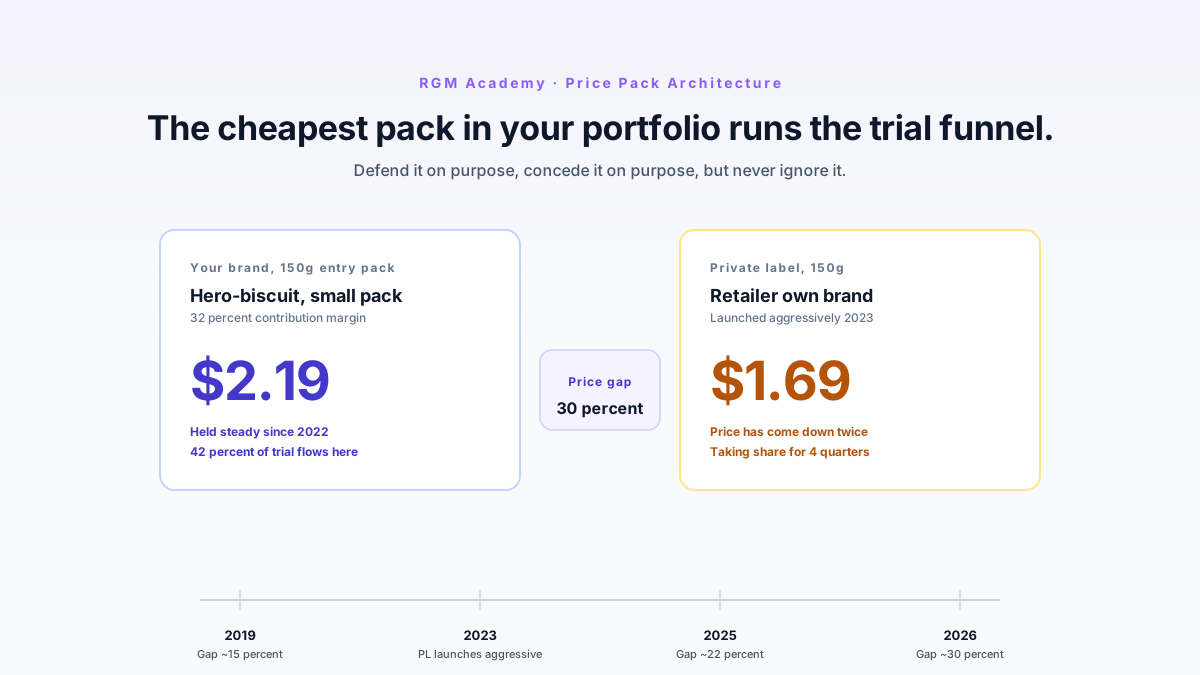
Its contribution margin is usually the thinnest in the range. A 150 gram entry pack at $2.19 typically carries a 25 to 32 percent contribution, where the 300 gram hero pack sits at 40 to 45 percent. Run a margin-ranking review and the entry pack lands at the bottom every time, which invites the question of why you are spending innovation time on it and the easy answer that you are not.
Its volume looks small too, 10 to 20 percent of total category volume in a typical mainstream brand against 35 to 50 percent for the hero pack, so ranked by volume it sits mid-table and gets mid-table attention.
And it is the most exposed to private label, which is where the value shopper goes first. Private-label unit share has reached about 50 percent across Europe's six biggest grocery markets, a record, and it has grown every year since 2021.1 The entry tier is where that share is won first, so when the brand team looks at where it is losing, the loss clusters at the bottom of the ladder, which makes the entry pack feel like a battle already lost.
Put those three pressures together and under-management follows. The entry pack gets a rolling 3 percent price rise, last year's media plan, no innovation, and no fresh trade money. It bleeds share slowly, and nothing gets escalated until a Chief Executive, three years on, is staring at a trial chart and asking what happened.
What the entry pack actually does for your brand
The volume it carries is not the point. The trial it runs is.
Loyalty-card and household-purchase panels keep finding the same thing across FMCG categories. The entry pack captures a disproportionate share of first-purchase occasions, the moments a shopper buys your brand for the first time. In many categories that runs to 30 to 45 percent of all new-shopper trial, against only 10 to 20 percent of brand volume.5 The precise share moves with the category, but the pattern holds, and it is the number hardest to find in a brand-review deck, because it needs panel data, not the sales report.
Trial versus volume
Volume is how many units a pack sells. Trial is something different. It counts the moments a shopper buys your brand for the very first time, a first-purchase occasion. A pack can be a small slice of total volume yet still bring in a large share of new shoppers, and that is exactly what the entry pack does. The post cites roughly 10 to 20 percent of brand volume against 30 to 45 percent of first-purchase occasions. You only see this gap in loyalty-card or household-purchase panel data, not in the standard sales report, which is why it stays hidden.
It does two more jobs. It anchors the bottom of your price ladder: shoppers judge your hero and premium packs against the cheapest shelf price your brand offers, so when the entry pack drifts up over three years, the perceived price of the whole brand drifts up with it. And it holds a shelf slot. Retailers stock an entry-tier price point for shoppers trading down, and the moment your entry SKU goes missing they fill that facing with their own label. Winning the slot back eighteen months later costs far more than holding it ever did.
The five questions to walk before your next price-pack review
The paired Price Pack Architecture (PPA) decision guide lays this out as a full decision tree. The short version is five questions.
How much of your trial flows through the entry pack? Above 30 percent and the pack is your main gateway, so conceding it means losing shoppers who never get the chance to trade up. Below 20 percent and the trial cost of letting it go is lower, which makes concession a serious option. This needs panel data, not the sales report.
How wide is the price gap to the cheapest private-label alternative? Published private-label research and commercial experience point to three rough zones. Below about 10 percent, your brand premium usually carries the gap. Between 10 and 25 percent, share erodes steadily. Past 25 percent, even loyal shoppers notice, and the whole brand reads as the expensive option.6
Can you close the gap by shrinking the pack instead of cutting the price? A smaller pack reaches a lower absolute price without anchoring a cheaper per-gram price for the hero pack above it. It works best when your category has room for a smaller format and your supply chain can build one without a year of lead time.
Can your margin take a direct cut if a shrink is not viable? A 10 percent list-price cut on a 32 percent-margin entry pack takes you to around 24 percent margin, about the level where the pack stops paying for itself once retailer and trade costs come out. A larger move, cutting from $2.19 to $1.85, roughly 15 percent, drops the margin to around 19 to 20 percent, below what a branded grocery SKU usually needs. The direct cut is the most margin-destructive option on the table.
Is conceding genuinely the right call? It is, if your premium tier can grow into the redirected money. If your premium pack is under 15 percent of category volume and flat, moving spend up the ladder will not compound, so you lose the entry tier and get nothing back. A premium tier worth redirecting toward is 15 percent or more of category volume, growing at 3 percent a year or better.
Why the pack shrink usually wins
Run the three options on the same biscuit pack and the answer to question three falls out of the math. The direct cut from $2.19 to $1.85 takes per-pack contribution from about $0.70 to about $0.36, a 48 percent hit, and risks anchoring a lower per-gram price that drags the hero pack down with it. A reformulation can save 10 to 15 percent on unit cost and allow a smaller move, but flowing a cheaper ingredient through supply usually takes 6 to 12 months, so you lose entry-tier share for three or four quarters first.
A pack shrink from 150 grams to 135 grams at $1.99 gives the cleanest trade-off. The shelf price drops $0.20, and the new gap to private label sits at roughly 18 percent, inside the zone where brand premium can still carry it. Ingredient cost falls close to the full pack-size reduction while fixed packaging overhead scales less, so unit cost drops by roughly $0.10 to $0.15 a pack. Contribution rebuilds to about $0.65, a 7 percent hit against the current contribution rather than 48. You defend most of the share and avoid the anchoring risk.
Why a pack shrink beats a price cut
When the price gap to private label opens up, the obvious move is to cut your shelf price. The problem is that contribution, the money left per pack after the cost of goods, falls fast, and a lower price per gram drags down the bigger packs above it on the ladder. Shrinking the pack instead reaches a lower absolute shelf price while keeping the price per gram healthier. In the biscuit example here, going from 150 grams to 135 grams costs about a 7 percent contribution hit, where the direct price cut costs about 48 percent.
The wider pattern fits the math. Across major FMCG groups in 2023 and 2024, the ones that returned to volume growth did so by re-engaging price-sensitive shoppers, often through pack-size management. Danone is a clear case: its volume and mix grew about 3 percent in its 2024 financial year, after two years of decline.7
When conceding on purpose is the right call
There is a version of this where concession is the smart answer, not the lazy one. Your entry pack is 8 percent of brand volume and 15 percent of trial, your premium pack is 22 percent of category and growing 5 percent, and the private-label attacker has a genuine cost advantage you cannot match by shrinking or reformulating. In that world, redirecting your trade money, innovation budget, and advertising up to the mid-premium tier is the profitable move.
If you choose it, choose it cleanly. Discontinue the entry SKU rather than letting it rot on the shelf, move the full trade envelope up a tier, and plan for two or three quarters of volume pressure while the mix shifts. And do not try to sneak back in eighteen months later, because re-entry costs about the same as the slow rebuild a conceded entry tier demands.
What to do Monday morning
Pull the panel data on your two or three highest-volume brands, the panel and not the sales report, and look at trial share by pack size. If the entry pack is running more than 30 percent of trial and the price gap to private label has opened past 10 percent, you have a decision waiting at your next PPA review, and a pack shrink is usually the answer.
The mistake is not the choice. It is leaving the entry pack unmanaged for three more years while private label takes another five points of share, then explaining to a Chief Executive why trial fell off a cliff. That meeting is the expensive one.
References
- Private-label unit share reached a record 50 percent across Europe's six biggest grocery markets (France, Germany, Italy, Netherlands, Spain, United Kingdom) and has grown every year since 2021. Country shares: Spain about 59 percent, Netherlands about 56 percent, United Kingdom and Germany about 52 percent, France about 46 percent, Italy about 36 percent. Circana, April 2026. circana.com
- Hein Schumacher was appointed Chief Executive of Unilever, effective 1 July 2023. Unilever press release. unilever.com
- Unilever set out its Growth Action Plan alongside Q3 2023 results in October 2023, prioritising fewer, stronger brands, faster growth, and improved competitiveness. Unilever press release. unilever.com
- Unilever reported that private label gained share in categories such as ice cream as consumers sought value, and that on a rolling-year basis only about 37 percent of its business was winning market share. Reuters, reported via Investing.com. investing.com
- The entry pack's outsized share of first-purchase occasions is a consistent finding across loyalty-card and household-purchase panel programmes (for example NielsenIQ and Kantar Worldpanel). The 30 to 45 percent of new-shopper trial range is a directional pattern across published panel analyses, not a single named study; the precise share varies by category and retailer.
- The price gap between private label and national brands has widened, with the average private-label discount around 20 percent in the United States and wider in Western Europe, and the gap growing since 2019. The 10 and 25 percent zones used here are practitioner rules of thumb consistent with that research, not exact published breakpoints. Numerator, 2025. numerator.com
- Danone returned to volume and mix growth in its 2024 financial year, up about 3 percent, after declines in the prior two years, as it moderated price increases. Food Business News. foodbusinessnews.net
Keep going
Pair this with the decision guide, then build the muscle behind each of the five questions with the lessons below.
More from the blog
Defend or Concede the Entry Pack (playbook). The same five questions as an interactive decision tree, with the 150g biscuit pack-shrink worked example from this article at the bottom.
Shrinkflation or Price Rises in 2026. The sister decision on the cost-inflation side: when you should shrink the pack to hold a price point, and when a straight rise is the cleaner move.
Why BOGO Is Dying. The companion pack-and-promotion decision on the same commercial calendar, with the same narrative-plus-decision structure.
What Is RGM? Where Price Pack Architecture sits inside the six-lever map, for readers who want the territory before the tactic.