Shrinkflation vs Price Rises: Which One Is Actually Working in 2026?
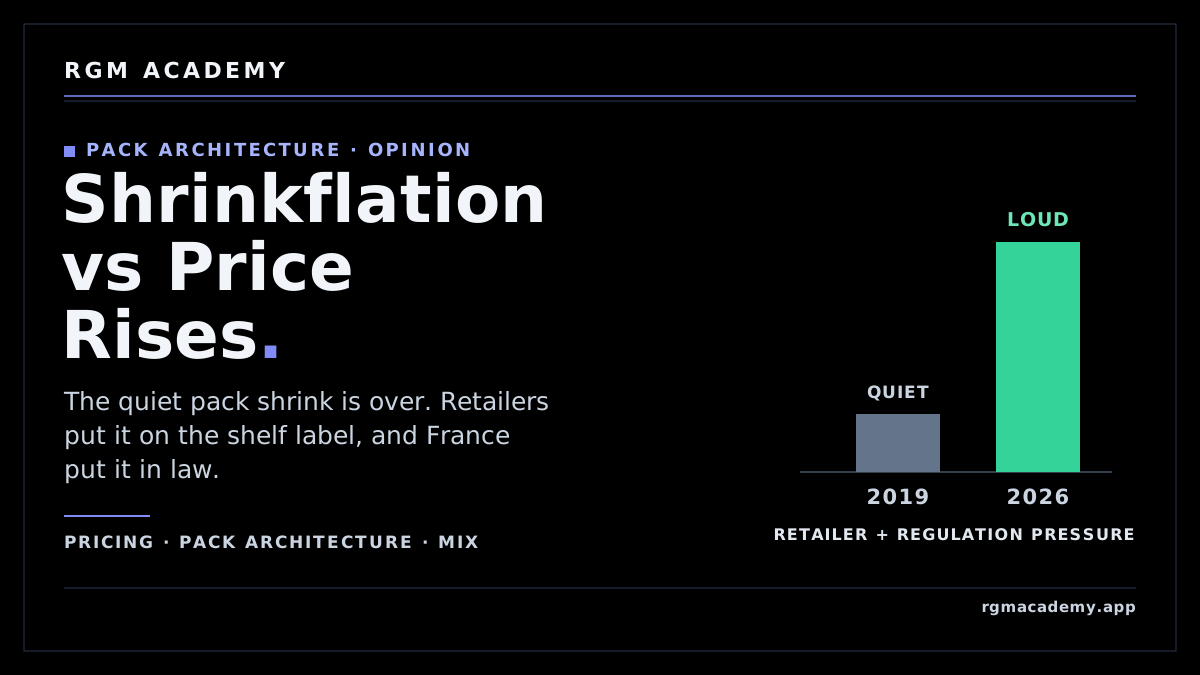
The quiet pack shrink is over in Europe. Retailers and regulators made sure of it.
The short version
- Between 2020 and 2023, quietly shrinking the pack was the default way to pass cost on, because a 5% pack shrink loses about half the sales a 5% price rise does. Shoppers read the shelf price, not the price per gram.
- Three forces broke the "nobody will notice" assumption inside ten months: retailer activism (Carrefour's shelf labels), regulation (France's on-pack disclosure law), and the speed of information (a shrink now travels at the pace of a screenshot).
- The old call weighed five factors. Now one of them, whether retailers and regulators are watching, mostly decides it on its own.
- Where that pressure exists (France, Italy, Germany, the UK), the quiet shrink is effectively closed, and a labelled shrink can cost more sales than a straight price rise. A price rise is a number. A shrink with a warning on it is a story.
- Mind which elasticity you use. A brand raising price alone is very price-sensitive (the brand-level average is about minus 2.6), but a market-wide move feels a much gentler minus 1.0 to minus 1.3, and that is the number the maths runs on.
- The 2026 move is a smaller visible price rise, paid for with a tighter promotional calendar and cost-out work, sometimes twinned with a value tier, not a silent ten-gram cut.
The shelf labels that named names
In September 2023, small paper signs appeared along Carrefour shelves in France, right next to specific products, telling shoppers in plain French that the pack had shrunk and the price per unit had gone up. They named PepsiCo, Nestlé, and Unilever products, a sugar-free Lipton iced tea here, a tin of Guigoz infant formula there.1 A tactic that had lived quietly inside Revenue Growth Management (RGM) decks for years suddenly had a face. The aim, Carrefour's client-communications director Stefen Bompais told Reuters, was "to be able to tell manufacturers to rethink their pricing policy."1
Four months later, after the annual negotiation broke down, Carrefour pulled PepsiCo off its shelves across France, Belgium, Spain, and Italy.2 By the time the two sides patched the French listings back together that spring, France had passed a law: from 1 July 2024, any brand that shrank a pack had to say so on the shelf.3 Draw a line through those three events and you have the end of cheap shrinkflation in Europe.
Why the quiet shrink was the default
The appeal was arithmetic. In a mainstream Fast-Moving Consumer Goods (FMCG) category, a 5% price rise usually costs you about 6% of your sales. A 5% pack shrink, for the same extra money per pack, usually costs about half of that. Shoppers read the shelf price. They do not read the price per gram, and they do not weigh the pack.
Two elasticities, not one
The "5% rise costs 6% of sales" figure is a category-level number: what happens when a whole category moves together, or a brand with real pricing power moves with the market. It usually sits between minus 1.0 and minus 1.3. There is a second, much steeper number you will see quoted, a brand-level average near minus 2.6 across 1,851 published estimates.4 That one measures a brand raising price alone while rivals hold, and losing share fast. Use the gentle category figure for a market-wide move, and keep the steep brand figure as a warning about going it alone. They are different measurements, not a contradiction.
Halve the sales loss for the same per-pack profit, in a cost environment that squeezed margins every quarter, and the move sold itself. Between 2021 and 2023 nearly every large maker in Europe used some version of it. Bain's first Consumer Products Report found that about 75% of the sector's 2023 global growth came from price rather than volume, and in the United States and Europe price accounted for roughly 95% of it.5 A lot of that was list-price rises. A quieter share was shrink.
Three forces that took the shine off
Three things broke the "they will never notice" assumption inside ten months.
First, retailer activism. Carrefour's labels were not marketing, they were a negotiating move, and Carrefour is no minnow: it holds about a fifth of French grocery, second only to E.Leclerc.1 When a retailer that size decides to make a hidden shrink visible, the tactic changes overnight.
Second, regulation. France's order of 16 April 2024 forces any brand selling there to flag a shrink on shelf, for two months from the day the smaller pack lands.3 The burden is small and the effect is psychological: the quiet window between the shrink and the moment a shopper works it out from the grams is now closed by law. Italy has legislated a similar rule, applicable from 2025, though it drew a European single-market objection.6 Germany's Verbraucherzentrale Hamburg runs a public list of shrunk packs, and the UK's Which? has tracked them for years.7
Third, the speed of information. A shrink used to move at the pace of a category review. Now it moves at the pace of a screenshot. The gap between the cut and the accusation has collapsed from months to hours, which kills the classic defence of quietly putting the grams back next year.
The one question that now decides it
The old call weighed five things in parallel: how long the cost problem would last, how strong the brand was, which pack you were shrinking, whether the retailer was pushing back, and whether the shelf price sat under a round number. In 2021 the retailer question was a mild weight at the back. In 2026 it usually decides the whole thing.
Ask it plainly. Is any retailer in your main market flagging shrinkflation, on shelf, in its own comms, or in a category review you have had this year? Is the market covered by on-pack disclosure, as France is, or by an active consumer watchlist, as Germany and the UK are? Has a newsroom or a national consumer body published a list of shrunk products that named yours or a close rival? If any answer is yes, the "nobody will notice" logic stops holding, and a labelled shrink starts to cost more sales than a straight rise.
How three forces became one decision
The old call weighed five things in parallel. Three forces collapsed it into one. First, a big retailer decides to make hidden shrinks visible on its own shelves. Then regulation closes the quiet window between the cut and the moment a shopper works it out from the grams. Then information speeds up, so a shrink now travels at the pace of a screenshot rather than a category review. Put those together and the chain runs one way: if a retailer or a regulator in your main market is watching, then the shrink cannot stay quiet, and then a labelled shrink can cost more sales than a straight price rise. A price rise is a number. A shrink with a warning on it is a story, and stories cost more.
What a biscuit brand does in 2026
Take a mid-tier biscuit brand with a 300-gram weekly-shop pack at $4.29 and a 42% margin. Cocoa, sugar, and shipping have pushed costs up 9% over the year. The brand sells about 8% above the category average, two of its four big retailers run shrinkflation watchlists, and the price sits mid-range, not under a round number.
On the old framework you shrink the pack: the sales loss is smaller and the pack is the right one to trim. On the 2026 framework you raise the price, because the retailer situation alone closes the shrink branch. A 4.9% rise to $4.50 looks ugly on the invoice and spends some negotiation goodwill. But a 42% margin brand can lose about 10.5% of its sales on that rise before it actually loses money, and the category meta-mean loss on a 5% rise is closer to 6%, so you go in with roughly four points of cushion. The brand's premium pulls its real elasticity toward that gentle category figure, not the steep brand-level one. What you do not do is spend the next six weeks watching a photo of your shrunk pack circulate in a consumer-group press release. The brand risk is finite, and measured in margin rather than in reputation. The full break-even walk is in the price rise versus pack shrink playbook.
Why the cushion, not the headline, is the point
The 4.9 percent rise to 4.50 looks ugly on the invoice, which is why teams flinch at it. The number that should settle the nerve is the cushion. At a 42 percent margin, the brand can afford to lose about 10.5 percent of its sales on that rise before it actually starts losing money. The loss a 5 percent rise typically produces is closer to 6 percent. So the brand goes in with roughly four points of room to spare, and the premium it already carries pulls its real loss toward that gentle category figure rather than the steep brand-level one. The price rise is the move that keeps your margin and your reputation intact. The brand risk is finite, and you can measure it in margin rather than in headlines.
Where this goes
By late 2026 the European story is largely settled. Shrink without disclosure is gone in France, going in Italy, and under consumer-group pressure everywhere else. The United States moves slower, with no federal disclosure law, but the press coverage stays loud, and private-label teams have started comparing grams per dollar against the national brands. Those comparisons have a way of leaking.
The winning move now is rarely a pure shrink. It is a smaller visible price rise, paid for in part by a tighter promotional calendar and cost-out work on pack materials, sometimes twinned with a value tier that protects the entry price the brand used to defend with shrink. Nestlé cut its US prices by 1% in the first quarter of 2025 to win back shoppers it had lost in frozen food and creamers, and Unilever has flagged that volume needs to come back into the growth mix.8 The case for price has not weakened. The smallest real price move still beats the biggest plausible volume gain, the argument in the 1% on price piece. What has changed is the cost of making a rise stick, and how much of the rest of the RGM stack you now need to support it.
References
- Carrefour put shrinkflation labels on French shelves from September 2023, naming PepsiCo, Nestlé, and Unilever products; client-communications director Stefen Bompais told Reuters the aim was "to be able to tell manufacturers to rethink their pricing policy." Carrefour holds about a fifth of the French grocery market, second to E.Leclerc. Fortune / Reuters, 16 September 2023. fortune.com
- Carrefour delisted PepsiCo products (Lay's, Doritos, Lipton, Quaker, 7Up) across France, Belgium, Spain, and Italy in early January 2024 over price increases; the products returned to French shelves around April 2024. France 24 / Reuters. france24.com
- France's order of 16 April 2024, effective 1 July 2024, requires shops over 400 square metres to display an on-shelf notice for two months when a pre-packaged product shrinks and its price per unit rises. FoodNavigator; Service-Public.fr. foodnavigator.com
- Brand-level own-price elasticity averages about minus 2.62 across 1,851 estimates from 81 studies (Bijmolt, van Heerde, and Pieters, "New Empirical Generalizations on the Determinants of Price Elasticity," Journal of Marketing Research, 2005). Category-level own-price elasticity is far gentler, typically minus 1.0 to minus 1.3 (Tellis, "The Price Elasticity of Selective Demand," JMR, 1988, widely cited). journals.sagepub.com
- Bain & Company's first Consumer Products Report found that about 75% of the sector's 2023 global revenue growth came from price rather than volume, with price accounting for roughly 95% of growth in the United States and Europe. PR Newswire, 14 February 2024. prnewswire.com
- Italy legislated a comparable shrinkflation disclosure rule (Law 193/2024, Article 15-bis of the Consumer Code), applicable from 2025, which drew a European single-market objection. Osborne Clarke. osborneclarke.com
- Germany's Verbraucherzentrale Hamburg publishes a running list of shrunk packs ("Mogelpackungsliste"); the UK's Which? has tracked shrinkflation for several years. vzhh.de; which.co.uk
- Nestlé cut its US prices by 1% in the first quarter of 2025 to win back shoppers lost in frozen food and creamers; Unilever data in the same reporting showed volume needing to return to its growth mix. Reuters, April 2025. bworldonline.com
Keep going
Pair this with the decision guide and the lessons that drill the moves behind it.
Playbook
Price rise or pack shrink? The decision guide behind this piece: the five questions as a tree, the break-even maths on how much sales loss a price rise can absorb, and the Carrefour and PepsiCo case written up step by step.
More from the blog
Why 1% More in Price Beats 5% in Volume. Why the price lever is worth defending in the first place, and the profit leverage behind it.
The Great RGM Reset. The wider shift from price-led to volume-led growth that this story sits inside.
What Is RGM? The six-lever framework that the post-shrink toolkit gets rebuilt around.