What Is Revenue Growth Management (RGM)? The Six-Lever Framework Every FMCG Leader Should Know in 2026
A 1% price move lifts operating profit by 8.7%. A 1% volume gain lifts it by 2.8%. Pick your lever carefully — and know the other five you are ignoring.
Bulent Kotan17 min read
Rich rendering temporarily unavailable — showing raw markdown.
*Revenue Growth Management is not a department. It is the discipline of choosing which lever to pull, when, and for whom — and most commercial teams are pulling two out of six on muscle memory.*
---
## The argument everyone recognises
Walk into a year-end commercial review at most mid-sized Fast-Moving Consumer Goods (FMCG) companies and you find the same argument. Finance wants another point of price. Sales wants to protect volume. Marketing wants to fund a consumer promotion. Supply chain wants less complexity in the pack range. The Chief Executive Officer (CEO) wants all of it and none of the trade-offs.
What is missing is a framework for deciding which lever to pull first, which ones reinforce each other when sequenced correctly, and which ones to leave alone until next year.
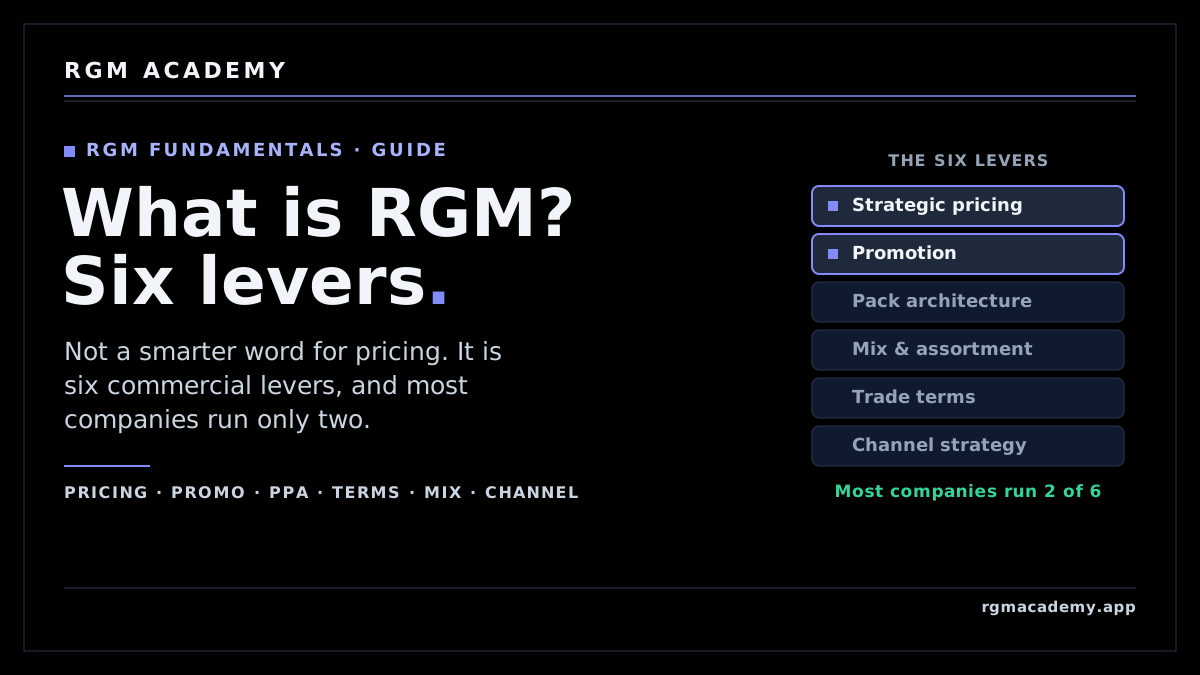
Revenue Growth Management (RGM) — called Net Revenue Management (NRM) in some companies, mainly depending on which consultancy set up the function — is that framework. It covers six commercial levers that together determine what a Consumer Packaged Goods (CPG) business earns on every unit it sells. Pricing is one of them. Promotion is another. Most companies are using two out of the six with any real discipline, which is why the year-end meeting keeps happening.
## Why this matters in 2026
Three forces are putting RGM back on the boardroom agenda simultaneously.
First, the 2022–2024 inflation cycle is over. Large-sample analysis from Boston Consulting Group (BCG) published in early 2025 shows that consumer goods companies extracted roughly 70% of their growth from price over the inflation years, with volume contributing almost nothing.¹ That playbook is exhausted. Nestlé cut prices in the United States (US) in the first quarter of 2025 for the first time since 2021.² Unilever flagged that its future growth mix needs to swing back toward volume.³ The pricing lever is still there, but it is not the default anymore.
Second, retailer tolerance has collapsed. The Carrefour–PepsiCo standoff of January 2024 — where Carrefour delisted Doritos, Lay's, 7 Up, Lipton, and Cheetos across France, Italy, Spain, Belgium, and Poland in protest at repeated price moves — changed the negotiating posture of the top European grocers overnight.⁴ The French shrinkflation disclosure decree that followed in July 2024 turned one RGM lever (pack-size reduction) into a regulatory hazard.⁵ In this climate, "take another point of price" stops being a sentence CFOs can finish.
Third, the Artificial Intelligence (AI) capability step-change is real but the operating models are not ready. Reckitt's partnership with McKinsey on the Revenue Growth Management Experience (RGMx) platform promises a 4–7 point margin uplift when it works end-to-end.⁶ Coca-Cola's $1.1 billion five-year partnership with Microsoft and OpenAI — signed in April 2024, up from $250 million in 2020 — is the largest AI bet any consumer goods company has publicly committed to.⁷ The tools are arriving. The frameworks inside most companies are still the ones written in 2014.
If you are a Vice President (VP) of RGM, NRM, Pricing, or Commercial Finance in 2026, the job is to take a six-lever framework, diagnose which two your company is actually using, and build the capability to use the other four before your competitor does.
<figure style="margin: 28px 0;">
<svg viewBox="0 0 760 300" xmlns="http://www.w3.org/2000/svg" style="width:100%;height:auto;font-family:Inter,system-ui,sans-serif;">
<style>
.bg{fill:#f8fafc}.gridline{stroke:#e2e8f0;stroke-dasharray:2,3}.axis{fill:#64748b;font-size:12px}.lbl{fill:#0f172a;font-size:12px;font-weight:600}.num{fill:#fff;font-size:12px;font-weight:700}
@media (prefers-color-scheme:dark){.bg{fill:#0f172a}.gridline{stroke:#334155}.axis{fill:#94a3b8}.lbl{fill:#f1f5f9}}
</style>
<rect class="bg" width="760" height="300" rx="10"/>
<text x="30" y="30" class="lbl" style="font-size:14px">Top-10 CPG growth decomposition, 2022–2025</text>
<text x="30" y="48" class="axis">Share of reported organic growth (%), approximate</text>
<!-- Y axis guides at 25/50/75/100 -->
<line x1="110" y1="90" x2="740" y2="90" class="gridline"/>
<line x1="110" y1="140" x2="740" y2="140" class="gridline"/>
<line x1="110" y1="190" x2="740" y2="190" class="gridline"/>
<line x1="110" y1="240" x2="740" y2="240" class="gridline"/>
<text x="100" y="95" class="axis" text-anchor="end">100%</text>
<text x="100" y="145" class="axis" text-anchor="end">75%</text>
<text x="100" y="195" class="axis" text-anchor="end">50%</text>
<text x="100" y="245" class="axis" text-anchor="end">25%</text>
<line x1="110" y1="240" x2="740" y2="240" stroke="#64748b" stroke-width="1"/>
<!-- 4 stacked bars: 2022 2023 2024 2025. Stack: price (indigo), volume (emerald), mix (amber). -->
<!-- 2022: price 72 / vol 18 / mix 10 -->
<rect x="160" y="98" width="80" height="102" fill="#6366F1"/>
<rect x="160" y="200" width="80" height="25" fill="#10B981"/>
<rect x="160" y="225" width="80" height="15" fill="#D4A574"/>
<text x="200" y="155" class="num" text-anchor="middle">72</text>
<text x="200" y="270" class="axis" text-anchor="middle">2022</text>
<!-- 2023: price 68 / vol 20 / mix 12 -->
<rect x="290" y="106" width="80" height="94" fill="#6366F1"/>
<rect x="290" y="200" width="80" height="28" fill="#10B981"/>
<rect x="290" y="228" width="80" height="12" fill="#D4A574"/>
<text x="330" y="159" class="num" text-anchor="middle">68</text>
<text x="330" y="270" class="axis" text-anchor="middle">2023</text>
<!-- 2024: price 55 / vol 30 / mix 15 -->
<rect x="420" y="132" width="80" height="68" fill="#6366F1"/>
<rect x="420" y="200" width="80" height="40" fill="#10B981"/>
<rect x="420" y="240" width="80" height="0" fill="#D4A574"/>
<rect x="420" y="225" width="80" height="15" fill="#D4A574"/>
<text x="460" y="172" class="num" text-anchor="middle">55</text>
<text x="460" y="270" class="axis" text-anchor="middle">2024</text>
<!-- 2025: price 35 / vol 45 / mix 20 -->
<rect x="550" y="180" width="80" height="60" fill="#6366F1"/>
<rect x="550" y="120" width="80" height="60" fill="#10B981"/>
<rect x="550" y="95" width="80" height="25" fill="#D4A574"/>
<text x="590" y="215" class="num" text-anchor="middle">35</text>
<text x="590" y="270" class="axis" text-anchor="middle">2025</text>
<!-- Legend -->
<rect x="650" y="95" width="12" height="12" fill="#6366F1"/><text x="668" y="105" class="axis">Price</text>
<rect x="650" y="115" width="12" height="12" fill="#10B981"/><text x="668" y="125" class="axis">Volume</text>
<rect x="650" y="135" width="12" height="12" fill="#D4A574"/><text x="668" y="145" class="axis">Mix</text>
</svg>
<figcaption style="margin-top:8px;color:#64748b;font-size:13px;font-style:italic;text-align:center;">Indicative decomposition of reported organic growth for the top ten global Consumer Packaged Goods companies, 2022–2025. Price-led growth dominated through 2022–2024; volume and mix are recovering as a share of the total from 2025 onward. Composite illustration informed by BCG volume-led growth research; individual company disclosures vary.</figcaption>
</figure>
## The six levers
Every textbook definition of RGM carves up the discipline slightly differently, and the arguments about taxonomy are not worth having. What matters is that a serious RGM framework covers all six of the following levers, and that the gaps between them are where the value leaks.
### 1. Strategic Pricing
The base of the stack. Strategic Pricing covers the list price architecture, the brand-level price premium over Private Label (PL) and mainstream competitors, the pass-through rates a manufacturer negotiates with retailers, and the competitive response function that governs whether a price move starts a price war or gets absorbed into the category.
The foundational number every Strategic Pricing leader should know: a 1% improvement in realised price, on average across large published samples of consumer goods companies, lifts operating profit by roughly 8.7%. A 1% volume gain lifts it by 2.8%. A 1% reduction in variable cost lifts it by 5.9%. Price is the single most leveraged commercial input in a CPG Profit and Loss (P&L), by a comfortable margin.⁸
Elasticity is the constraint. Published large-sample meta-analyses of brand-level price elasticity in mainstream FMCG cluster in the −1.7 to −2.6 range.⁹ Inside that range, price moves are contribution-positive when the realised elasticity sits above the Break-Even Elasticity — and every Strategic Pricing decision ultimately gets tested against that scalar.
### 2. Price-Pack Architecture (PPA)
If Strategic Pricing sets the single price of a single SKU (Stock Keeping Unit), PPA designs the ladder of SKUs — pack sizes, price tiers, shopper occasions, and the price-per-unit relationships between them. Coca-Cola codified the discipline in the 1990s under the acronym Occasion-Brand-Pack-Price-Channel (OBPPC), and the modern CPG industry inherited that vocabulary.
The central object is the *incentive curve*: the plot of price-per-kilo (or per-litre, per-serving) against pack size. In a healthy category that curve slopes downward — larger packs cost less per unit of content, and shoppers trade up. In a broken category the curve is flat or inverted, and the largest pack costs more per kilo than the routine pack. Simon-Kucher's 2025 Growth Playbook identifies "accidentally vacated price points" — entry-tier packs whose prices drifted upward during the inflation cycle and opened shelf space for Private Label — as one of the largest architectural debts in the industry.¹⁰
### 3. Trade Promotion Optimization (TPO)
The lever with the highest failure rate. Bain & Company's published RGM research finds that roughly 70% of SKUs drive fewer than 5% of category revenue, and that 75% of trade promotion programmes fail against their stated objective.¹¹ The Promotion Optimization Institute (POI) 2025 Fall Summit reported an industry-scorecard figure of 1,640 promotional events audited across a major European CPG, of which 340 (21%) had negative turnover and consumed roughly €4.3 million in trade spend on events that destroyed value.¹²
TPO is the discipline of deciding which events to run, at what depth, with which mechanic (Temporary Price Reduction, Multi-buy, Buy-One-Get-One, Display-only, Feature-plus-Display), on which pack, in which week — and then measuring whether the uplift was incremental or cannibalised. It is the most operationally intensive lever in the stack and the one where most companies have the weakest data foundations.
### 4. Trade Terms
The annual architecture of discounts, rebates, and performance-based incentives that flow from the manufacturer to the retailer. Trade terms cover on-invoice discounts (channel, customer, logistics, payment), off-invoice rebates (growth, distribution, promotional allowance), and the conditional earning mechanisms that tie terms to retailer performance.
A typical European FMCG manufacturer runs a Gross-to-Net (G2N) ratio in the 18–30% range — meaning 18–30% of gross sales value flows back to retailers through trade terms. The Revenue Growth Management (RGM) lever inside trade terms is not the *size* of the envelope but its *shape*: how much of that 22% is conditional versus unconditional, how it is tiered by customer, and whether it is restructured in phases that trade retailer-earning opportunity for manufacturer protection against leakage.
### 5. Mix and Assortment
The fifth lever is the composition question: which SKUs carry what share of volume, revenue, and profit; which packs sit in which tiers (economy, mainstream, premium, super-premium); which shopper segments get served through which pack-price-occasion combinations. The Bain 70%-of-SKUs-drive-5%-of-revenue finding is a mix diagnosis in disguise — it says that most CPG portfolios carry a long tail of unproductive assortment that the fifth lever should have pruned years ago.
Mix is the only lever that moves both margin and topline without touching price or promotion. A 5% shift of volume from a Core tier into an Upper Core or Premium tier, with no price change, can deliver the same P&L impact as a 1% list-price increase. This is why premiumisation — when it is real and not cosmetic — is the most durable of the six levers.
### 6. Route-to-Consumer (RtC) and Channels
The sixth lever is how the product reaches the shopper. Modern Trade, Traditional Trade, Convenience, Cash-and-Carry, Online Pure Play, Omnichannel, Direct-to-Consumer (DTC), and — increasingly — Quick Commerce (Q-commerce), which in India alone is forecast by Morgan Stanley at a $57 billion Total Addressable Market (TAM) by the end of the decade.¹³
Channel strategy matters for RGM because each channel has different shopper economics, different basket sizes, different pack-format preferences, and different promotional mechanics. A SKU that is a hero in hypermarket modern trade can be a loss-maker in Q-commerce if the pack is mis-sized and the retail-media tax is mis-modelled. The rise of retailer media networks — projected by eMarketer at $106 billion globally by 2027 — has turned channel economics into a moving target that finance and commercial are still learning to model together.¹⁴
<span style="color: #D4A574;">**📸 Screenshot suggestion**: The RGM Academy module map on the `/home` route, showing the six lever modules (Pricing, PPA, TPO, Trade Terms, PIL, Integration) as tiles. Filename: `what-is-rgm-02.png`. Alt text: "RGM Academy interactive course map showing the six Revenue Growth Management levers as clickable modules."</span>
## The Coca-Cola OBPPC case — what integration actually looks like
The easiest way to see the six levers work together is to study the company that codified the framework and still runs it.
Coca-Cola's OBPPC framework is not a slogan; it is a discipline executed against a global Key Performance Indicator (KPI) stack. At the heart of the framework is the insight that a shopper's willingness to pay is not a property of the product — it is a property of the *occasion*. A 330 millilitre (ml) can at a football match is not the same product, commercially, as a 2-litre bottle in a weekly grocery shop. Different pack, different price, different margin, different channel, different promotional mechanic.
The system that maps those permutations — occasion × brand × pack × price × channel — is what gives Coca-Cola its capacity to run a single global brand with locally-calibrated price-per-litre economics. The outputs of the framework are familiar to anyone who has stood in a supermarket aisle: the 1.5-litre multi-pack priced for a weekly shop, the 330 ml single-can chiller pack priced for impulse, the 600 ml "grab-and-go" bottle priced for convenience, the 200 ml mini-can priced as a premium gift format. Each one is a different cell in the OBPPC matrix, each priced independently against the shopper willingness-to-pay (WTP) for that occasion.
Coca-Cola's $1.1 billion generative AI partnership with Microsoft and OpenAI, announced in April 2024, is the latest layer on top of the same system — automating the execution of OBPPC at a granularity that would be manually impossible. The widely-reported use-case (AI-written push notifications lifting incremental SKU sales) is the under-counted commercial detail; the headline figure is the capability investment.⁷
The broader lesson for RGM leaders is not "copy Coca-Cola's framework." It is that OBPPC integrates five of the six levers into a single planning matrix — pricing, PPA, TPO, mix, channel — and the sixth (trade terms) is the contractual envelope within which the matrix is executed with each retailer. A framework that stops short of this integration is an RGM framework with a hole in it.
<figure style="margin: 28px 0;">
<svg viewBox="0 0 760 340" xmlns="http://www.w3.org/2000/svg" style="width:100%;height:auto;font-family:Inter,system-ui,sans-serif;">
<style>
.bg{fill:#f8fafc}.cell{fill:#fff;stroke:#e2e8f0;stroke-width:1}.cellFilled{fill:#D4A574;opacity:0.18;stroke:#D4A574;stroke-width:1.5}.cellGap{fill:#ef4444;opacity:0.1;stroke:#ef4444;stroke-dasharray:4,3}.head{fill:#0f172a;font-size:12px;font-weight:600}.val{fill:#0f172a;font-size:10px;font-weight:600}.gap{fill:#b91c1c;font-size:10px;font-weight:700}
@media (prefers-color-scheme:dark){.bg{fill:#0f172a}.cell{fill:#1e293b;stroke:#334155}.head{fill:#f1f5f9}.val{fill:#f1f5f9}}
</style>
<rect class="bg" width="760" height="340" rx="10"/>
<text x="30" y="28" class="head" style="font-size:14px">OBPPC matrix: Occasion × Channel, with pack-price cells</text>
<text x="30" y="46" style="fill:#64748b;font-size:11px;font-family:Inter,system-ui,sans-serif">Filled cells = a pack-price combination serves that occasion+channel. Red dashed = white space the portfolio does not cover.</text>
<!-- Column headers -->
<text x="230" y="80" class="head" text-anchor="middle">Convenience</text>
<text x="390" y="80" class="head" text-anchor="middle">Supermarket</text>
<text x="550" y="80" class="head" text-anchor="middle">Q-commerce</text>
<text x="710" y="80" class="head" text-anchor="middle">Online Pure</text>
<!-- Row headers + cells. 4 occasions × 4 channels -->
<!-- ROW 1 Impulse -->
<text x="150" y="115" class="head" text-anchor="end">Impulse</text>
<rect x="160" y="95" width="140" height="45" class="cellFilled"/><text x="230" y="122" class="val" text-anchor="middle">330 ml · $1.49</text>
<rect x="320" y="95" width="140" height="45" class="cellFilled"/><text x="390" y="122" class="val" text-anchor="middle">330 ml · $1.69</text>
<rect x="480" y="95" width="140" height="45" class="cellGap"/><text x="550" y="117" class="gap" text-anchor="middle">GAP</text><text x="550" y="132" class="gap" text-anchor="middle" style="font-size:9px">no impulse SKU</text>
<rect x="640" y="95" width="140" height="45" class="cellGap"/><text x="710" y="117" class="gap" text-anchor="middle">GAP</text><text x="710" y="132" class="gap" text-anchor="middle" style="font-size:9px">no impulse SKU</text>
<!-- ROW 2 Routine -->
<text x="150" y="165" class="head" text-anchor="end">Routine</text>
<rect x="160" y="145" width="140" height="45" class="cell"/><text x="230" y="172" class="val" text-anchor="middle">600 ml · $2.49</text>
<rect x="320" y="145" width="140" height="45" class="cellFilled"/><text x="390" y="172" class="val" text-anchor="middle">1.5 L · $2.99</text>
<rect x="480" y="145" width="140" height="45" class="cellFilled"/><text x="550" y="172" class="val" text-anchor="middle">1.5 L · $3.19</text>
<rect x="640" y="145" width="140" height="45" class="cellFilled"/><text x="710" y="172" class="val" text-anchor="middle">6 × 1.5 L · $17</text>
<!-- ROW 3 Sharing -->
<text x="150" y="215" class="head" text-anchor="end">Sharing</text>
<rect x="160" y="195" width="140" height="45" class="cell"/><text x="230" y="222" class="val" text-anchor="middle">1.5 L · $2.99</text>
<rect x="320" y="195" width="140" height="45" class="cellFilled"/><text x="390" y="222" class="val" text-anchor="middle">2 L · $3.49</text>
<rect x="480" y="195" width="140" height="45" class="cellFilled"/><text x="550" y="222" class="val" text-anchor="middle">2 L · $3.69</text>
<rect x="640" y="195" width="140" height="45" class="cellFilled"/><text x="710" y="222" class="val" text-anchor="middle">4 × 2 L · $13</text>
<!-- ROW 4 Gift -->
<text x="150" y="265" class="head" text-anchor="end">Gift</text>
<rect x="160" y="245" width="140" height="45" class="cellGap"/><text x="230" y="267" class="gap" text-anchor="middle">GAP</text><text x="230" y="282" class="gap" text-anchor="middle" style="font-size:9px">no gift SKU</text>
<rect x="320" y="245" width="140" height="45" class="cellFilled"/><text x="390" y="272" class="val" text-anchor="middle">Gift tin · $12.99</text>
<rect x="480" y="245" width="140" height="45" class="cellGap"/><text x="550" y="267" class="gap" text-anchor="middle">GAP</text><text x="550" y="282" class="gap" text-anchor="middle" style="font-size:9px">no gift SKU</text>
<rect x="640" y="245" width="140" height="45" class="cellFilled"/><text x="710" y="272" class="val" text-anchor="middle">Gift tin · $14.99</text>
<!-- Legend -->
<rect x="160" y="305" width="14" height="14" class="cellFilled"/><text x="182" y="317" style="fill:#64748b;font-size:11px;font-family:Inter,system-ui,sans-serif">Filled cell — pack/price combination in market</text>
<rect x="460" y="305" width="14" height="14" class="cellGap"/><text x="482" y="317" style="fill:#64748b;font-size:11px;font-family:Inter,system-ui,sans-serif">White space — occasion/channel not covered</text>
</svg>
<figcaption style="margin-top:8px;color:#64748b;font-size:13px;font-style:italic;text-align:center;">Illustrative OBPPC matrix for a soft-drinks portfolio. Each filled cell represents a pack-price combination that serves an occasion × channel. White-space cells are where a competitor or Private Label can enter; closing them is the operational output of a full OBPPC programme.</figcaption>
</figure>
## The practitioner playbook — diagnosing your own RGM capability
If you are stepping into an RGM, NRM, or Pricing leadership role, the diagnostic below will tell you within a week which of the six levers your company is actually using.
1. **Ask the head of Pricing to show you the Break-Even Elasticity for the next planned list-price move.** If the calculation does not exist or the answer is "we track elasticity at category level", Strategic Pricing is weaker than it looks.
2. **Open your three largest customers' shelf plans and plot the price-per-kilo curve across your pack-size ladder.** If the curve is flat or inverted, PPA is not functioning as a discipline. Fix the curve and you will recover gross profit measured in tens of basis points per category in year one.
3. **Pull last year's promotional calendar. Sort events by return on investment (ROI). Count how many had negative incrementality.** If the number is below 10%, your measurement infrastructure is undersized. The real industry number is closer to 20–30%.
4. **Pull your top-five customer trade-term structures. Compute conditional share (off-invoice performance-based rebate divided by total Gross-to-Net).** If it is below 30%, your trade terms lever is almost entirely passive. You are paying for entitlements, not performance.
5. **List your top-50 SKUs by gross profit. List your bottom-50. Compute the share of total gross profit that sits in the bottom half of the portfolio.** If the answer is below 15%, you have a mix problem — and the Bain 70/5 rule says you probably have a long tail of unproductive SKUs.
6. **Map every revenue stream by channel and compute the Return on Advertising Spend (ROAS) for your retailer-media investments.** If retailer media and trade promotion are governed by different owners with no shared view of total retailer investment, you are at risk of double-paying.
7. **Finally, look at your own capability build. Does RGM sit inside Finance, Sales, Marketing, or as a Centre of Excellence reporting to the CCO or CEO?** The Promotion Optimization Institute's 2025 consensus was that the highest-performing RGM functions sit as a cross-functional Centre of Excellence — not buried in Finance and not owned by Sales.¹²
Seven checks, one week of work. At the end you will know which two of the six levers your company is actually using, and which four are nominal.
## Pitfalls and trade-offs
The six-lever framework has two failure modes worth naming.
The first is *false completeness*. It is easy to convince a leadership team that a company has RGM capability because it uses the vocabulary. Having a Pricing team, a PPA canvas, a promo calendar, a trade-terms template, a portfolio review, and a channel strategy deck is not the same as integrating them. The integration — the cross-lever analysis, the shared data foundation, the common P&L view — is where the capability actually lives.
The second is *lever paralysis*. Because the six levers interact, any single move has downstream consequences in two or three others. A list-price lift changes the incentive-curve indices on the pack ladder; a deep promotional mechanic changes the pricing architecture retailers reference in their corridor; a trade-terms restructure changes the Gross-to-Net that all five other levers are optimising against. The temptation in a cautious organisation is to model every cross-effect until nothing moves. The cure is sequencing — run one lever hard while holding the others steady, measure what changed, then move the next.
RGM is not a static picture. It is a sequenced programme, and the programme is always behind schedule.
## What this means
Properly practised, Revenue Growth Management is the operating discipline that turns a CPG company's commercial assumptions into a measured, multi-lever programme. The framework decides when to reach for each of the six levers — Strategic Pricing, Price-Pack Architecture, Trade Promotion Optimization, Trade Terms, Mix and Assortment, Route-to-Consumer — and how to sequence them against each other.
The companies that will outgrow their categories in 2026 and 2027 are the ones building the capability now: the data foundation, the cross-functional Centre of Excellence, the AI tooling that sits on top of a framework already working. If your company still runs the "pricing versus promotion" argument every quarter, the missing piece is the framework to decide — not another budget round.
---
## References
1. Boston Consulting Group. "Driving Successful Volume-Led Growth in Consumer Markets." 2025. https://www.bcg.com/publications/2025/driving-volume-led-growth-in-consumer-markets
2. Fortune. "Nestlé, Unilever Flag Price Cuts and Tariff Pressure in Q1 2025 Results." April 2025. https://fortune.com/europe/2025/04/24/price-hikes-unilever-nestle-tariffs/
3. Unilever. Q1 2025 Trading Statement and full-year 2024 results. Press release. https://www.unilever.com/news/press-and-media/press-releases/
4. Fortune. "Carrefour Pulls PepsiCo Products After Price Hikes." January 2024. https://fortune.com/europe/2024/01/04/shrinkflation-pepsico-price-increases-carrefour-french-supermarket-pulls-snacks/
5. Bird & Bird. "France: Shrinkflation — New Obligation to Inform Consumers." July 2024. https://www.twobirds.com/en/insights/2024/france/shrinkflation-nouvelle-obligation-d-informer-les-consommateurs
6. McKinsey & Company. "Periscope Revenue Growth Management (RGMx)." https://www.mckinsey.com/capabilities/growth-marketing-and-sales/solutions/periscope/solutions/revenue-growth-management
7. The Coca-Cola Company. "The Coca-Cola Company and Microsoft Announce Five-Year Strategic Partnership to Accelerate Cloud and Generative AI Initiatives." April 2024. https://www.coca-colacompany.com/media-center/the-coca-cola-company-and-microsoft-announce-five-year-strategic-partnership-to-accelerate-cloud-and-generative-ai-initiatives
8. Large-sample cross-industry research published across multiple consulting and academic sources; the 8.7% / 5.9% / 2.8% / 1.8% canon is repeatedly cited in Bain, McKinsey, BCG, and Simon-Kucher publications. Example: Simon-Kucher 2025 Growth Playbook. https://www.simon-kucher.com/en/insights/easy-gains-rough-terrain-2025-growth-playbook-unlock-nuanced-cpg-opportunity
9. Published meta-analyses of price elasticity in branded FMCG (e.g., unconditional mean near −2.62 across ~1,851 estimates; older samples near −1.76). Referenced in BCG and McKinsey CPG pricing publications.
10. Simon-Kucher. "From Easy Gains to Rough Terrain: 2025 Growth Playbook." https://www.simon-kucher.com/en/insights/easy-gains-rough-terrain-2025-growth-playbook-unlock-nuanced-cpg-opportunity
11. Bain & Company. "Revenue Growth Management." https://www.bain.com/industry-expertise/consumer-products/revenue-growth-management/
12. Promotion Optimization Institute. "POI 2025 Fall Summit Recap." https://poinstitute.com/events/poi-2025-fall-summit/ ; https://clarkstonconsulting.com/insights/poi-2025-fall-summit-recap/
13. Akoi. "India Quick Commerce Landscape 2025." https://www.akoi.in/blog/https-www-akoi-in-blog-india-quick-commerce/ (citing Morgan Stanley TAM estimate)
14. eMarketer. "Growing Retail Media Networks Prioritize Measurement, Unraveling Complexity." https://www.emarketer.com/content/growing-retail-media-networks-prioritize-measurement-unraveling-complexity
---
## 📚 Learn more on RGM Academy
Take these concepts deeper with lessons from [RGM Academy](https://rgmacademy.app):
- **Elasticity and Pass-Through** — The foundational lesson on how demand responds to price and how much of a list-price move actually reaches the shelf. *Why this matters for this article: every Strategic Pricing decision gets tested against elasticity and pass-through; without them, the 8.7% figure is an aspiration, not a result.*
→ [Start the lesson](https://rgmacademy.app/pricing/1-elasticity)
- **Price Tiers and Portfolio Architecture** — The opening lesson of the Price-Pack Architecture module, covering economy / mainstream / premium / super-premium tiering and the weighted-margin math of a healthy portfolio. *Why this matters for this article: the PPA lever is not a single decision — it is a lattice of tier, pack, and channel calls that have to be made coherently.*
→ [Start the lesson](https://rgmacademy.app/ppa/1-price-tiers)
- **Promo ROI and the Net Incremental Profit Bridge** — The canonical TPO diagnostic: separating incremental volume from subsidised baseline and computing the true return on a promotional event. *Why this matters for this article: the reason 20–30% of promotions destroy value is almost always that the Bridge was never drawn.*
→ [Start the lesson](https://rgmacademy.app/tpo/1-promo-roi)
- **Trade Terms Anatomy** — The five-bucket taxonomy (Structural, Efficiency, Performance, Promotional, Consumer Activation) that unpacks what a 22% Gross-to-Net ratio is actually paying for. *Why this matters for this article: the Trade Terms lever is where most of the conditional-versus-unconditional leverage lives.*
→ [Start the lesson](https://rgmacademy.app/trade-terms/1-anatomy)
---