NRM vs RGM: Same Discipline, Different Owner
The label tells you where it reports. The capability gap tells you whether it works.
The short version
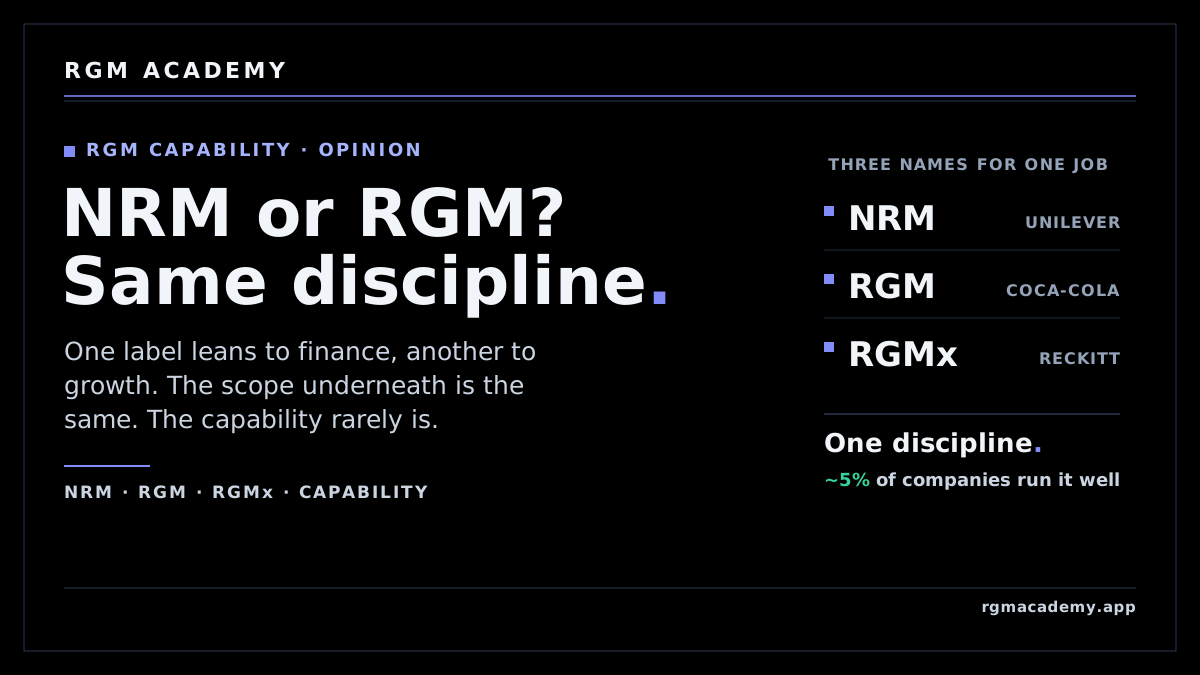
- Net Revenue Management (NRM), Revenue Growth Management (RGM), and RGMx are one discipline wearing three labels. Unilever says NRM, Coca-Cola says RGM, Reckitt brands its build RGMx. The lever set underneath is identical.
- The label is not a conceptual boundary. It is a reporting-line signature. NRM usually means the function sits close to finance and the gross-to-net line. RGM usually means it sits close to the commercial growth agenda. The work is the same either way.
- The fight over which word is correct is a distraction. The real divide is between the roughly 5 percent of consumer-goods companies that run the discipline well and the 95 percent that run a labelled programme.5
- About 75 percent of RGM programmes do not grow profit for both the retailer and the manufacturer, and more than 80 percent of consumer-goods chief executives are dissatisfied with their results.67 The gap is the story, not the vocabulary.
- Three markers separate a real capability from a branded one: a single integrated fact base on one cadence, a team that carries its own profit and loss, and decision infrastructure fast enough to act on within the week.
- The Monday read: stop arguing the label. Score yourself on the three markers, fix the reporting line and the profit ownership before you buy the tool, and let the name follow the capability.
The label names a reporting line, not a discipline
Walk into three consumer-goods companies, ask who looks after pricing, promotions, pack sizes, and trade money, and you get three different names for the same job. At Unilever it is Net Revenue Management. The 2024 annual report credits Europe's performance to a "disciplined approach to net revenue management", paired with a push to cut product lines and simplify recipes.1 At Coca-Cola it is Revenue Growth Management. The company says it "continues to exemplify leadership in revenue growth management by offering relevant global and local brands in a variety of packages at the right price points."2 At Reckitt it has a product name, RGMx, the AI-enabled tool suite built with McKinsey and rolled out across its markets since 2021.3
Three labels, one job
Net Revenue Management, Revenue Growth Management, and RGMx sound like three disciplines and are really one. Each is the management of the same commercial levers: the gross-to-net waterfall, trade terms, strategic pricing, trade promotion, pack-price architecture, mix and portfolio, and customer planning. NRM is the name finance tends to use, RGM the name the commercial side tends to use, and RGMx a branded software build. The scope underneath does not change with the label. What changes is which function holds the pen, which is why the name is worth reading as an org chart rather than a definition.
Practitioners spend real energy arguing which of these is the correct term. It is the wrong fight. Put the lever sets side by side and they match: the gross-to-net waterfall, trade terms, strategic pricing, trade promotion, pack-price architecture, mix and portfolio, and customer planning. Every one of those sits inside all three labels. BCG's 2025 work on volume-led growth does not even bother with the distinction. It uses RGM as the single umbrella term across every lever and never treats NRM as a separate category.4
The debate survives because it is really a turf question dressed as a definitional one. Whoever gets to name the function usually gets to run it. So if the scope is identical, the useful question is not which label is right. It is what the label quietly tells you about the company that chose it.
What the evidence actually shows
It tells you very little about the discipline and quite a lot about the company.
Start with the number that matters more than any label. Bain's read of the sector is that only about 5 percent of consumer-goods companies are getting future-proofed RGM right.5 The same body of work finds that around 75 percent of RGM programmes do not generate positive profit growth for both the retailer and the manufacturer,6 and that more than 80 percent of the chief executives Bain has spoken to are dissatisfied with their RGM results.7 Read those three figures together and the NRM-versus-RGM debate looks like what it is: an argument about the name on the door of a room that, four times out of five, is not delivering.
Why three Bain numbers settle the argument
Read on their own, each figure is just a statistic. Read together, they end the NRM-versus-RGM debate. Only about 5 percent of consumer-goods companies are judged to get RGM right. About 75 percent of programmes do not grow profit for both the retailer and the manufacturer. More than 80 percent of the chief executives Bain has spoken to are dissatisfied with their results. Line those up and the picture is plain: four times out of five the room is not delivering, whatever name is on its door. So arguing about the right three letters is arguing about the cheapest part of the whole exercise. The expensive part is the capability the letters are supposed to stand for.
The interesting line is not between two disciplines. It is between the small group that has built a real capability and the large group that has rebranded a planning cycle. Unilever's recent numbers hint at what the first group looks like from the outside: underlying sales up 3.0 percent in the first quarter of 2025, with growth coming from both volume and price rather than from price alone.8 That is a portfolio being steered, not simply repriced. For most companies, the label is doing public-relations work the capability has not earned.
The wiring sets the emphasis, not the scope
The label is still worth reading. Just read it as an org chart, not a glossary.
The word a company picks usually tracks where the function reports and who holds the pen. "Net revenue management" leans toward finance. It puts the gross-to-net line at the centre, treats trade money as a cost to control, and measures success in net realised price and margin recovered. You can hear it in Unilever's own framing, which pairs net revenue management with cutting product lines and recipe complexity, the language of a margin and mix agenda.1 "Revenue growth management" leans toward the commercial and marketing side. It puts the shopper and the pack at the centre, treats trade money as an investment to steer, and measures success in profitable volume and share. Coca-Cola's public version, the right brands in the right packages at the right price points, is a growth and availability story.2 RGMx is a third signal again: a company that has decided its binding constraint is data and tooling, and has gone out to buy it.3
None of those centres of gravity is wrong. Each is an answer to a fair question about who is best placed to make the call in that particular company. But the centre of gravity decides what gets prioritised, what gets cut first when budgets tighten, and which numbers the monthly review actually opens. Same scope, different emphasis, and the emphasis is what shows up in the results.
The retailer, for its part, does not care what you call any of it. When Carrefour judged PepsiCo's increases unacceptable in January 2024, it pulled Lay's, Quaker, Lipton, and Pepsi from its shelves across France, Belgium, Spain, and Italy, with signs telling shoppers why.9 No label survives a delisting. On the day it lands, the capability either holds the relationship together or it does not.
The three markers that separate the real thing from the branded thing
If the label will not tell you whether a company can actually do this, what will? Three markers, and each is easier to check than any amount of strategy-deck vocabulary.
The first is an integrated view. One fact base, one version of the numbers, on one cadence that finance, sales, and marketing all work from. Most companies run three versions of the truth and hold a quarterly argument about which is right. A real capability keeps a single commercial picture and refreshes it often enough to act on.
The second is cross-functional authority. The team carries its own profit and loss and has the standing to overrule a brand manager protecting a promotion or a key-account manager protecting a customer. Analysis without authority produces excellent slides and very little change. The pen has to sit with the people who hold the integrated view.
The third is decision infrastructure. Not the platform everyone is buying, but the plumbing beneath it: a gross-to-net cube you can actually interrogate, refreshed monthly, and a promotion whose return you can read within a week rather than the following quarter. Speed is the tell. If it takes a month to learn whether last month's promotion worked, what you have is documentation, not management.
The three markers, as a test you can run
If the label will not tell you whether a company can really do this, three checks will, and they run in sequence. First, is there one fact base on one cadence that finance, sales, and marketing all work from? If there are three versions of the truth and a quarterly argument about which is right, stop here. Second, does the team carry its own profit and loss and have the standing to overrule a brand manager protecting a promotion? Analysis without authority produces excellent slides and very little change. Third, can it read a promotion's return within a week rather than the following quarter? If it takes a month to learn whether last month's promotion worked, what you have is documentation, not management. Plenty of companies clear one marker. A fair number clear two. Very few clear all three, and that is roughly the 5 percent.
Score a company against those three and the pattern is familiar. Plenty clear one. A fair number clear two. Very few clear all three, which is roughly what Bain's 5 percent is counting, whatever each of those companies happens to call the function.
What to do with this
Stop arguing the label. It is the cheapest part of the whole exercise and the part that changes nothing.
Do three things instead. Score yourself against the three markers and write down the one you fail. For most companies it is the second, authority, because the analysis is the easy part and the org redesign is the hard part. Fix the wiring before the toolset: decide where the function reports and give the team a profit and loss to own, because a platform handed to a group with no authority just produces confident noise faster. And let the name follow the capability rather than lead it. Call it NRM, call it RGM, call it whatever your chief executive will fund. The companies in the 5 percent did not get there by choosing the right three letters. They got there by building the thing the letters are supposed to stand for.
References
- Unilever's 2024 Annual Report credits Europe's performance to a "disciplined approach to net revenue management", alongside reducing product lines and recipe complexity. Unilever Annual Report on Form 20-F 2024 (US SEC). sec.gov
- "The Coca-Cola Company continues to exemplify leadership in revenue growth management by offering relevant global and local brands in a variety of packages at the right price points." The Coca-Cola Company, fourth-quarter and full-year 2024 results, February 2025. investors.coca-colacompany.com
- Reckitt's RGMx, an AI-enabled revenue-growth-management tool suite designed and deployed with McKinsey, rolled out across its markets from 2021. McKinsey & Company. mckinsey.com
- BCG's 2025 publication on volume-led growth uses "revenue growth management" as the single umbrella term across pricing, promotion, assortment, and trade investment, without treating net revenue management as a separate category. Boston Consulting Group, 2025. bcg.com
- "Only 5% of CPGs are getting future-proofed RGM right." Bain & Company, Revenue Growth Management practice. bain.com
- "About 75% of RGM programs do not generate positive profit growth for both the retailer and the manufacturer." Bain & Company. bain.com
- "More than 80% of the CP chief executives we've spoken to are dissatisfied with their RGM results." Bain & Company. bain.com
- "Underlying sales growth in Q1 2025 was 3.0%, driven by both volume and price." Unilever Q1 2025 Trading Statement, April 2025. investegate.co.uk
- Carrefour stopped selling PepsiCo products, including Lay's, Quaker, Lipton, and Pepsi, across France, Belgium, Spain, and Italy in January 2024, citing "unacceptable price increases." CNBC, 5 January 2024. cnbc.com
Keep going
Pair this with the pieces and lessons that build the capability the label is supposed to stand for.
More from the blog
What Is RGM? The six-lever map every one of these labels is really pointing at, for readers who want the territory before the turf war.
The Great RGM Reset. Why capability, not vocabulary, decides who wins as the industry shifts from price-led to volume-led growth.
Why CPG Promotions Destroy Value. The decision-infrastructure marker in action: how to tell real promotional lift from volume you would have sold anyway.