Dear Agent: A Brand's Guide to Selling to Software
Agentic commerce puts an AI agent between you and the shopper, and your human playbook breaks.
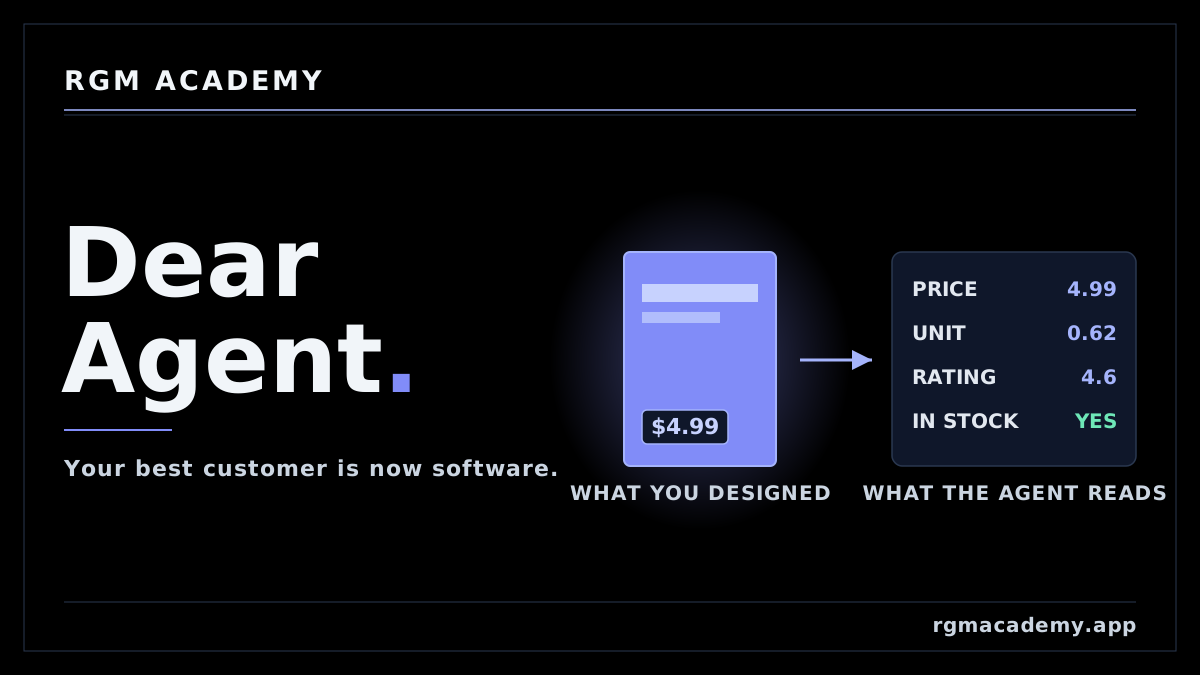
Dear Agent: we have not met, but you have already shopped my category. You skipped the packaging we spent two years perfecting and felt nothing when our price ended in a 9. You read the number, checked it against a dozen rivals in about a second, and moved on. You were only doing your job. The awkward part, for those of us who sell things, is that your job is rewriting mine.
The short version
- The shopper who sends a software proxy is your fastest-growing kind. Traffic to US retail sites from AI tools grew 393 percent year over year in early 2026, and those visitors flipped from converting 38 percent worse than an ordinary shopper to 42 percent better inside a year.1
- An agent buys on cold facts, so the levers built for a human break one by one: charm pricing and urgency stop working, a promotion hidden in a banner is invisible, pack design loses its voice, and loyalty turns into a database rule rather than a feeling.
- The money moves to whoever the agent can read and trust, which favours the payment networks and the platforms that own the checkout, and leaves retail media income exposed.
- It is still small, a low single-digit share of digital sales, only 14 percent of people trust an agent to place an order, and just 6 of 27 large European consumer firms can show a profit impact yet.1415
- My position, held at about seven in ten: do not chase full autonomy and do not wait it out. The readiness work, clean data and machine-readable offers and clear pricing, already pays off in your ordinary online business, so make your products legible to machines now and keep humans where being human is the product.
Has your fastest-growing shopper already arrived?
Start with the thing that is easy to wave away and hard to unsee. Traffic to US retail sites from generative-AI tools like ChatGPT, Gemini and Perplexity grew 393 percent year over year in the first quarter of 2026.1 A big percentage off a small base is a parlour trick, so the figure that matters is quality: a shopper arriving from an AI tool converted about 38 percent worse than an ordinary visitor in March 2025, and about 42 percent better a year later.1 The traffic did not only grow, it matured, crossing from frustrating to useful inside twelve months.
You can see it in named places. Amazon says its assistant Rufus helped drive close to 12 billion dollars of incremental annualised sales, with monthly users up 115 percent year over year,2 and Bain finds that around 44 percent of US online shoppers now mostly begin a purchase inside a large language model or split their search with one.3 The machine that consumer goods built around human attention, emotion and impulse now works for software that has none of those things and reads structured data instead, and every lever we pull assumes a person is on the other end.
What is agentic commerce, and what are AEO and GEO?
Agentic commerce is shopping done by an AI agent for a person: it searches, compares, and at the far end can buy, inside limits the shopper sets, running on large language models like ChatGPT and Gemini. Two disciplines come with it. Answer Engine Optimization, or AEO, is making sure an agent can find and correctly read your product facts, the way Search Engine Optimization once did for Google. Generative Engine Optimization, or GEO, is making sure the model treats your content as a trusted source when it explains a category.
Why do your pricing and promotion tricks die on contact with a machine?
Pricing is where the loss is sharpest. Almost everything we call pricing psychology is a trigger for human bias: the price ending in 99, the premium anchored next to a decoy, the urgency banner, the theatre of a "was" price beside an "is" price. An agent reads none of it as theatre. It reads 4.99 as 4.99, sets it beside the alternatives, and applies the rule its owner gave it. Shrinkflation gets harder too, because an agent compares price per unit by default and surfaces the shrink you hoped to hide.
The people building the plumbing are blunt. As one pricing-software team put it, "incentives are moving from visual stickers on a page to variables in an API call."4 An API, the application programming interface, is just the doorway one piece of software uses to talk to another, and a promotion that lives as a hero image is invisible through it. To reach an agent, the mechanic has to be exposed as machine-readable logic, with explicit eligibility, thresholds and stacking rules. Google and Shopify used the National Retail Federation show in January 2026 to launch the Universal Commerce Protocol for exactly this exchange, with Etsy, Wayfair, Target and Walmart among the backers.5 Money spent on display-only mechanics returns nothing once the buyer is software.
There is a profit sting where margins are thin: an agent that compares a dozen retailers in seconds routes each line to whoever is cheapest at that second, and a weekly price file is no match for it.
The basket, fragmented: a worked example
Picture an online grocery basket of 100 dollars, ten items at 10 each, on a 4 percent net margin, so the whole trip earns the retailer 4.00. Now an agent quietly moves the two cheapest staples to a rival that is a shade cheaper on them. Those two lines were 20 dollars of the basket and 80 cents of the profit (20 times 0.04). Lose them and you have given up a fifth of the basket and a fifth of the profit, with no fat anywhere else to absorb it. The numbers are illustrative, but they reconcile.
The deeper point is that an agent shops line by line, indifferent to the cross-subsidy a grocery basket leans on, where a few thin staples pull the shopper in and the rest of the basket pays for them, so persuading a shopper to choose you no longer means you keep the trip.
Can an agent even see what makes you different?
If an agent does the shopping, what is the pack for? Pack design is tuned for the human eye, the colour and the front-of-pack claim and the way it shouts from a shelf, while an agent reads attributes instead: dimensions, count, price per unit, certifications. McKinsey and QuantumBlack warn that products "emotionally legible to people but semantically opaque to machines risk becoming invisible in agent-mediated flows."6 Adobe found that US retail product pages are on average only about 66 percent machine-readable, so put two near-identical products side by side, one with complete structured attributes and one with its specifications buried in marketing copy, and the agent ranks the legible one regardless of which a human would have reached for.1 Loyalty goes the same way, because a points dashboard means nothing unless its logic is exposed as data the agent can query, so as the same researchers say, "loyalty becomes less about sentiment and more about policy."6
Brand equity does not carry over on its own either. When it assembles a recommendation, an agent leans on review counts, ratings and whatever the model treats as authoritative. Bain analysed around 500 million AI citations with the search-data firm ScrunchAI and found that 89 percent of unbranded shopping prompts, the "best cheap running shoe" questions, are answered from third-party sources rather than the brand's own pages.3 Nine times out of ten, in the moment a category is decided, the brand is absent from the answer. That reshapes brand building rather than ending it: the currency becomes category fame and earned presence in the places the model trusts, which is why Bain's phrase lands hard for anyone who grew up on the thirty-second film, that "metadata is becoming the new advertising asset."7 The oldest finding in our field is that a brand grows more by being easy to buy than by being well loved, and an agent pushes that to its limit, since it has no affection for any brand to begin with.
So who actually gets paid in the new shop?
A shift this big reshuffles who captures the money. McKinsey and QuantumBlack size the value flowing through agentic commerce at 3 trillion to 5 trillion dollars by 2030, with up to 1 trillion in the US, though like all four-year forecasts it is conditional.8 They call it orchestrated revenue, the total value an agent helps arrange rather than the slice any one player keeps, so treat it as the size of the river rather than anyone's bucket.
The best-positioned players are the payment networks. Visa's Intelligent Commerce and Mastercard's Agent Pay have both shipped rails built to tell a trusted, authorised agent from a bad actor, with a tokenised card credential under the purchase,910 so while everyone upstream argues about standards, the networks collect a fee on the transaction no matter who wins the discovery fight. The platforms are circling the same prize and the early scramble has been uneven: OpenAI launched Instant Checkout inside ChatGPT in September 2025 and had reworked it by March 2026 after high-intent browsing did not convert, while Walmart kept its own checkout and customer data and plugged its assistant into ChatGPT and Gemini instead, a model worth copying: it keeps the valuable parts in-house and rents only the reach.11
Then there is the line nobody on the retail media team wants to raise. US retail media search advertising was heading for nearly 38 billion dollars in 2025, and a good agent ignores a paid placement that does not fit the request, whatever the budget behind it.12 Gartner predicted back in 2024 that traditional search volume would fall about 25 percent by 2026 as chatbots absorb queries,13 so a fast-growing, high-margin line starts to look a good deal less reliable.
Where should you let the robot drive, and where do you keep your hands on the wheel?
The strategy needs a dose of cold water first. By any measure, agentic commerce is still small, a low single-digit share of digital sales, and the trust underneath is thinner still: a YouGov survey found only 14 percent of Americans would let an AI place an order for them, though 65 percent happily let it compare prices.14 The corporate scoreboard is humbler again, with only 6 of 27 large European consumer firms in a McKinsey and QuantumBlack survey able to point to a profit impact of 1 percent or more, and over half saying it was too early to tell.15 The digital chief at ADEO, the group behind Leroy Merlin, warns that full automation would remove the chance to cross-sell or upsell and leave a retailer a delivery company competing on price alone.16
So why not wait it out? Because the slope is steep and the quality already turned, which is what the conversion reversal is telling you. A small reality is compounding fast, and the work to be ready takes longer than most roadmaps assume.
Put the two together and a posture falls out. Decide, category by category, where the value to your shopper is pure efficiency and let the agent drive there while making sure it can read and trust you; where the value is the human experience itself, keep your hands on the wheel. A roll of bin bags should be effortless for an agent to reorder, while a kitchen renovation should never become a price-matched line item. IKEA's chief digital officer frames the open question as whether the sale ends up captured on the agent's platform or redirected back to your own shop,17 which is why the retailers with leverage are building their own agents rather than handing the customer over.
The readiness work pays for itself either way. Audit your catalog for machine-readability first, since about a third of it is invisible to an AI today, then expose your promotions as logic rather than pictures and move brand money toward earned presence and accurate third-party data. Choose your posture on purpose, building your own agent where you have the scale, participating through the platforms where you do not, and protecting the human-led categories. The returns banked so far sit in operations rather than autonomous shopping: IKEA already ties around 1.3 billion euros a year to its AI-assisted service channel.17
The pushback I expect. It is 2 percent, you are overreacting, call me when it is 20. I take that seriously and still think it misreads the number, because the cost of being ready is mostly catalog hygiene and clear pricing, work that pays for itself today whether the agents arrive or not, and it has a long lead time while the traffic quality has already turned. By the time it is obviously 20 percent, the brands legible to machines will have banked two or three years of advantage you cannot buy back in a quarter. I would change my mind if trust never crossed the line and shoppers kept agents on comparison while refusing, durably, to let them buy, so the slope itself is what I am watching. The real danger is the slow one, waking up late to find that being unreadable to the machines now doing the shopping has become the most expensive gap on your page.
References
- Adobe, analysis of US retail traffic from generative-AI sources, April 2026: AI referrals up 393 percent year over year in Q1 2026; AI-referred visitors converted about 38 percent worse than non-AI traffic in March 2025 and about 42 percent better by March 2026; individual product pages averaged 66 percent machine-readability. business.adobe.com
- Amazon, reported via Modern Retail, April 2026: Rufus drove close to 12 billion dollars of incremental annualised sales (an Amazon disclosure at its February 2026 earnings) and monthly active users were up 115 percent year over year. modernretail.co
- Bain and Company, "Your Next Customer Will Find You Using AI", April 2026, drawing on a US survey (n=1,500, September 2025) and about 500 million citations of ScrunchAI search data: roughly 44 percent of online buyers mostly start in a large language model or split their search, and 89 percent of unbranded prompts are answered from third-party sources. bain.com
- Voucherify, "Agentic commerce: optimize incentives for AI agents", March 2026: "Incentives are moving from visual stickers on a page to variables in an API call." voucherify.io
- Universal Commerce Protocol, co-developed by Google and Shopify and announced at the National Retail Federation show, January 2026, with Etsy, Wayfair, Target, Walmart and others among launch backers. techcrunch.com
- McKinsey and QuantumBlack, "The Automation Curve in Agentic Commerce", January 2026: products "emotionally legible to people but semantically opaque to machines"; "loyalty becomes less about sentiment and more about policy"; the automation curve and optimal delegation. mckinsey.com
- Bain and Company, "Agentic AI in Retail: How Autonomous Shopping Is Redefining the Customer Journey", May 2026: "Metadata is becoming the new advertising asset", and the commoditization finding for unbranded category queries. bain.com
- McKinsey and QuantumBlack, "The Agentic Commerce Opportunity", October 2025: 3 trillion to 5 trillion dollars of orchestrated revenue globally by 2030, with up to 1 trillion in the US (a conditional forecast). mckinsey.com
- Visa, "Intelligent Commerce", 2026: rails letting merchants accept agent-initiated payments and verify agent identity. investor.visa.com
- Mastercard, "Agent Pay", April 2025: agentic payment technology with merchant interfaces "to distinguish trusted agents from bad actors". mastercard.com
- CNBC, March 2026: OpenAI launched Instant Checkout in September 2025 and reworked its ChatGPT shopping approach by March 2026; Walmart embedded its own assistant in ChatGPT and Gemini while keeping its checkout and customer data. cnbc.com, cnbc.com
- Digiday, citing eMarketer, 2026: US retail media search advertising was heading for nearly 38 billion dollars in 2025, with search about 60 percent of retail media spend. digiday.com
- Gartner, press release, February 2024: a prediction that traditional search engine volume will drop 25 percent by 2026 as AI chatbots and other virtual agents absorb queries. gartner.com
- YouGov, US consumer sentiment on AI in retail, published January 2026: about 65 percent trust AI to compare prices, but only 14 percent trust it to place orders on their behalf. yougov.com
- McKinsey and QuantumBlack, "The AI Paradox in Europe's Consumer Industries", 2026: a survey of 27 European consumer-industry executives found only 6 of 27 reporting a profit impact of 1 percent or more, with over half saying it was too early to tell. mckinsey.com
- McKinsey, "Building the AI advantage: how ADEO is preparing for retail's next wave", 2026: Matthieu Grymonprez, group digital chief at ADEO (the group behind Leroy Merlin), on the risk that full automation turns a retailer into a delivery company competing on price. mckinsey.com
- McKinsey, "Elevating the customer experience: IKEA's agentic AI journey", June 2026: Parag Parekh, chief digital officer of Ingka Group, on whether commerce gets captured on the agent platform or redirected to the brand, and about 1.3 billion euros a year tied to the AI-assisted service channel. mckinsey.com
Keep going
Pair this with the decision guide and the lessons that drill the moves behind it.
Playbook
Match a competitor's price, or hold? An agent that checks a dozen rivals a second turns price-matching from an occasional decision into a constant one. This guide walks when to follow a cut and when holding is the better call.
More from the blog
Retail media networks. The high-margin income line most exposed to agents, and why so much of it is trade spend wearing a media badge.
Shrinkflation versus price rises. Why taking cost out of the pack gets harder when an agent compares price per unit by default.
Why one percent of price beats five of volume. The margin arithmetic behind basket fragmentation, and why thin-margin lines have no cushion to lose.