How Brands Really Grow: Easy to Buy, Not Easy to Love
Growth comes from more buyers, not deeper loyalty, and most marketing targets the wrong people.
Every planning round brings the same instinct back: deepen the relationship, reward the regulars, build the loyalty. It feels right, and the dashboard seems to agree. In most categories, though, it points your money at the wrong people.
The short version
- Growing brands almost all grow the same way: by adding buyers. About 80 percent of growing brands worldwide widen their buyer base, and across hundreds of categories how many people buy you tracks revenue while how often they buy barely moves.12
- Loyalty is mostly market share in disguise. Bigger brands look more loyal because they have more buyers, not the other way round, so in an everyday category loyalty largely follows from size rather than driving it.3
- Yet brand owners now put about half their marketing money into loyalty and customer relationship management, almost all of it aimed at the buyers they already have.4
- It comes down mostly to what you can measure. Loyalty hands you a clean number to report, while reach pays back slowly and is hard to attribute, so the dashboard wins the budget.
- What loyalty spend buys is far less than the business case claims, because your best customers were always going to join. Correct for that and most of the lift disappears.6
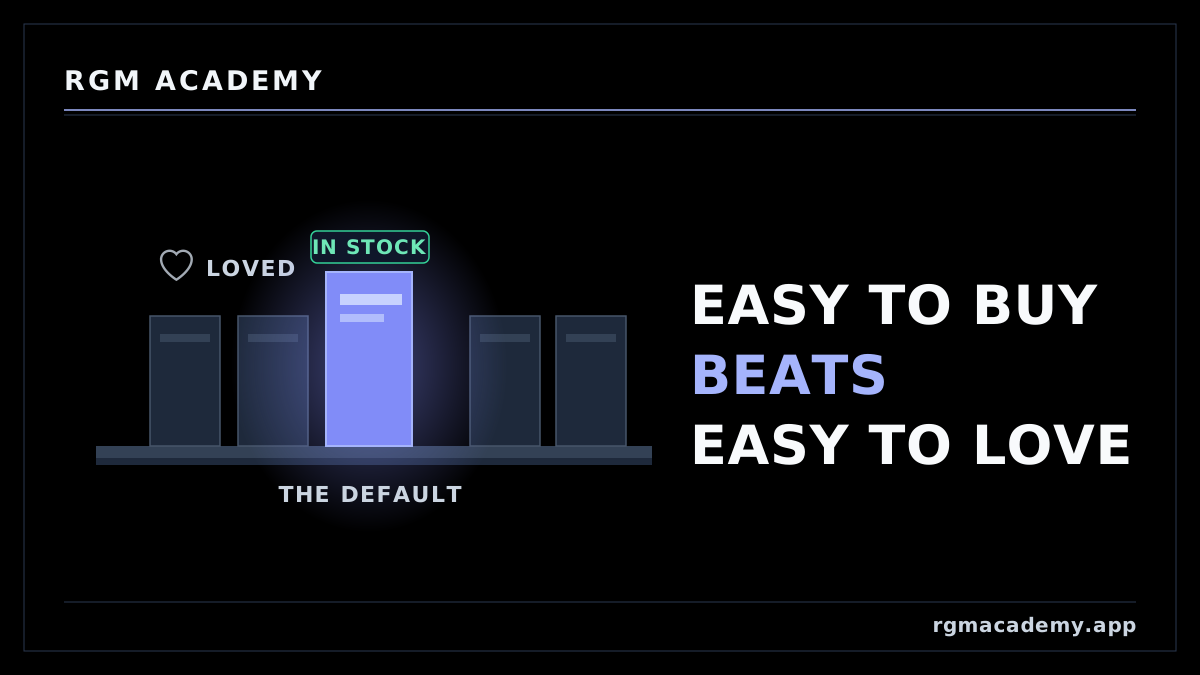
- My position: being easy to buy beats being easy to love, so the work is fixing your availability rather than deepening devotion. Loyalty still earns its place in a few real cases, and a good operator knows which of them they are in.
Why do growing brands almost always grow the same way?
The most reliable finding in marketing is also the one most likely to be ignored in your next planning round. A brand sells more in only two ways: more people buy it (penetration), or its existing buyers buy more often (frequency). Almost all real growth comes from the first. When Kantar tracked which brands grew across more than a decade of global shopper data, about 80 percent of those that expanded did it by adding buyers, not by lifting frequency, and in Asia the figure was 88 percent.1 The Ehrenberg-Bass Institute found the same across hundreds of categories: how many people buy you tracks revenue almost perfectly, while how often they buy barely moves.2 Almost all of the movement is in penetration, while frequency stays remarkably flat.
This wrecks the loyalty story. Loyalty, a pattern established so often it is treated as a law, is mostly a by-product of size. Bigger brands have more buyers and, because of that, slightly more loyal ones too. The effect has a name, double jeopardy, and it punishes a small brand twice: fewer buyers, each a little less devoted.3 The causation runs one way: brands do not grow because people love them, they pick up a little extra loyalty once they are already big. So in an everyday category, working on loyalty mostly polishes a number that reflects your size without doing much to change it.
One scope note, since this is where the argument is most misread: I mean consumer-goods brand owners, the people who make the things on the shelf. Retailer loyalty cards and platform subscriptions run on different economics, which I will come back to.
If loyalty is such a weak lever, why is most of your money chasing it?
Look at where the money goes. In a 2026 survey of three thousand marketers, brand owners reported putting about 51 percent of total marketing budget into loyalty and customer relationship management.4 Retail media, the advertising you buy from retailers, has climbed toward a fifth of some consumer-goods budgets and runs on first-party data, so it too concentrates on people already in the category.5 The half of the budget that reaches new buyers has been shrinking for a decade.
Why, when the evidence points the other way? Because loyalty and targeting are measurable and reach is not. You can draw a clean line from a loyalty email to a sale; a broad campaign that nudges people who have never bought you pays back slowly and resists attribution. Faced with a finance director who wants a number this quarter, the manager spends where the number is easy. So the pull toward loyalty is driven by what is simple to measure, even when the evidence on what actually grows a brand points elsewhere.
Mental and physical availability
Two simple ideas explain most of growth. Mental availability is how easily your brand comes to mind in a buying moment, built from distinctive assets, the colour, the logo, the jingle you own, and from being linked to the little cues that trigger a purchase, like "quick midweek dinner" or "something for the kids". Physical availability is how easy you are to actually find and buy: in distribution, on the shelf, at eye level, in stock. Get both of these high and you are easy to buy, and neither of them has much to do with love.
What are you actually buying when you buy loyalty?
One number should reset every loyalty business case. When researchers studied grocery loyalty programmes, members looked far more valuable than non-members, handing the retailer a much larger share of their spend. Run that through a spreadsheet and any programme looks like a triumph. Then they corrected for the obvious problem, that your heaviest, most loyal shoppers are the ones who sign up first. Once they did, the real effect was about seven times smaller than the raw gap. Roughly 86 percent of the apparent advantage came from your heaviest shoppers signing up, people who were already loyal before the card existed, so the programme mostly captured loyalty that was already there.6
To be fair, the evidence is not one study. A meta-analysis of more than four hundred findings concludes that programmes do help, conditionally, with the clearest gains from nudging light buyers into buying a little more often,7 which is close to the work of adding buyers in the first place. The trouble is the business case that promises a 30-point lift from a scheme that mostly signs up the people who were never going to leave.
The figures below are illustrative; only the correction is sourced. A programme with a million members might look to add about 58 a member in extra spend, so 58 million in "extra" sales against, say, a 6 million cost, a return of about ten to one on paper. Once you apply the correction, the real effect is about seven times smaller, nearer 8 a member, or 8 million, against the same 6 million plus the margin you hand back in points. The apparent ten-to-one winner is barely breaking even, and what value it holds sits in the data more than in any loyalty.
Why does being easy to buy beat being easy to love?
The cleanest proof comes from outside grocery. In 2022 Google paid Apple around 20 billion dollars in a single year to be the search engine already selected in Apple's browser, whether or not anyone actively preferred it.8 When a court examined the deal in 2024 it found the default decisive, for a reason buried in Google's own research: when users were quietly switched to a rival, about half did not even notice.8 Most people do not go out of their way to pick what they like best, they take what is already in front of them.
The shelf works the same way. Eye level is the default, the first result in the app is the default, being in stock when the shopper is standing there is the default. This is physical availability, and it does an outsized share of the work, reinforced by advertising rather than replaced by it.9 Circana's 2025 read of US consumer-goods growth named distribution expansion, ahead of pricing, as a key lever separating the winners from the rest.10 Mental availability is the other half: brands "meaningfully different to more people", in Kantar's phrase, command up to five times the penetration of brands that are not.11 What wins is being the easy answer when a half-attentive shopper reaches for something, which owes far more to availability than to affection.
The targeting trap
Efficiency is the one good word on the loyalty-tech side. Why pay to reach a hundred people when ninety will never buy you, so you back only the ten who might? It sounds unarguable, which is why it keeps strangling growth. At the 2025 conference of the body that holds the largest database of marketing effectiveness, budget size explained about 89 percent of the variation in long-term profit payback, and efficiency only about 11 percent.12 Yet 56 percent of marketers were narrowing onto sub-segments and 62 percent had stopped targeting the over-45s, a path the researchers called a "death spiral".12 The classic 60/40 split of brand building to activation has drifted the other way, and rebalancing back toward brand can lift revenue return by between 25 and 100 percent.13 The answer is to reach the whole category intelligently, light buyers and non-buyers included, rather than narrowing onto the handful you can already identify.
So when is loyalty actually the right game?
If I argued only one side I would be doing what I just criticised. Retention is genuinely the main event in four cases. In subscription or direct-to-consumer, where the customer pays every month, keeping them is the business, and lifetime value against acquisition cost is the right maths. In a mature category almost everyone already buys, the runway for new buyers is short, so the lever shifts to trading people up and improving mix. In an identity or prestige category, the product carries real meaning and real switching costs, a devotion an everyday biscuit will never command. And there is the defensive case: across 27 countries, the benefit of a programme all but vanishes where almost every rival runs one, so you may have to run yours just to stop losing share.14 That makes it a cost of staying in the game rather than a source of growth, and it should be budgeted as such.
Which game are you in?
Four quick questions. Is your category one people buy from a repertoire of brands, or one they subscribe to and stay? Is there a long runway of people who do not buy you yet, or are you near the ceiling of category buyers? Is the purchase routine and low-attention, or wrapped in identity and meaning? And are you the only one with a programme, or is everyone running one? If the category is a repertoire, has a long runway of non-buyers, and is bought on autopilot, the answer is availability. If people subscribe and stay, almost everyone already buys, the product carries real identity, or you alone lack a programme, retention earns its keep.
The clearest proof comes from the brands that tried hardest to be loved. The celebrated direct-to-consumer names of the last decade were built on devotion, and almost all hit the same wall. Warby Parker, which began online-only, took about 70 percent of its revenue through physical stores in the third quarter of 2024, the channel it once swore it would never open.15 Glossier, which defined online-native beauty, broke out when it walked into Sephora in 2023.16 Dollar Shave Club, the subscription that became a loyalty case study, was sold off by its parent, which framed the exit as stepping back to its core.17 Those brands earned real affection, and it still did not spare them from having to become far easier to buy.
Is this just "spend more on advertising"?
No. The argument is not "advertise more", it is "stop pointing your money at the people you already have". You can act on it without an extra pound: move budget from retargeting your base to reaching the category, and from chasing love to fixing availability, the distribution gaps, the out-of-stocks, the distinctive assets you have let fade. Being easy to buy is mostly about where you point the budget rather than how big it is.
The pushback I expect. "Our heavy buyers are most of our revenue, so how can loyalty not matter?" They are, but they were heavy before the programme enrolled them, so keeping them matters while crediting the scheme with creating them is the error. "The studies show loyalty programmes work." Conditionally, mostly by nudging light buyers into buying more often, which is closer to penetration; the trap is the 30-point lift projected from a scheme that signs up your most loyal buyers first. "Drop our programme and rivals take our share." Where everyone runs one, that is true, so treat it as a defensive cost and do not call it growth.
What would change my mind. If the brands that put the highest share of spend into loyalty and targeting grow their buyer base faster than those spending on reaching the category, I am wrong, and I will be watching.
The weight of the evidence has pointed one way for years, and your buyers are not sitting there waiting to love you more. Tens of millions of people simply find you a little too hard to think of, or too hard to find, and that is where your growth lives. Spend the next planning round making yourself easier to buy, and you will have the laws of growth on your side for once instead of fighting them.
References
- Kantar, Brand Footprint 2025: about 80 percent of brands that grew worldwide did so by adding buyers (penetration), rising to 88 percent in Asia. kantar.com
- Ehrenberg-Bass Institute, How Categories Grow (Dunn and others), Journal of Business Research, 2025: penetration tracks revenue while purchase frequency is comparatively stable. sciencedirect.com
- Byron Sharp, How Brands Grow, Oxford University Press, 2010: double jeopardy and the Pareto (roughly 60/20) law. global.oup.com
- Antavo, Global Customer Loyalty Report 2026: a self-reported survey of 3,000 marketers, who put about 51 percent of total marketing budget into loyalty and CRM. antavo.com
- eMarketer, retail media advertising forecast and trends, 2025: retail media climbing toward a fifth of some consumer-goods budgets, built on first-party data. emarketer.com
- Leenheer and others, the effect of loyalty programmes on share of wallet, International Journal of Research in Marketing, 2007: after correcting for self-selection, the effect is about seven times smaller than a naive estimate, so roughly 86 percent of the apparent advantage is selection. papers.ssrn.com
- Belli and others, a meta-analysis of loyalty programme effectiveness, Journal of the Academy of Marketing Science, 2022: programmes help conditionally, with the clearest gains from light and moderate buyers. link.springer.com
- United States v. Google, ruling of August 2024: the reported 20 billion dollar payment to Apple in 2022 to remain the default search engine, which the court found decisive; the ruling also cited a 2015 study in which almost half of users (12 of 26) did not notice when their iPhone search was secretly switched from Google to Bing. 9to5mac.com, techpolicy.press
- Michelon and others, Complex Convergence: The Interplay of Distribution and Advertising for Brand Growth, 2024: distribution and advertising reinforce each other, with distribution central to how brands grow. papers.ssrn.com
- Circana, 2025 US CPG Growth Leaders, April 2026: distribution expansion, rather than pricing alone, emerged as a key lever for growth. globenewswire.com
- Kantar, Blueprint for Brand Growth, 2024: brands "meaningfully different to more people" command up to five times the market penetration of brands that are not. kantar.com
- Les Binet and James Davis, "Go Big or Go Home", IPA Effectiveness Conference, 2025: budget size explains about 89 percent of profit payback, ROI efficiency about 11 percent; 56 percent target sub-segments and 62 percent neglect the over-45s; the targeting "death spiral". ipa.co.uk
- WARC, The Multiplier Effect, 2024, with Binet and Field's 60/40 benchmark: rebalancing from a performance-led split back toward brand building can lift revenue return by between 25 and 100 percent. warc.com
- Bombaij and Dekimpe, do loyalty programmes work across countries, 2020: the sales benefit fades where most competitors also run one, across 27 countries. loyaltyrewardco.com
- Retail Dive, Warby Parker Q3 2024 earnings, November 2024: co-CEO Dave Gilboa said the retail channel was about 70 percent of revenue in the quarter. retaildive.com
- Retail Dive, Glossier's first wholesale partnership with Sephora, launched February 2023 across more than 600 North American stores. retaildive.com
- Unilever, the sale of Dollar Shave Club to Nexus Capital Management, October 2023, seven years after the 2016 acquisition; the chief executive cited it among unsuccessful moves away from the core. unilever.com
Keep going
Pair this with the decision guide and the lessons that drill the moves behind it.
Playbook
Private label response: how brands defend share. Private label wins on physical availability, the retailer's own brand always in stock and in front of you. This guide walks how to defend penetration when the easiest thing to buy in the aisle is not yours.
More from the blog
The Great RGM Reset: From Price-Led to Volume-Led in 2026. The companion argument from the revenue side: why the next phase of growth is won on volume and buyers, not another price increase.
Private label hit 23% in the US and 50% in Europe. Three ways brands fight back. The same availability logic applied to the shelf fight that worries most brand owners.
Which RGM Lever to Pull First. Once you accept that easy to buy is an allocation decision, this is the decision tree for where the next pound should go.