50% off all plans.Ends 20 May 2026Claim 50% off
Back to blog
Pricing

Private label hit 23% in the US and 50% in Europe. Three ways brands are fighting back.

The first instinct is to cut price. The Heinz UK turnaround shows why that almost never works.

Bulent Kotan12 min read

Private label has stopped being a recession story and become a permanent one. In Europe's biggest six grocery markets, half of all units sold are now own-label. In the US the figure is roughly a quarter and rising. Inside almost every brand-owner planning conversation now, somebody has to decide what to do about it. Most reach for the move that almost never works. Here is the read on what does, with the Heinz UK 2024 turnaround as the receipt.

Private label is no longer a recession story

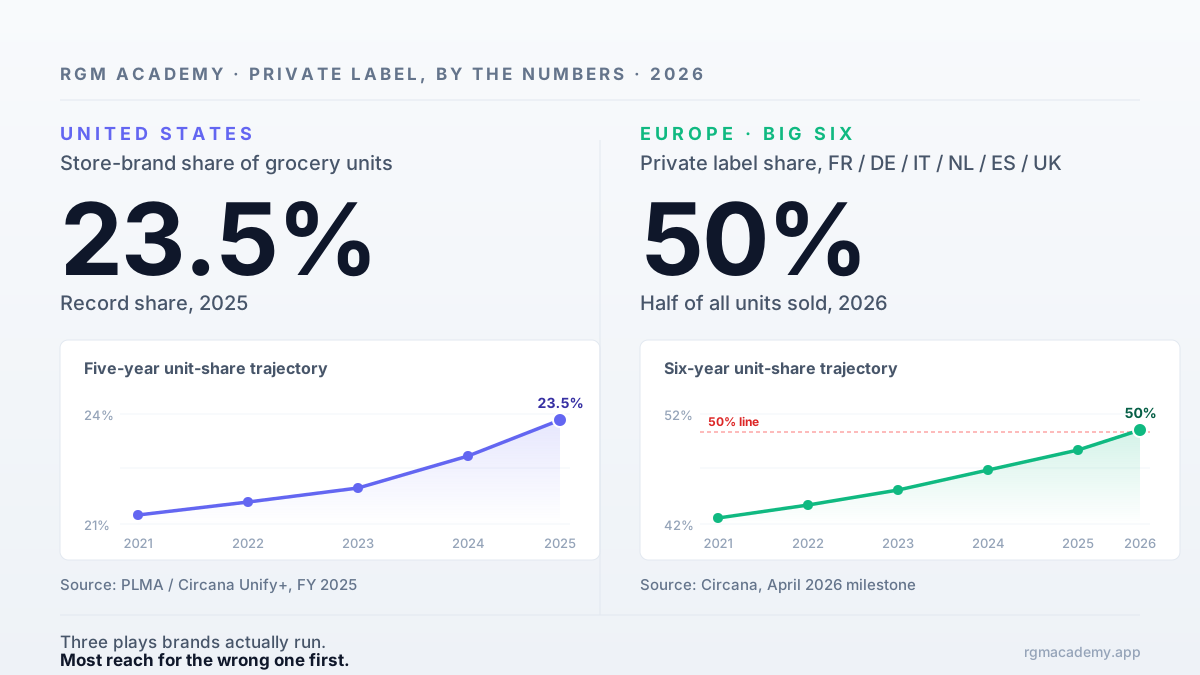
The shape of the data has shifted in the last 24 months. In April 2026, Circana confirmed that private label had crossed 50 percent unit share across France, Germany, Italy, the Netherlands, Spain, and the UK for the first time, with the share having risen every year since 2021.¹ At the same time in the US, the Private Label Manufacturers Association (PLMA), drawing on Circana Unify+ panel data, reported that store-brand dollar share had risen from 19.1 percent in 2021 to 21.3 percent in 2025, and unit share had reached a record 23.5 percent. Total US store-brand sales hit $282.8 billion across the year.² Across 17 European markets tracked by NielsenIQ, the value share of private label sat at 38.8 percent in the same window.³

These are not recession-cycle numbers. They are the new floor. The brand-owner planning conversation that used to start with "we will hold list price and wait for shoppers to come back" now starts with the question of which combination of moves to make before the next year's calendar locks.

Private label unit share, US vs Europe big six, 2021 to 2026 US: PLMA / Circana Unify+ FY 2021 to 2025. Europe: Circana big-six unit share, April 2026 milestone. 10% 20% 30% 40% 50% 60% Unit share of grocery 2021 2022 2023 2024 2025 2026 23.5% (2025) 50% line crossed, April 2026 United States (PLMA / Circana) Europe big six (Circana) Lines reflect verified data points at the endpoints (US 2021 to 2025, EU 2026 milestone). Intermediate years are interpolated for visual continuity, not point estimates.
Fig 1. The gap between the US and Europe is now permanent, not a passing phase. Europe's big six just crossed half of all units. The US is at a quarter and still rising.

So the question every brand owner is now planning around is not whether to respond, but how. There are three plays brands actually run when they face this. Most reach for the wrong one first.

The three plays

The first play is to hold the list price and reinvest in the brand. You refuse to chase the private-label price down. You hold or even widen the list-price gap. The protected margin funds advertising, innovation, and the shelf and trade conditions that build long-term equity. This is the Option A play, and it is the play most brand owners say they want to run but rarely do under quarterly pressure.

The second play is to defend specific price-pack combinations under the umbrella brand. You do not cut headline price across the portfolio. You make targeted moves on the entry-tier packs or occasion packs where own-label is hurting most, while your hero SKU and your premium tier hold their list price. This is Option B. The retailer sees this as you working with them, not against them, and the premium story on the parent brand stays intact.

The third play, the one most brand owners reach for first, is to launch a fighter brand or cut the parent's headline price. This is the play the published research keeps coming back to, and the pattern is clear and not pretty. Most fighter brands fail because they take more sales from the parent brand than they take from the own-label rival.⁴ The same math applies to a defensive price cut on the parent brand. The extra sales that come back from own-label are rarely worth the profit you give up on the sales that would have happened anyway at the higher price.

The three plays brands actually run against private label Two of them work. The third one is the most popular and the least successful. Option A Hold list price, reinvest in equity WORKS WHEN EQUITY IS REAL Refuse to chase the price down. The protected margin funds advertising and NPD. Strongest long-term margin defence of the three. Best when the perceived- quality gap is holding. Option B Selective price and pack under the umbrella WORKS ON THE EXPOSED EDGES Defend the entry tier or specific pack-occasion slots. Hero and upscale tier hold. Easier retailer conversation. Lower year-1 margin pinch. Best when the gap is closing on a sub-tier, not portfolio. Anti-pattern Fighter brand or parent headline price cut ALMOST ALWAYS FAILS Most fighter brands cannibalise the parent more than they hurt the PL rival. Headline price cut on the parent brand is the same trap in a different costume. First instinct, worst answer. The two cards on the left are the plays that defend share without burning the equity. The one on the right is the play most brand owners reach for first.
Fig 2. The decision is between A, B, and a blend of A with B. The fighter brand sits on the right because the cannibalisation math almost never proves out.

The reason Option C is the wrong default is best understood by looking at the cannibalisation math before any specific case. Three numbers decide whether a fighter brand or a defensive parent price cut will create or destroy value.

The math behind why the wrong answer is the wrong answer

Three numbers decide whether a fighter brand or a defensive price cut on the parent brand will create value or destroy it.

The first number is the share of the new fighter's sales that will come out of your own parent brand. The marketing word for this is the cannibalisation rate. The second is the share that will actually come from the own-label rival you were trying to fight. That is the part you genuinely defended. The third is the gap in profit per unit between your parent product and the fighter (or between the old higher price and the new cut price).

If more than half of the fighter's sales come out of the parent, and the profit per unit on the fighter is more than ten points lower than the parent, the fighter loses you money from day one. The same math kills a defensive price cut on the parent brand. The extra sales you win back from own-label are almost never worth the profit you give up on the sales you would have made anyway. In most categories where private label has reached the share levels in Figure 1, both numbers come back against the move.

When does a fighter brand or defensive price cut create value? Cannibalisation rate (parent volume taken) on the y-axis vs margin gap (parent minus fighter or pre-cut minus post-cut) on the x-axis. Loses money from day one High cannibalisation, narrow gap. Loses money from day one High cannibalisation, wide gap. Borderline Low cannibalisation, narrow gap. Worth running the math Low cannibalisation, wide gap. 50% 100% 0% Cannibalisation rate 0 pts 10 pts 25 pts Gross margin gap (parent minus fighter) Three of the four quadrants destroy value. Only one quadrant (low cannibalisation, wide margin gap) is worth running the full math on. Most real cases land in the upper half.
Fig 3. The fighter-brand decision lives in a 2x2 with three losing boxes. The Ritson research is consistent on which box most real cases sit in.

The point of looking at the numbers like this is simple. Before you greenlight a fighter brand or commit a defensive price cut on the parent, the evidence on cannibalisation has to be real. Not a hope. Not a hand-waving argument. A measured rate from panel data or a controlled in-store test. Without that evidence, the right default is to walk Option A or Option B. The Heinz UK case below shows what the right default looks like at scale.

Heinz UK 2022 to 2024: the worked example

In late June 2022, Tesco delisted Heinz Beanz, Tomato Soup, and Salad Cream from its shelves in a dispute over Kraft Heinz's proposed inflation-driven price rises.⁵ The story ran in every UK national paper for two weeks. The two parties reached a settlement and the products returned in early July, but the equity damage was already done.

Across 2022 and 2023, the slow-motion erosion played out at shelf. The price gap between Heinz Beanz 415 gram and Tesco own-brand 420 gram widened past a pound at the shelf as Heinz held list price into a category where own-label was quietly upgrading recipe quality. Heinz Beanz prices were up around 40 percent year-on-year by March 2023, on the back of inflation pass-through.⁶ Heinz UK volumes had been dropping at close to twenty percent year-on-year through the worst windows of 2023, as shoppers traded down to Tesco and Aldi own-label baked beans.⁷ Pre-tax profit fell sharply across 2023, dropping to £104.1 million from a higher base the year before, even as revenue rose to £967.1 million on the back of price.⁸

The seductive wrong answer at that moment would have been a portfolio-wide list-price cut to chase Tesco own-label down, or a fighter brand launched into the value tier. Heinz did neither.

The corrective programme that ran across 2023 was Option A blended with selective Option B. The "Unbeanlievable" creative campaign launched in February 2023.⁹ The "It Has To Be Heinz" global brand platform launched in June 2023, the first time Heinz had unified its brand messaging across all regions in over 150 years and the largest media investment in the brand's history.¹⁰ New product launches accelerated across the rest of 2023 and into 2024: Beans Bowlz, Beanz pizza, the Heinz with Cathedral City Cheesy Beanz collaboration in February 2024.¹¹ The Grocer reported in September 2025 that Kraft Heinz had "invested heavily in lowering prices since the second half of 2023" on selected entry-tier lines, the Option B selective price discipline running alongside the Option A equity programme.⁷

The numbers from calendar 2024 show what the response actually delivered. Revenue held at £952.7 million (down 1.5 percent year-on-year). Volumes declined just 0.3 percent, a major recovery from the near-twenty-percent declines in the prior years. Pre-tax profit nearly doubled to £191.9 million, up £87.8 million from £104.1 million in 2023.⁸ The volume defended within a percentage point. The profit recovered. And no fighter brand had been launched.

Heinz UK pre-tax profit, 2023 to 2024 (£m) No fighter brand. No portfolio-wide list-price cut. Equity reset plus selective entry-tier discipline. 0 50 100 150 200 Pre-tax profit (£m) £104.1m 2023 £191.9m 2024 +£87.8m year on year (profit nearly doubled) Volume: 2023: down ~20% 2024: down 0.3% Pre-tax profit data: Grocery Gazette, September 2025. Volume context: The Grocer, September 2025. The volume defence within a percentage point and the profit doubling came from the equity reset plus selective entry-tier discipline, not from a portfolio-wide price cut or a fighter-brand launch.
Fig 4. The Heinz UK 2024 turnaround. The brand defended without firing the wrong play.

The trade-off was real. Heinz absorbed roughly 18 to 24 months of share erosion before the equity programme started reading in tracker data and the volume stabilised. Some of the volume that went to Tesco and Aldi own-label across 2022 and 2023 did not all come back. The alternative path, a defensive list-price cut on the parent or a fighter-brand launch, would have hit the profit line harder and would have done less to slow the perceived-quality gap from closing.

Walmart Bettergoods 2024: a second teaching point

The Heinz case shows what the right play looks like when the threat is a value-tier own-label that has been quietly upgrading. The Walmart Bettergoods launch shows what the threat looks like when own-label moves up-market and starts to look and feel like a real brand. Marketing academics call this the brandification of private label. The Bettergoods launch is the cleanest case study of it.

On 30 April 2024, Walmart launched Bettergoods, the largest food private-brand launch in 20 years across its US store base.¹² The line debuted with 300 SKUs across three sub-tiers: Culinary Experiences (premium and globally inspired), Plant-Based, and Made Without (free-from products). Most items were priced under $5.¹² Within just over a year, Bettergoods had been purchased by 28 percent of US households.¹³

The surprising finding comes from Numerator's data on the ice cream category. Walmart's older private-label line, Great Value, and the new Bettergoods sit on the same shelves. You would expect a lot of shopper overlap between the two. Instead, Bettergoods buyers were almost 13 points less likely to also buy Great Value ice cream than the typical brand's shoppers (55 percent versus a 64 percent average).¹³ That is the opposite of what most retailers would predict from launching a second private-label line. Premium private label was not just moving shoppers between the retailer's own tiers. It was bringing in extra basket spend from shoppers who would not otherwise have bought private label at that price point.

That is what makes the premium private label trend a more dangerous long-term threat to brands than the old value-tier private label ever was. The retailer is no longer just competing for the budget shopper. The retailer is competing for the same well-off shopper your hero SKU is positioned for, with more new launches across the year, and bringing in basket spend that did not exist before.

Walmart's three-tier private-label architecture, 2024 Bettergoods (premium), Great Value (mainstream), opening-price (entry). Side-by-side on the same shelf. BETTERGOODS Premium private label 300 SKUs at launch 3 sub-tiers Most items under $5 28% household reach in year one (Numerator, 2025) GREAT VALUE Mainstream private label Walmart's anchor private-label tier Wide assortment Value-pricing focus NATIONAL BRANDS For comparison The shelf neighbour Bettergoods sits next to Per Numerator: typical brand's shoppers cross- shop Great Value at 64% in ice cream Counter-intuitive finding: Bettergoods ice cream buyers were 13 points LESS likely to also buy Great Value than the typical brand's shoppers (55% vs 64% average). Premium PL is finding incremental basket, not cannibalising the existing value tier.
Fig 5. Premium private label is the long-term threat. It gives the retailer more shots on goal, aimed at the same well-off shopper a national brand thought it had a lock on.

The 5-question rubric, compressed

The full decision rubric runs in the paired playbook. The short version, with the lesson behind each question, is below.

Q1. What is your revenue premium over the closest private-label SKU, and is it widening or narrowing over the last 24 months? Pull the last eight quarters of point-of-sale data on your hero SKU and the comparable own-label SKU. A premium above 1.4 holding flat means equity is doing the work and you have time. A premium that has dropped from above 1.4 to below 1.3 means the rest of the questions decide the response. The math behind this question is the same elasticity and revenue-premium math that underpins every list-price decision in the category.

Q2. Has the perceived-quality gap to private label held, or is the retailer closing it with a premium own-label tier? Pull the last four waves of brand-tracker data. A holding gap means the equity investment is paying. A narrowing gap is the early warning that the retailer's quality programme is winning. The launch of premium own-label tiers (Tesco Finest, Sainsbury's Taste the Difference, Aldi Specially Selected, Walmart Bettergoods) is the single fastest-moving variable in the category.

Q3. What are you doing during this down-cycle that you would not do in expansion? The single most reliable way to permanently lose share to private label is to cut brand advertising, innovation pipeline funding, premium-tier shelf investment, or sales-force coverage during a downturn. Brand-owner cuts made in the recession years almost always outlive the recession itself. Heinz had been holding price and cutting media spend across 2022 into early 2023 before the corrective programme. That is the textbook acceleration of permanent private-label gain, and the Heinz recovery only worked once the cuts were reversed.

Q4. Is your innovation cadence keeping pace with the retailer's own-label launch cadence in the same category? Premium private label has shifted retailers from running a single me-too product to running a full innovation pipeline. If the retailer is launching new own-label products at twice the rate you are launching brand new ones, the perceived-quality gap (Q2) will close on its own because the retailer simply has more shots on goal. The right play is to invest in your innovation pipeline and your pack architecture, not to wait for the next round of price reviews.

Q5. Before you launch a fighter brand or cut headline price, can you prove the cannibalisation will be lower than the own-label volume defended? Run the cannibalisation math from Figure 3. If more than half of the new sales come from your own parent brand, and the profit per unit is at least 10 points lower, the move loses you money from day one. This is the question that stops the most expensive wrong move from being committed.

The order of the five questions is not negotiable. Heinz fixed Q2 and Q3 before they ran the selective Q5 move. A defensive price move at Q5 on top of an unfixed Q2 and Q3 is the textbook way to permanently lose ground to own-label.

The Monday-morning move

Three things to do this week, before the next planning cycle locks.

Pull the rolling 24-month revenue premium on your hero SKU against the closest private-label SKU at your top three retailers. If the premium is holding above 1.4, your immediate problem is keeping it there. If it has slipped below 1.3, the rest of the rubric kicks in.

Audit the last 24 months of brand-investment spend, not just the trade-spend line. Above-the-line advertising, NPD pipeline funding, sales-force coverage on the top 30 stores, premium-tier shelf programmes. If any line has been cut more than 15 percent year-on-year, that is the first thing to restore. The defensive price moves layer on top of restored equity investment, not in place of it.

For any defensive price move or fighter-brand idea your team is considering, run the cannibalisation math before the resourcing conversation. The two numbers that decide it (the share of the new volume coming from your own parent, and the share coming from private label) are the gating evidence. If they are not measured, the answer is to default to Option A blended with selective Option B and re-walk the rubric in 12 months.

What you should not do is run a portfolio-wide list-price cut to chase own-label down, or commission a fighter-brand business case before the cannibalisation evidence is in. Those are the moves the Heinz UK case retired in 2023, and the Walmart Bettergoods data teaches you about from the retailer's side. Premium private label is a permanent change in how grocery competition works. The response that wins is faster innovation and a clear quality story, not a price chase.

Keep going:

  • Walk the full 5-question decision guide with a worked example → The paired playbook runs the same five questions as an interactive decision tree, with the full Heinz UK 2022 to 2024 walkthrough at each node and the Walmart Bettergoods sidebar.
  • The case for ending half your promotional plan → Companion article on what the protected margin should be reinvested into. If you are running Option A and you have not separated the kill list from the shrink list on your promo calendar, the equity reinvestment is leaking out the same hole the price cut would have.
  • Why on-invoice and off-invoice trade money behave differently in 2026 → The Option B selective price moves in this article run through the trade-money architecture covered here. Knowing where each dollar lands changes which selective moves are viable.
  • The 1% price lever, revisited → The mathematical backstop behind Option A. A 1 percent rise in price typically lifts operating profit by roughly nine percent. The same lever in reverse explains why a defensive price cut on the parent rarely pays back from private-label volume defended.

Take the ideas in this article further, inside RGM Academy's lessons:

  • Price Elasticity of Demand. The lesson behind Question 1 (revenue premium math). You walk a live elasticity simulation with an AI coach and learn how a 1 to 2 point premium translates into the volume defence you need to hold list price against an own-label competitor that is moving down. Why this matters here: the revenue premium is the single number that decides whether you have time on Option A or whether the rubric needs the rest of the questions immediately.Start the lesson

  • Price Tiers and Ladders. The lesson behind Question 2 (perceived-quality gap and the rise of premium own-label). Walks the architecture of a category's price tiers and shows what the introduction of a premium private-label tier (Tesco Finest, Walmart Bettergoods) does to the shape of the ladder. The same simulator is the one a category manager would use to model the response. → Start the lesson

  • Promo Calendar Optimization. The lesson behind Question 3 (down-cycle behaviour). Builds the event-by-event ranked promo calendar and surfaces where the brand-owner cuts that hurt long-term equity are typically hiding. The Heinz pattern of holding list price and cutting media spend is the canonical wrong move that this lesson trains you to spot. → Start the lesson

  • Promo ROI Fundamentals. The lesson behind Question 5 (cannibalisation math). Walks the full-accounting promo ROI calculation with an AI coach and decomposes the uplift into cannibalisation, forward-buying, competitor switching, and genuinely new shoppers. The cannibalisation rate is the single number that decides whether a defensive promotional move is destroying value before it ships. → Start the lesson

References

  1. Circana, "Private label has reached a 50% unit share across France, Germany, Italy, the Netherlands, Spain and the UK for the first time," reported in Retail Times, April 2026. https://retailtimes.co.uk/private-label-reaches-record-50-unit-share-across-europes-six-biggest-grocery-markets/
  2. Private Label Manufacturers Association (PLMA), "U.S. Private Label Industry Reached $282.8 Billion in Sales in 2025," press release citing Circana Unify+ FY 2025, January 20, 2026. https://www.plma.com/article/us-private-label-industry-reached-2828-billion-sales-2025
  3. NielsenIQ, "NielsenIQ's global report reveals challenges and opportunities for private label and branded product growth," 2025 (38.8 percent value share across 17 European markets, MAT W52 2025). https://nielseniq.com/global/en/news-center/2025/niqs-global-report-reveals-challenges-and-opportunities-for-private-label-and-branded-product-growth/
  4. Mark Ritson, "Should You Launch a Fighter Brand?", Harvard Business Review, October 2009. The canonical practitioner-facing treatment of why most fighter brands cannibalise the parent more than they damage the private-label competitor. https://hbr.org/2009/10/should-you-launch-a-fighter-brand
  5. LBC News, "Tesco removes Heinz beans amid price row," June 29, 2022. https://www.lbc.co.uk/news/tesco-removes-heinz-beans-price-row/
  6. City AM, "Heinz price increases help sales near £1bn as inflation battle continues," September 2024. https://www.cityam.com/heinz-price-increases-help-sales-near-1bn-as-inflation-battle-continues/
  7. The Grocer, "Heinz UK sales stabilise after troublesome few years," September 22, 2025 (verbatim quote: "invested heavily in lowering prices since the second half of 2023"; volume context: 0.3 percent decline 2024 vs near-twenty-percent prior-year drops). https://www.thegrocer.co.uk/news/heinz-uk-sales-stabilise-after-troublesome-few-years/709721.article
  8. Grocery Gazette, "Heinz UK profits double," September 22, 2025 (pre-tax profit £104.1m 2023 to £191.9m 2024; revenue £952.7m 2024 down 1.5 percent from £967.1m 2023). https://www.grocerygazette.co.uk/2025/09/22/heinz-uk-profits-double/
  9. The Drum, "Kraft Heinz taps EMF for 'Unbeanlievable' campaign," February 8, 2023. https://www.thedrum.com/news/2023/02/08/kraft-heinz-taps-emf-unbeanlievable-campaign
  10. Marketing Beat, "Heinz debuts global creative strategy 'It Has to be Heinz'," June 1, 2023 (first unified global brand platform in over 150 years; Wieden+Kennedy creative; largest media investment to date for Kraft Heinz). https://www.marketing-beat.co.uk/2023/06/01/heinz-global-strategy/
  11. The Grocer, "Heinz teams up with Cathedral City to launch Cheesy Beanz," February 2024. https://www.thegrocer.co.uk/news/heinz-teams-up-with-cathedral-city-to-launch-cheesy-beanz/688204.article
  12. Walmart corporate, "Walmart launches bettergoods, a new private brand making elevated culinary experiences accessible for all," April 30, 2024 (300 SKUs, three sub-tiers, most items under $5, "largest private brand food launch in 20 years"). https://corporate.walmart.com/news/2024/04/30/walmart-launches-bettergoods-a-new-private-brand-making-elevated-culinary-experiences-accessible-for-all
  13. Numerator, "Walmart's bettergoods has a sweet first year," 2025 (28 percent of US households purchased Bettergoods within just over a year; ice cream cross-shop with Great Value at 55 percent vs typical-brand 64 percent average, a 13-point gap indicating Bettergoods is finding incremental basket rather than cannibalising the value tier). https://www.numerator.com/resources/blog/bettergoods-walmart-private-brand/