The Case for Ending Half Your Promotional Plan
Five questions that split your promo calendar between events to kill and events to shrink
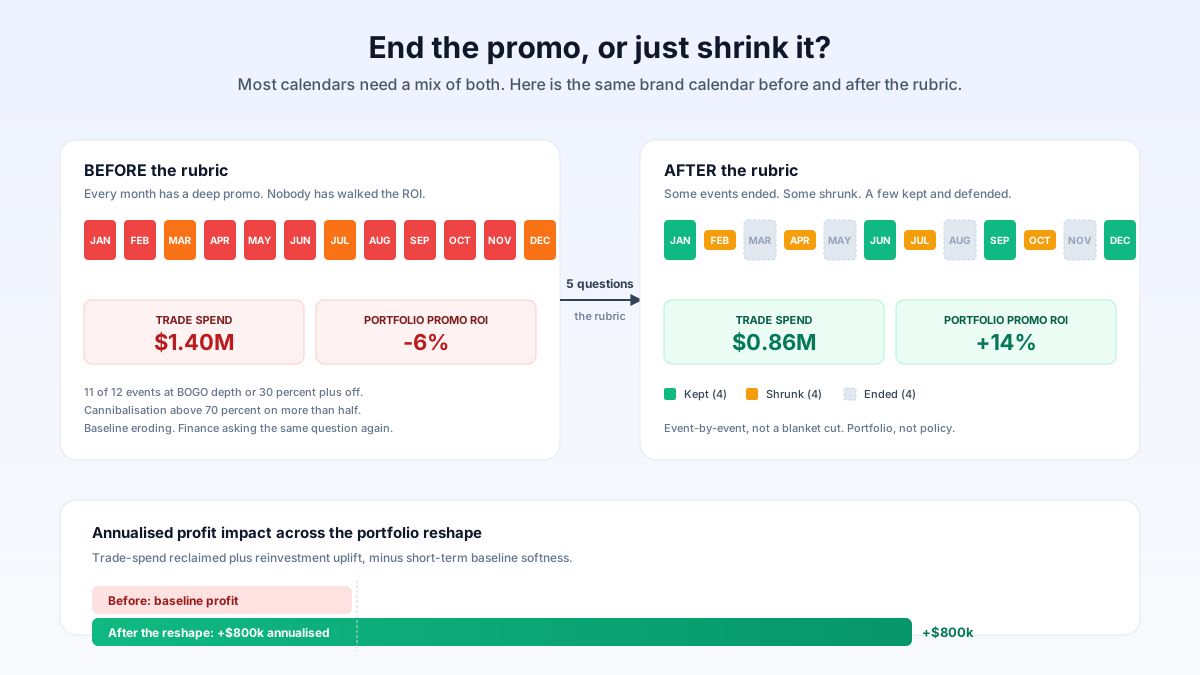
The short version
- Most Fast-Moving Consumer Goods (FMCG) promotional calendars are inherited, not designed. Events get added in good years and never come off in bad ones.
- The finding that more than half of promotions do not earn their cost is consistent across NielsenIQ and McKinsey work.12 The right response is not a blanket budget cut. It is a sorted list: which events to kill, and which to shrink.
- Kill the events that are discounts in disguise. When most of the volume is your own baseline sold cheaper, no contract holds the slot, and the category does not need the window, ending the event costs you almost nothing real.
- Shrink the events where the window is load-bearing but the design is not. Cut the depth, the frequency, or the duration. Most of the genuine lift survives. Most of the cost does not.
- Before you end an event cold, run the reference-price test. Pause one cycle and watch the baseline. If it holds, end it. If it resets lower and stays there, step the depth down across a few cycles instead.
- Kraft Heinz is the case study. After its 2019 writedown it rebuilt event by event, on incrementality, not by hitting a round-number trade-spend target.4
Half the events on your promotional calendar do not earn their cost. You probably know which half. The part nobody wants to do is decide, event by event, whether to kill the thing or just shrink it. This is the sequence most commercial teams walk anyway, written down so you can run it before the calendar locks instead of after the writedown.
The calendar is an inheritance
Every FMCG company runs a promotional calendar that grew over a decade. Events were added in good years and never taken off in bad ones. A retailer ask became a standing commitment. A seasonal mechanic became permanent. At some point the calendar stopped being a plan and became an inheritance.
The numbers on what those calendars deliver are not flattering. NielsenIQ's work on trade-promotion effectiveness put it bluntly: over half of all trade promotions produce little to no sales lift, so the money behind them is largely wasted.1 McKinsey reached the same place from a different angle, finding that 59 percent of consumer-goods promotions lose money globally, and 72 percent in the United States.2 The exact share depends on category and on how strictly you define incrementality, but the shape is settled, and most commercial leaders have heard it enough times to stop arguing with it.
Calendars keep growing anyway, because ending an event is harder than adding one. The retailer objects. The brand team fears the baseline. The account manager already has the slot on the plan. Each event looks too small to fight over, and the aggregate only becomes visible when Finance totals the spend and nobody can point to the profit behind half of it.
Two lists, not one
The mistake is to treat this as one decision. It is two. Some events should be killed outright. Others should be kept but shrunk. They are different lists, and they call for different moves.
Killing an event is what it sounds like. The window comes off the calendar, the trade-spend line drops to zero, and the product sits at its shelf price. Shrinking means you keep the window and reshape what happens inside it. You have four dials. Depth, where 30 percent off becomes 15 percent off. Frequency, where a quarterly event becomes semi-annual. Duration, where a four-week feature becomes two. And mechanic, where a buy-one-get-one (BOGO) becomes a shallower loyalty-funded cut.
What sorts an event onto one list or the other is two things. How much of its volume is genuinely incremental, and whether the window is load-bearing for a reason the ROI does not capture. Plot those two and the calendar starts to organise itself.
Cannibalisation and incremental volume
When you run a promotion, the extra units that sell are not all new business. Some are baseline volume, the units a shopper would have bought anyway, now sold cheaper. Some are pulled forward, bought this month instead of next. Only the rest is genuinely new demand the promotion created. Cannibalisation is the share that is not new, mostly your own baseline subsidised at a lower price. The higher that share, the less the event is finding demand and the more it is simply discounting sales you already had.
The five questions that sort them
Walk these event by event, starting with the bottom quartile by profit drag.
Is the return on investment (ROI) really below cost of capital? Pull the incremental profit for the last 12 and 24 months and divide by the total spend the event consumes. The word that matters is total. Most teams count the on-invoice slice and the main off-invoice pool and stop. A full accounting adds the slotting fees, the display labour, the bonus-pack write-offs, the temp-label runs, and the management time. Load those in and many events drop well below the simple number, sometimes by a third or more. Compare the fully-loaded figure against your cost of capital, which for a mainstream consumer-goods company usually sits between 8 and 12 percent. Below that line on the full accounting, the event is a candidate.
Cost of capital as a hurdle rate
Money tied up in a promotion has to earn at least as much as it would earn elsewhere in the business, otherwise you are better off doing something else with it. Cost of capital is that minimum acceptable return, the hurdle a use of money has to clear to be worth funding. For a mainstream consumer-goods company it usually sits between 8 and 12 percent. When an event's fully-loaded return on investment falls below that line, the event is destroying value even if it looks profitable on a simpler count, which is why it becomes a candidate to cut.
How much of the volume is cannibalised from your own baseline? This is the question that usually decides kill versus shrink. A 20 percent cut that lifts volume 60 percent looks good until you decompose it. If 45 of the extra units would have sold anyway and 10 were pulled forward from next month, only 5 are genuinely new. As a working rule most commercial teams use, above roughly 70 percent cannibalisation you are running a discount dressed as a promotion. Kill it, because the volume you lose is mostly your own baseline sold cheaper. Between about 40 and 70 percent there is real lift on a bloated frame, so shrink it. Below 40 percent the event is doing real work, so leave it alone.
Has reference-price decay set in? A frequent deep promotion can train shoppers to treat the promo price as the fair price, so the regular price starts to look expensive even though it has not moved.3 The test is an experiment most teams never run. Pause one cycle and watch the baseline in that window and the two after it. If it holds close to the rolling average, decay is mild and a clean ending is safe. If it drops and does not recover within a cycle or two, decay is live, and ending cold will cost you structural volume. Those events should be stepped down across several cycles, not ended in one.
Reference-price decay
Shoppers carry a rough idea of what a product should cost, and they build it from the prices they keep seeing. Promote often enough and deep enough, and the promo price quietly becomes the price they treat as fair. The regular shelf price then starts to look expensive even though it has not changed. That drift is reference-price decay. It matters here because an event in this state is holding up your baseline. End it cold and the baseline can reset lower and stay there, so you step the depth down across several cycles instead.
Is the event locked into a Joint Business Plan (JBP)? Some events exist because the JBP with the retailer requires them: feature participation, calendar slots, volume-tier thresholds. Ending one of those unilaterally is not a profit decision, it is a contract decision, and the retailer's response usually lands on unrelated lines. Shrink these inside the contract wording until the next JBP cycle, then negotiate the commitment out, armed with data on how much retailer margin the event delivered without incremental sales.
Does the category depend on the promotion? Some categories run on promotional visibility. Ice cream lives on summer. Confectionery runs a gifting calendar. Entry packs use promo windows as the main trial engine. There the event earns its keep on trial and habit, which the standard incrementality math understates, so shrink rather than end. A steady weekly-shop staple with no seasonal or trial dependency carries no such excuse, and the direct ROI is the whole story.
What Kraft Heinz learned the hard way
The case for doing this at scale is the reset Kraft Heinz ran after February 2019, when it took non-cash impairment charges of 15.4 billion dollars, mostly against the Kraft and Oscar Mayer brands, and the stock fell close to 27 percent in a single day.4 The widely shared diagnosis was that a decade of zero-based budgeting under its private-equity ownership had cut brand-building to around half of peer levels, while the company leaned on heavy promotional pricing to hold quarterly volume. At a 2023 investor conference, a Kraft Heinz executive put it plainly. The company would not go back to "2019 levels in which we were going to do these deep promotions that many times actually returned negative ROI."
Miguel Patricio, formerly Chief Marketing Officer at AB InBev, became Chief Executive in mid-2019, raised media spend by about 30 percent, and cut promotional intensity, moving the money toward brand building. The rebuild was not a blanket cut, which is the part worth studying. Some events were removed, the deepest and most frequent first. Others were scaled back rather than cancelled. In 2022 the company's organic net sales rose by close to 10 percent, driven by pricing rather than promotional volume, while volume itself softened. That was rather the point. The company had stopped renting volume with promotions that lost money.
What to do Monday morning
Pull the last two years of promotional ROI by event on your top ten products and rank them by profit drag. Walk the five questions through the bottom quartile before the next calendar lock, starting with the ones that are clearly negative on the full accounting. For each, write down the path and the reason. End the events with high cannibalisation, mild decay, no JBP tie, and no category dependency. Shrink the rest, and be specific about which dial you are turning, and by how much.
Then cycle the money. A workable split is roughly a third back into higher-ROI promotions on products with measured incrementality, roughly a third into brand advertising, which is what most weak calendars quietly underfund, and the last third held back to Finance as margin recovery. That last third is what gets the first review approved and earns you the credibility for the second. What you should not do is run a blanket cut to hit a round-number trade-spend target. That is the move Kraft Heinz already retired.
References
- NielsenIQ's analysis of trade-promotion effectiveness reports that over half of all trade promotions produce little to no sales lift, leaving much of the spend behind them wasted. "How to measure trade promotion effectiveness", NielsenIQ, 2022. nielseniq.com
- McKinsey found that 59 percent of consumer-goods promotions lose money globally, and 72 percent in the United States. "How analytics can drive growth in consumer packaged goods trade promotions", McKinsey & Company, 2019. mckinsey.com
- Reference-price formation and decay, the way a frequent promotion re-anchors what shoppers treat as the fair price, are reviewed in Kalyanaram and Winer, "Empirical Generalizations from Reference Price Research", Marketing Science, 14(3), 1995. pubsonline.informs.org
- Kraft Heinz announced non-cash impairment charges of 15.4 billion dollars in February 2019, across goodwill and intangible assets and primarily against the Kraft and Oscar Mayer brands; the shares fell close to 27 percent. Securities and Exchange Commission Form 8-K, February 2019: sec.gov. The promotional reset, the roughly 30 percent media-spend increase, and the statement that the company would not return to deep promotions that often returned negative ROI are reported in MediaPost (2020) mediapost.com and FoodNavigator-USA, 16 June 2023 foodnavigator-usa.com. Full-year 2022 organic net sales rose close to 10 percent, driven by pricing: Kraft Heinz fourth-quarter and full-year 2022 results, kraftheinzcompany.com.
Keep going
Pair this with the decision guide and the lessons that build the muscle behind each question above.
More from the blog
End or Shrink a Promotion (playbook). The same five questions as an interactive decision tree, with a worked example on a Tier 2 biscuit where a quarterly BOGO is failing ROI and cannibalisation sits near 78 percent.
Why BOGO Is Dying. The mechanic that shows up on more kill lists than any other, and what to run when you need to keep the window and change the mechanic.
Why CPG Promotions Destroy Value. Goes deeper on the incrementality question at the heart of the kill decision, through three metrics that separate real lift from volume you would have sold anyway.
On-Invoice or Off-Invoice. The other half of the JBP conversation. Once you know which events to kill, this is where the freed-up money should go.