Why 1% More in Price Beats 5% in Volume
A 1% price gain moves operating profit by about 11%, far more than volume.
The short version
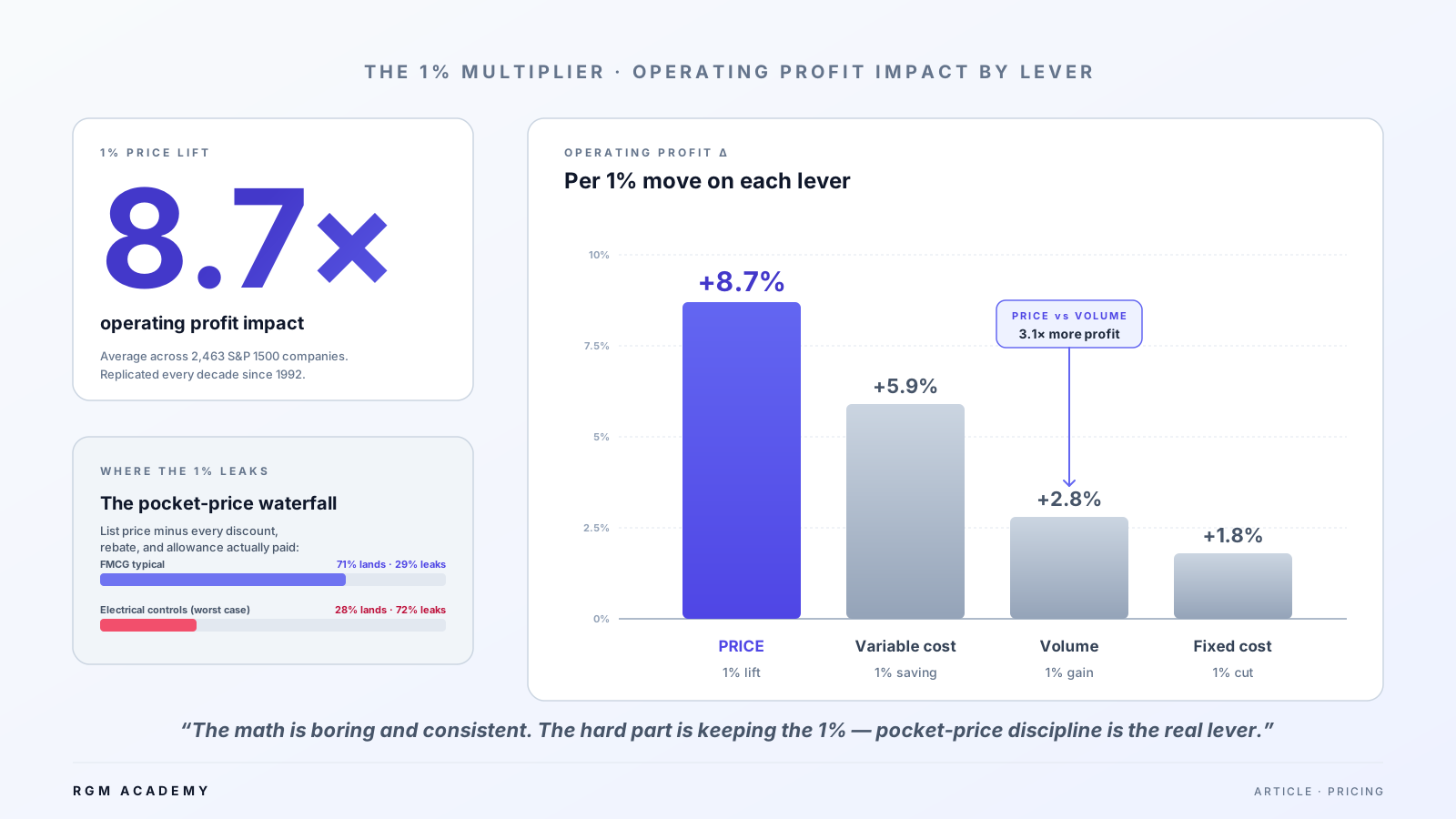
- A 1% increase in price moves operating profit by about 11.1% on average, far more than a 1% saving in variable cost (7.8%), a 1% gain in volume (3.3%), or a 1% cut in fixed cost (2.3%).1
- The reason is leverage. A price gain carries no extra cost to make or move the product, so the whole 1% of revenue lands on a thin profit base. In this sample that base is about 9% of revenue, which is why 1% of sales becomes 11.1% of profit.
- On paper, 5% more volume (about 16.5% more profit) beats a 1% price gain. The catch is that volume in a flat category is almost never free. You buy it with promotion and trade money, and it only matches the price gain if more than two-thirds of it is genuinely incremental. Most promotions miss that bar.
- So the claim is narrow and it holds: a clean 1% price gain you can hold beats a 5% volume gain you have to buy and defend every quarter.
- Most of the price gain leaks before it reaches the profit and loss account (P&L). Between the list price you set and the pocket price you bank sits a waterfall of rebates, terms, and allowances that can swallow anywhere from a fifth to more than half of it.2
- The Monday move: compute your own price-leverage multiple, draw your pocket-price waterfall customer by customer, and put one disciplined price move on the same page as the next volume chase before you choose.
The slide nobody asked about
Picture last quarter's commercial review. The sales director walked the board through distribution gains. Supply chain presented the cost-out programme. Marketing showed a deck on penetration and brand health. Somewhere around slide 47, when everyone was checking their watch, the head of revenue management flicked past a single chart showing the category had taken 1.2% of price over the year.
No one asked a question about it. That slide was probably the most important number on the deck.
Why a 1% price gain is worth 11.1%
Across a cross-industry sample of 2,463 companies, the average effect of a 1% move in each commercial lever on operating profit looks like the figure below.1
Price is the most powerful single lever in a consumer-goods P&L, by a wide margin. The original study put it at three to four times the effect of volume growth and about 1.4 times the effect of cost savings, and every team that has rerun the analysis on a fresh set of companies has landed in the same neighbourhood. Michael Marn and Robert Rosiello of McKinsey published the first version in Harvard Business Review in 1992, and the directional ranking has been stubbornly stable ever since.1
The arithmetic is simple, even if the implication is not. When you sell a unit, revenue rises by the shelf price and cost rises by what it took to make and move that unit. Raise price by 1% and you add 1% of revenue with no extra cost behind it, so the whole amount flows to operating profit. And operating profit sits on a far thinner base than revenue. In this sample the average operating margin is about 9%, so 1% of revenue is 11.1% of profit. There is no magic in it. It is an accounting identity most teams never work through.
Operating leverage, in plain words
Profit is a thin slice of revenue. If your operating margin is around 9%, then for every 100 you sell you keep about 9. Add 1 of pure price, with no cost behind it, and that 1 lands straight on the 9. One divided by nine is 11.1%. The thinner your margin, the bigger the number: on a retailer running a 2 to 3% margin, the same 1% of price is a 30 to 50% swing in profit. That is operating leverage, and price is the only lever that pulls it for free.
So why 5 percent, not 3?
A fair reader will object. If price is more than three times the power of volume, then a 1% price gain matches about a 3% volume gain, not 5. And on the raw figures, 5% more volume is worth about 16.5% of profit (five times 3.3%), which beats the 11.1% from price outright. On paper, the bigger volume number wins.
The paper comparison is unfair, and not in price's favour. The 3.3% per 1% of volume assumes the volume arrives at full margin and costs nothing to win. Real volume does not. In a flat category, 5% more units is a stretch you reach for with promotion, deeper distribution, and trade investment, and most of that spend subsidises shoppers who were going to buy anyway. For a 5% volume push to match the 11.1% a clean price gain delivers, more than two-thirds of it has to be genuinely incremental and won at full margin.2 Most promotions clear nowhere near that bar.
So the claim in the title is narrow, and it holds. A clean 1% on price, the kind you set once and hold, beats a 5% volume gain you have to buy every quarter and defend against the competitor who matches you the following week. One is profit you keep. The other is profit you rent.
Incrementality, and why bought volume rarely pays
Incremental volume is the volume you would not have sold without the promotion. The rest is subsidy: a discount handed to shoppers who were going to buy at full price anyway. Most grocery promotions run well below half incremental, which means more than half the money funds sales you already had. That is why a headline volume gain so often arrives with a shrinking profit line. When you weigh a price move against a volume move, compare them net of what each costs to win, not at the gross number on the slide.
Most of that 1% never arrives
This is the part that turns 11.1% from a result into an aspiration. Between the list price you set and the pocket price you actually bank, after off-invoice rebates, on-invoice terms, promotional allowances, listing fees, logistics charges, and the rest of the revenue waterfall, there is a gap. A wide one.
The pocket-price work in The Price Advantage documented list-to-pocket drops ranging from a fifth of list price in some categories to more than half in others.2 So somewhere between half and four-fifths of every pound of list-price gain you negotiate survives to the P&L, and only if you hold the line.
The leakage is rarely even. The same body of work found some customers receiving total discounts far above the average while only a handful actually bought at list. When rack-price discipline slips into per-customer negotiation, the gap between price power, what the market will bear, and price realisation, what you actually collect, widens by stealth. The 1% you announced in January is materially less than that by December. That is why the single most valuable diagnostic in revenue management is not an elasticity study. It is a pocket-price waterfall drawn customer by customer, with the outliers labelled.
The teams that made it stick
The 11.1% is an average, and the spread around it has a long right tail. Two disguised cases from The Price Advantage show the upper end.2 A data-communications company, called Soundco in the book, rebuilt its pocket-price waterfall customer by customer and lifted realised price by a few points with volume intact. Operating profit moved by a large multiple of the price gain, the textbook reward for waterfall discipline. A second company, Normcomp, ran a value-equity programme that repositioned its premium tier on explicit customer-value drivers and won both price headroom and share at once.
Rafi Mohammed's The 1% Windfall collects the same pattern across named companies, from Whirlpool to Tyson to Sears, whose 1% price improvements turned into outsized profit lifts for one reason: thin starting margins.3 On a business earning a fraction of a percent in margin, a clean 1% of price is not an 11% move. It is a different order of magnitude. None of these were home runs from a pricing genius. They were teams that chose to spend disproportionate attention on the lever with disproportionate leverage.
What I would do Monday
Three moves. First, compute your own multiple. Take last year's P&L, apply a 1% price increase with zero volume response, and trace it to operating profit. Whatever number you land on is the gravitational pull of price on your business. If it is 11% or 15%, a 1% miss on price outweighs anything the cost-out programme will deliver this quarter. Second, draw your pocket-price waterfall, gross sales to invoice to pocket, customer by customer. Any account below 80% realisation is a conversation your key account manager should be having this week. Third, pick one price move, not a portfolio-wide increase. One product, one tier, one threshold, one customer. Run it through a real P&L sensitivity model with a realistic elasticity, put it on the same page as a cost-out programme of the same size, and hand both to the CFO.
The 11.1% will not fix your business by itself. But it will, if you let it, move the centre of gravity of every commercial review you sit through from here on.
References
- Marn, Michael V., and Robert L. Rosiello. "Managing Price, Gaining Profit." Harvard Business Review, September to October 1992. Exhibit 1, based on the average economics of 2,463 companies in the Compustat aggregate: a 1% improvement in price lifts operating profit 11.1%, against 7.8% for variable cost, 3.3% for volume, and 2.3% for fixed cost. hbr.org
- Marn, Michael V., Eric V. Roegner, and Craig C. Zawada. The Price Advantage. Wiley, 2003. The practitioner reference for pocket-price waterfall analysis, list-to-pocket leakage, and the disguised Soundco and Normcomp cases. Pocket-price waterfall overview
- Mohammed, Rafi. The 1% Windfall: How Successful Companies Use Price to Profit and Grow. Harper Business, 2010. Collects company cases, from Whirlpool to Tyson to Sears, where thin starting margins turned a 1% price gain into outsized profit lifts. harpercollins.com
Keep going
Pair this with the decision guide and the lessons that drill the moves behind it.
Playbook
Match a competitor's price, or hold? The discipline behind not giving the 1% straight back the moment a rival undercuts you, with the questions that decide when to hold the line.
More from the blog
The Great RGM Reset. The wider shift from chasing volume to defending price, and why it stopped being optional.
Eating the Tariff. What happens to the price lever when a cost shock lands and you have to decide how much to pass on.
The Squeezed Middle. Where the price-versus-volume choice meets the shelf, and how to rebuild a range that has hollowed out.