Back to blog
Integration

The Great Revenue Growth Management (RGM) Reset: From Price-Led to Volume-Led in 2026

Three years of price extraction are over. The CPGs that win 2026 are the ones that rebuild volume muscle while retailer trust is broken and AI is still half-built.

Bulent Kotan14 min read

Rich rendering temporarily unavailable — showing raw markdown.

**Executive summary**

For three years, Fast-Moving Consumer Goods (FMCG) companies ran a price-led growth model that worked in an environment of input-cost inflation, passive retailers, and grateful capital markets. All three conditions have reversed. Nestlé cut prices in the United States (US) in the first quarter of 2025 for the first time in nearly four years.¹ Unilever has publicly flagged that volume must return as a meaningful share of growth mix.² Boston Consulting Group's (BCG) 2025 study on volume-led growth is the clearest signal yet that the next three years require a different operating model — one built on Price-Pack Architecture (PPA), Trade Promotion Optimization (TPO), Artificial Intelligence (AI)-native decisioning, and the rebuilding of retailer trust that the 2022–2024 cycle eroded.³ This piece unpacks what has broken in the inherited Revenue Growth Management (RGM) playbook, what the leaders are doing differently, and what a credible 2026 reset looks like. It is, above all, a call to stop treating RGM as a pricing function and start treating it as the integrated capability that it always should have been.

---

## The price-led era and why it ended

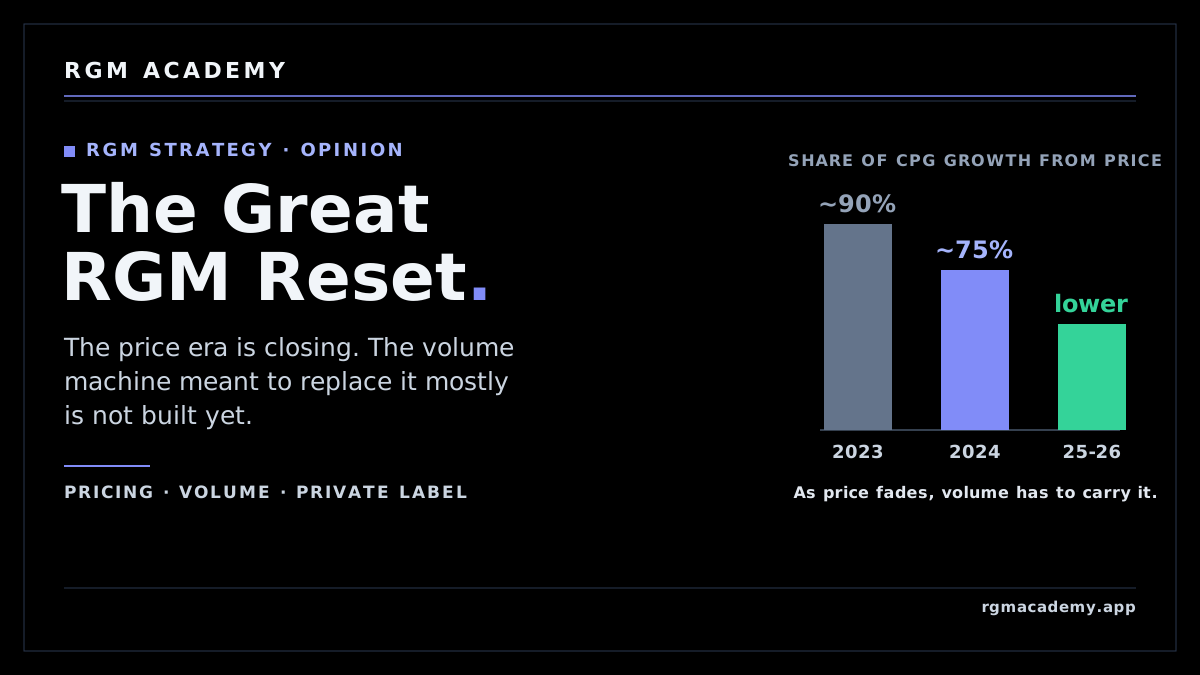
Between 2022 and 2024, the top twenty global Consumer Packaged Goods (CPG) companies extracted the vast majority of their reported revenue growth from price rather than volume. BCG's analysis of the cohort puts the split at roughly seventy-thirty in favour of price.³ The pattern was almost universal: serial list-price moves, twice-yearly trade-term resets, pack-size reductions, and a promotional cadence that leaned heavily on Temporary Price Reductions (TPRs) and depth-driven events.

The cycle worked because three things happened at once. Input costs — energy, wheat, dairy, packaging substrates, freight — all rose sharply, giving Chief Financial Officers (CFOs) a cost-justified case for shelf-price moves. Retailers absorbed much of the early pass-through because their own cost bases were rising too, and because consumers had been conditioned by pandemic-era scarcity to accept price rises as inevitable. Capital markets rewarded the numbers; gross margins expanded, earnings-per-share grew, and any company that could tell a "pricing power" story commanded a premium multiple.

By the middle of 2024 the music slowed. Three separate signals landed in close succession.

First, retailers pushed back. The Carrefour–PepsiCo standoff of January 2024 was the most visible. Carrefour delisted Doritos, Lay's, 7 Up, Lipton, and Cheetos across France, Italy, Spain, Belgium, and Poland, citing repeated PepsiCo price increases that it considered unjustified.⁴ The story ran on the front page of *Fortune*, *Washington Post*, and every major European trade publication for two weeks.⁴ Six months later, the French government passed a shrinkflation disclosure decree requiring on-shelf labelling whenever a pack size is reduced without a corresponding price cut — effectively closing a lever that had been a quiet workhorse of the previous three years.⁵

Second, category volumes cratered. By Q4 2024, most large CPG categories in Europe and North America were reporting negative volume-mix on positive price, which is the commercial equivalent of a thermometer registering heat in a fire alarm. The top ten global CPG brands, collectively, were growing at roughly 4.8% — still faster than Private Label (PL) at 4.3% — but the growth came almost entirely from price, and the delta between brands and PL had narrowed to the thinnest point in a decade.⁶

Third, the Chief Executive Officers (CEOs) themselves changed their language. Unilever's commentary through 2024 and into Q1 2025 shifted from "pricing will normalise" to "underlying volume-mix will become the dominant driver".² Nestlé announced a modest (+1%) US price cut in Q1 2025 and flagged that specific geographies would see similar moves as the year progressed.¹ These are small numbers in isolation. What matters is the direction of travel.

The price-led era is not over because companies decided it should be. It is over because the three conditions that made it work — input-cost cover, passive retailers, and grateful markets — have simultaneously disappeared.

<figure style="margin: 28px 0;">
<svg viewBox="0 0 760 320" xmlns="http://www.w3.org/2000/svg" style="width:100%;height:auto;font-family:Inter,system-ui,sans-serif;">
  <style>
    .bg{fill:#f8fafc}.grid{stroke:#e2e8f0;stroke-dasharray:2,3}.axis{fill:#64748b;font-size:11px}.lbl{fill:#0f172a;font-size:12px;font-weight:600}.heading{fill:#0f172a;font-size:14px;font-weight:600}
    @media (prefers-color-scheme:dark){.bg{fill:#0f172a}.grid{stroke:#334155}.axis{fill:#94a3b8}.lbl{fill:#f1f5f9}.heading{fill:#f1f5f9}}
  </style>
  <rect class="bg" width="760" height="320" rx="10"/>
  <text x="30" y="28" class="heading">Top-10 CPG reported organic growth, 2020–2025</text>
  <text x="30" y="46" class="axis">Price contribution peaks in 2022–2023, normalising from 2024 onward</text>
  <!-- Plot area: x from 80 to 720, y from 80 to 260 -->
  <!-- X axis: years 2020 2021 2022 2023 2024 2025. 6 ticks spaced 128 apart starting at 80 -->
  <!-- Y axis: 0 to 8%. 260 = 0, 80 = 8%. 22.5px per percent. -->
  <!-- Grid -->
  <line x1="80" y1="80" x2="720" y2="80" class="grid"/>
  <line x1="80" y1="125" x2="720" y2="125" class="grid"/>
  <line x1="80" y1="170" x2="720" y2="170" class="grid"/>
  <line x1="80" y1="215" x2="720" y2="215" class="grid"/>
  <line x1="80" y1="260" x2="720" y2="260" stroke="#64748b"/>
  <text x="72" y="85" class="axis" text-anchor="end">8%</text>
  <text x="72" y="130" class="axis" text-anchor="end">6%</text>
  <text x="72" y="175" class="axis" text-anchor="end">4%</text>
  <text x="72" y="220" class="axis" text-anchor="end">2%</text>
  <text x="72" y="264" class="axis" text-anchor="end">0%</text>
  <!-- X labels -->
  <text x="80"  y="280" class="axis" text-anchor="middle">2020</text>
  <text x="208" y="280" class="axis" text-anchor="middle">2021</text>
  <text x="336" y="280" class="axis" text-anchor="middle">2022</text>
  <text x="464" y="280" class="axis" text-anchor="middle">2023</text>
  <text x="592" y="280" class="axis" text-anchor="middle">2024</text>
  <text x="720" y="280" class="axis" text-anchor="middle">2025</text>
  <!-- Price line (indigo): pts (year,pct): (2020,1.0)(2021,3.2)(2022,7.0)(2023,6.3)(2024,3.8)(2025,1.5) -->
  <polyline fill="none" stroke="#6366F1" stroke-width="3" stroke-linejoin="round" points="80,237 208,188 336,102 464,117 592,174 720,226"/>
  <circle cx="80" cy="237" r="4" fill="#6366F1"/>
  <circle cx="208" cy="188" r="4" fill="#6366F1"/>
  <circle cx="336" cy="102" r="5" fill="#6366F1"/>
  <circle cx="464" cy="117" r="4" fill="#6366F1"/>
  <circle cx="592" cy="174" r="4" fill="#6366F1"/>
  <circle cx="720" cy="226" r="4" fill="#6366F1"/>
  <!-- Volume line (emerald): pts (2020,2.4)(2021,3.0)(2022,-0.5)(2023,-0.2)(2024,1.4)(2025,2.8) — using 0 as floor -->
  <polyline fill="none" stroke="#10B981" stroke-width="3" stroke-linejoin="round" points="80,206 208,192 336,272 464,265 592,228 720,197"/>
  <circle cx="80" cy="206" r="4" fill="#10B981"/>
  <circle cx="208" cy="192" r="4" fill="#10B981"/>
  <circle cx="336" cy="272" r="4" fill="#10B981"/>
  <circle cx="464" cy="265" r="4" fill="#10B981"/>
  <circle cx="592" cy="228" r="4" fill="#10B981"/>
  <circle cx="720" cy="197" r="5" fill="#10B981"/>
  <!-- Mix line (amber): flat-ish around 1% -->
  <polyline fill="none" stroke="#D4A574" stroke-width="2.5" stroke-linejoin="round" points="80,242 208,240 336,245 464,240 592,238 720,235"/>
  <circle cx="80" cy="242" r="3" fill="#D4A574"/>
  <circle cx="208" cy="240" r="3" fill="#D4A574"/>
  <circle cx="336" cy="245" r="3" fill="#D4A574"/>
  <circle cx="464" cy="240" r="3" fill="#D4A574"/>
  <circle cx="592" cy="238" r="3" fill="#D4A574"/>
  <circle cx="720" cy="235" r="3" fill="#D4A574"/>
  <!-- Legend -->
  <circle cx="540" cy="56" r="4" fill="#6366F1"/><text x="550" y="60" class="axis">Price</text>
  <circle cx="600" cy="56" r="4" fill="#10B981"/><text x="610" y="60" class="axis">Volume</text>
  <circle cx="670" cy="56" r="4" fill="#D4A574"/><text x="680" y="60" class="axis">Mix</text>
  <!-- Annotation: peak year -->
  <text x="336" y="94" style="fill:#6366F1;font-size:11px;font-weight:600;font-family:Inter,system-ui,sans-serif" text-anchor="middle">peak: ~7%</text>
</svg>
<figcaption style="margin-top:8px;color:#64748b;font-size:13px;font-style:italic;text-align:center;">Year-on-year organic growth split into price, volume, and mix contribution for the top ten global CPG companies. Volume turned negative in 2022–2023 as price absorbed most of the category growth; both lines began normalising from 2024. Composite illustration based on BCG volume-led growth research and individual company Q4 disclosures.</figcaption>
</figure>

## The volume problem nobody has the capability for

Volume-led growth is meaningfully harder than price-led growth, and most commercial organisations are staffed for the easier problem.

A point of price improvement is, in accounting terms, a transaction. It requires a decision, a negotiation, a contract update, an execution window. A point of volume growth is an outcome — the aggregate consequence of thousands of individual shopper decisions made at shelf, and the lagging effect of months of brand investment, distribution expansion, and promotional execution. A team cannot *decide* to grow volume; it can only build the conditions under which volume grows and wait to see whether shoppers oblige.

The CPG industry has spent the last decade hollowing out exactly the capabilities volume growth requires.

Innovation pipelines have shrunk, not because innovation is harder but because the return-on-investment (ROI) maths of price moves has been so much more attractive during inflation that capital was steered away from the slower-paying lever.⁷ Brand marketing budgets have been eroded by the migration of dollars into performance media and retailer-media networks — the lever that drives the next three months of sales but rarely builds the next three years of brand equity.

Pack-Price Architecture has drifted. Simon-Kucher's 2025 Growth Playbook uses the phrase "accidentally vacated price points" — the mainstream entry tier that got pushed up through serial rounds of inflation pass-through and opened shelf space that Private Label quickly claimed.⁷ In the US, Private Label unit share stood at 23.2% in the first half of 2025; in the European Union it was 38.8% by value.⁶ Neither number is cyclical. Both are structural ceilings that the branded players have to plan around.

The trade-promotion function has become less effective, not more. The Bain & Company finding — that 70% of SKUs drive fewer than 5% of category revenue, and roughly 75% of trade-promotion programmes fail against stated objectives — is a mathematical description of a capability that has been under-invested for a decade.⁸ The Promotion Optimization Institute's (POI) 2025 Fall Summit put specific numbers around the pain: of 1,640 promotional events audited in a canonical European CPG portfolio, 340 (21%) had negative turnover, consuming roughly €4.3 million in trade spend on events that destroyed value.⁹

Volume growth in this environment is not the default output of an FMCG business. It is the payoff of a three-year programme of capability rebuilding that most companies have only just started.

## What the winners are doing differently

Four things separate the companies that have begun the reset from the ones still defending the 2022 playbook.

### Rebuilding the entry tier

The entry-tier work is unglamorous and essential. Unilever's Power Brands strategy — where roughly 75% of turnover concentrates on a defined set of global brands — explicitly carves out a mass-market tier that competes on accessibility rather than premium positioning.² Nestlé's new Vital Pursuit brand, launched nationwide in the US through Walmart, Target, and Kroger in September 2024, is a different kind of entry-tier move: the first new US brand Nestlé launched in roughly thirty years, positioned around Glucagon-Like Peptide-1 (GLP-1) compatibility and the portion-controlled eating patterns those medicines encourage.¹⁰ Different strategies, same underlying logic: the entry tier had been quietly abandoned during inflation, and re-entering it required a deliberate capability build rather than a pricing decision.

### Case sidebar: Nestlé's Vital Pursuit launch

Nestlé's Vital Pursuit is a worked example of what entry-tier re-entry looks like when it is done well. The brand was launched in May 2024 and reached nationwide US distribution by September 2024 across Walmart, Target, and Kroger.¹⁰ The positioning is explicitly calibrated to the rising prevalence of GLP-1 medications — smaller portion sizes, higher protein content, glycaemic-friendly formulation — rather than the traditional "healthy frozen meal" claim that has crowded the category for decades. The pricing sits in the $4.99–5.49 band, which is above the Private Label floor but meaningfully below the premium frozen-meal tier. Early published reads put the uplift on surrounding Nestlé frozen-meal SKUs at positive but modest, suggesting cannibalisation was manageable.

What makes the case interesting for RGM purposes is what it is *not*. It is not a price cut. It is not a trade-promotion calendar. It is not a pack-size reduction. It is a brand-tier addition that gives Nestlé a credible play on a shopper occasion — GLP-1-aware eating — that no existing brand in the portfolio was well-positioned to serve. The RGM lever it uses is Mix, not Price. The capability that makes it possible is a combination of innovation velocity, Route-to-Consumer (RtC) execution across three major retail chains, and the political will inside a 150-year-old company to launch a new US brand for the first time in a generation.

### Rebuilding promotional discipline

The second move the winners are making is to rebuild the Trade Promotion Optimization function from the data layer upward. This is not a glamorous investment; it is a multi-year rebuild of baseline estimation, incrementality measurement, and a Performance Grid that classifies every promotional event into one of four quadrants (Best, Good, Review, Stop) based on ROI and incrementality.⁹ The companies furthest along this path are the ones whose TPO functions have migrated out of Sales ownership and into a cross-functional Centre of Excellence — the POI 2025 consensus pattern among the highest-performing CPG RGM functions.⁹

When it works, the numbers are substantial. The POI canonical scorecard of 1,640 events found that 30% (492 events) qualified as Best-in-class with positive ROI and positive incrementality, while 21% (340 events) qualified as Stop — negative turnover events that should be eliminated entirely.⁹ Reallocating the trade spend from Stop events to the lowest-ranked Best events is, in most CPG portfolios, worth a mid-single-digit improvement in trade ROI at roughly flat investment — the kind of return that earns the attention of even the most sceptical Chief Commercial Officer.

### Rebuilding the retailer relationship

The third move is the slowest and the one most requires senior ownership. Retailer trust did not erode by accident during the inflation years; it eroded because the negotiating posture of CPGs shifted from "let's grow the category together" to "let's extract another point of price before the cycle turns." Retailers noticed. The Carrefour–PepsiCo standoff was the most visible, but similar dynamics played out quietly across German discounters, British multiples, and North American grocery banners.

Rebuilding the relationship is a Joint Business Planning (JBP) discipline. Bain's published RGM research cites a 10% incremental profit-pool growth figure that becomes available to both sides when JBP moves from sales-led trade-terms negotiation to cross-functional profit-pool optimisation.⁸ The mechanics require the CPG to show up to the annual plan meeting with retailer-specific Category Value Assessment (CVA) analysis, shared elasticity assumptions, and a transparent view of total retailer investment that reconciles trade spend and retail-media spend in a single number. The companies that can do this get back in the door at the Category Captain level. The ones that cannot get delisted.

### Building the AI capability without overpaying for it

The fourth move is the most fashionable and the easiest to get wrong. Every major CPG is publicly committed to AI. Coca-Cola's $1.1 billion five-year partnership with Microsoft and OpenAI is the largest public commitment.¹¹ Reckitt's partnership with McKinsey on the RGMx platform is the most deeply integrated with the commercial operating model.¹² BCG has rebranded its Growth AI offering as RGM AI and claimed eight distinctions in the POI 2025 Panorama.¹³

The risk in all of this is substitution effect. AI tooling is only as effective as the data foundation underneath it and the operating model around it. POI 2025 put it bluntly: "AI can't fix bad data or bad process."⁹ The leaders are investing in the foundation — master-data governance, SKU-level granularity, event-level promotional tracking, shared customer P&Ls with retailers — before they turn on the agentic pricing modules. The laggards are buying tools and calling it transformation. The difference will become visible in 2027 earnings calls.

<figure style="margin: 28px 0;">
<svg viewBox="0 0 760 300" xmlns="http://www.w3.org/2000/svg" style="width:100%;height:auto;font-family:Inter,system-ui,sans-serif;">
  <style>
    .bg{fill:#f8fafc}.label{fill:#0f172a;font-size:12px;font-weight:600}.heading{fill:#0f172a;font-size:14px;font-weight:600}.axis{fill:#64748b;font-size:11px}.track{fill:#e2e8f0}
    @media (prefers-color-scheme:dark){.bg{fill:#0f172a}.label{fill:#f1f5f9}.heading{fill:#f1f5f9}.axis{fill:#94a3b8}.track{fill:#1e293b}}
  </style>
  <rect class="bg" width="760" height="300" rx="10"/>
  <text x="30" y="28" class="heading">Reset-capability maturity across the top-10 global CPGs</text>
  <text x="30" y="46" class="axis">1 = not started · 5 = in production across the portfolio</text>
  <!-- Each capability bar has: leader score (emerald), median score (cyan), laggard score (red). 3 dots across the track. -->
  <!-- Plot area: x from 260 to 720 (460 wide = score 0..5) -->
  <!-- Score-to-x: x = 260 + (score/5)*460 -->
  <!-- X axis gridlines at scores 1..5 -->
  <line x1="260" y1="80" x2="260" y2="260" stroke="#e2e8f0"/>
  <line x1="352" y1="80" x2="352" y2="260" stroke="#e2e8f0" stroke-dasharray="2,3"/>
  <line x1="444" y1="80" x2="444" y2="260" stroke="#e2e8f0" stroke-dasharray="2,3"/>
  <line x1="536" y1="80" x2="536" y2="260" stroke="#e2e8f0" stroke-dasharray="2,3"/>
  <line x1="628" y1="80" x2="628" y2="260" stroke="#e2e8f0" stroke-dasharray="2,3"/>
  <line x1="720" y1="80" x2="720" y2="260" stroke="#e2e8f0"/>
  <text x="260" y="280" class="axis" text-anchor="middle">1</text>
  <text x="352" y="280" class="axis" text-anchor="middle">2</text>
  <text x="444" y="280" class="axis" text-anchor="middle">3</text>
  <text x="536" y="280" class="axis" text-anchor="middle">4</text>
  <text x="628" y="280" class="axis" text-anchor="middle">5</text>
  <!-- Capability 1: Entry-tier reactivation. leader 4.0 / median 2.5 / laggard 1.5 -->
  <text x="250" y="105" class="label" text-anchor="end">Entry-tier reactivation</text>
  <rect x="260" y="98" width="460" height="10" class="track" rx="5"/>
  <rect x="260" y="98" width="184" height="10" fill="#10B981" rx="5"/>
  <circle cx="398" cy="103" r="6" fill="#06B6D4" stroke="#fff" stroke-width="2"/>
  <circle cx="305" cy="103" r="6" fill="#ef4444" stroke="#fff" stroke-width="2"/>
  <!-- Capability 2: Trade-promo rebuild. leader 3.5 / median 2.2 / laggard 1.2 -->
  <text x="250" y="145" class="label" text-anchor="end">Trade-promo rebuild</text>
  <rect x="260" y="138" width="460" height="10" class="track" rx="5"/>
  <rect x="260" y="138" width="138" height="10" fill="#10B981" rx="5"/>
  <circle cx="361" cy="143" r="6" fill="#06B6D4" stroke="#fff" stroke-width="2"/>
  <circle cx="297" cy="143" r="6" fill="#ef4444" stroke="#fff" stroke-width="2"/>
  <!-- Capability 3: Retailer-trust restore. leader 3.2 / median 2.0 / laggard 1.0 -->
  <text x="250" y="185" class="label" text-anchor="end">Retailer-trust restore</text>
  <rect x="260" y="178" width="460" height="10" class="track" rx="5"/>
  <rect x="260" y="178" width="110" height="10" fill="#10B981" rx="5"/>
  <circle cx="342" cy="183" r="6" fill="#06B6D4" stroke="#fff" stroke-width="2"/>
  <circle cx="260" cy="183" r="6" fill="#ef4444" stroke="#fff" stroke-width="2"/>
  <!-- Capability 4: AI data foundation. leader 3.8 / median 2.3 / laggard 1.4 -->
  <text x="250" y="225" class="label" text-anchor="end">AI data foundation</text>
  <rect x="260" y="218" width="460" height="10" class="track" rx="5"/>
  <rect x="260" y="218" width="165" height="10" fill="#10B981" rx="5"/>
  <circle cx="371" cy="223" r="6" fill="#06B6D4" stroke="#fff" stroke-width="2"/>
  <circle cx="297" cy="223" r="6" fill="#ef4444" stroke="#fff" stroke-width="2"/>
  <!-- Legend -->
  <circle cx="340" cy="58" r="5" fill="#10B981"/><text x="350" y="62" class="axis">Leader (top quartile)</text>
  <circle cx="470" cy="58" r="5" fill="#06B6D4"/><text x="480" y="62" class="axis">Median</text>
  <circle cx="550" cy="58" r="5" fill="#ef4444"/><text x="560" y="62" class="axis">Laggard (bottom quartile)</text>
</svg>
<figcaption style="margin-top:8px;color:#64748b;font-size:13px;font-style:italic;text-align:center;">Illustrative maturity scoring of the four reset capabilities across the top-10 global CPGs, based on publicly disclosed investments, partnerships, and 2024–2025 earnings commentary. Leader / median / laggard positions are indicative; individual companies vary by capability.</figcaption>
</figure>

### Case sidebar: Unilever Power Brands

Unilever's Power Brands strategy is the clearest worked example of disciplined portfolio concentration after the inflation cycle. The Power Brands programme — a defined set of 30 global brands that now account for roughly 75% of turnover — was reinforced through 2024 and 2025 as the vehicle for Unilever's return-to-volume-growth thesis.² Q1 2025 reported underlying sales growth of +3%, with Power Brands growing at +3% and non-core assets either held flat or exited. The ice cream business was separated into a standalone entity during the same cycle, completing a multi-year portfolio rationalisation.²

What the Power Brands case demonstrates for RGM practice is the mix lever working at scale. Concentrating investment — brand marketing, trade spend, innovation capital, executive attention — on 30 brands instead of 300 is not a marketing tactic. It is a portfolio-level RGM decision that accepts short-term revenue erosion in the tail in exchange for a faster-growing, more defensible core. The decision is brutal on the brand teams whose assets get deprioritised; it is rational on the P&L; and it is the kind of call only the CEO and the RGM Centre of Excellence, in combination, can credibly make.

## The retailer trust problem

The hardest part of the reset is psychological rather than analytical, and it sits in the negotiation room rather than on the trading floor.

For three years, most CPGs approached the annual trade negotiation with the same posture: "Here is the list-price move. Here is the pack-size change. Here is the trade-term envelope we need you to accept." Retailers — who are themselves under unprecedented pressure from the rise of hard discounters, the expansion of Private Label, and the shift of shopper demand toward Q-commerce and online pure-play — increasingly responded by pushing back harder than the CPG playbook assumed. The Carrefour–PepsiCo delisting was the most public expression of that shift. The German discounter-driven cost renegotiations of mid-2024 were the less-reported but more systemic expression.⁴

The analytical solution is well-understood. Joint Business Planning, when it is done properly, sits in a different register entirely. The CPG arrives with retailer-specific data: category growth, shopper-panel dynamics, cross-price elasticity between the retailer's own Private Label and the CPG's branded portfolio, Net Promoter Score among that retailer's shoppers, the specific pack-price combinations where the retailer has white space in its OBPPC matrix. Both sides compute the size of the prize — the incremental profit pool available if the negotiation succeeds — and agree on a shared view of how it gets split.

Bain's research places the incremental profit-pool growth available through properly executed JBP at approximately 10%, shared between the CPG and the retailer.⁸ That number is not a negotiation position; it is a modelled output from shared data, and the CPGs that can bring that modelling capability to the table are the ones retailers are willing to talk to in 2026.

The cultural problem is that most Sales and Key Account teams have spent three years being rewarded for successful price extraction, and their negotiation muscles are now disproportionately weighted in the direction of take rather than give. Retraining the function, rewriting the incentive structures, and inserting an RGM Centre of Excellence into the retailer-facing planning process is a 12–18 month change programme that most companies have not yet started.

<figure style="margin: 32px 0;">
<svg viewBox="0 0 760 460" xmlns="http://www.w3.org/2000/svg" style="width:100%;height:auto;font-family:Inter,system-ui,sans-serif;">
  <defs>
    <style>
      .bg{fill:#f8fafc}.panel{fill:#ffffff;stroke:#e2e8f0}
      .lbl{fill:#64748b;font-size:10px}.val{fill:#0f172a;font-size:13px;font-weight:700}
      .modTagC{fill:#06B6D4;font-size:10px;font-weight:700;letter-spacing:3px}
      .subT4{fill:#64748b;font-size:11px}
      .tierName{font-size:14px;font-weight:800;letter-spacing:2px}
      .tierDesc{fill:#475569;font-size:10px}
      .trackC{fill:#e2e8f0}
      @media (prefers-color-scheme:dark){.bg{fill:#0f172a}.panel{fill:#1e293b;stroke:#334155}.lbl{fill:#94a3b8}.val{fill:#f1f5f9}.subT4{fill:#94a3b8}.tierDesc{fill:#cbd5e1}.trackC{fill:#334155}}
    </style>
  </defs>
  <rect class="bg" width="760" height="460" rx="10"/>

  <!-- Header -->
  <rect x="20" y="16" width="720" height="44" rx="8" class="panel"/>
  <circle cx="40" cy="38" r="6" fill="#06B6D4"/>
  <text x="56" y="34" class="modTagC">LESSON 3 &mdash; TRADE TERMS</text>
  <text x="56" y="50" class="subT4">Customer Tiering Sandbox &mdash; allocate GTN by strategic role</text>
  <text x="720" y="34" class="lbl" text-anchor="end">Sandbox</text>
  <text x="720" y="50" class="subT4" text-anchor="end">12 customers loaded</text>

  <!-- 4 tier cards in a 2x2 grid. Each 340 x 160. Gap 20. -->
  <!-- Seed (top-left) - emerald -->
  <g transform="translate(20 80)">
    <rect width="340" height="160" rx="10" class="panel"/>
    <rect x="0" y="0" width="8" height="160" rx="4" fill="#10B981"/>
    <text x="24" y="30" class="tierName" fill="#10B981">SEED</text>
    <text x="24" y="50" class="tierDesc">Emerging accounts &middot; high growth potential</text>
    <text x="24" y="84" class="lbl">CUSTOMERS IN TIER</text>
    <text x="200" y="84" class="val" text-anchor="end">4</text>
    <text x="24" y="104" class="lbl">VOLUME GROWTH TARGET</text>
    <text x="200" y="104" class="val" text-anchor="end" fill="#10B981">+10%</text>
    <text x="24" y="128" class="lbl">GTN ALLOCATION</text>
    <rect x="24" y="138" width="176" height="10" rx="5" class="trackC"/>
    <rect x="24" y="138" width="50" height="10" rx="5" fill="#10B981"/>
    <text x="210" y="146" class="val" text-anchor="start" font-size="11">8% of GTN</text>
  </g>

  <!-- Accelerate (top-right) - indigo -->
  <g transform="translate(380 80)">
    <rect width="340" height="160" rx="10" class="panel"/>
    <rect x="0" y="0" width="8" height="160" rx="4" fill="#6366F1"/>
    <text x="24" y="30" class="tierName" fill="#6366F1">ACCELERATE</text>
    <text x="24" y="50" class="tierDesc">Rising stars &middot; invest disproportionately</text>
    <text x="24" y="84" class="lbl">CUSTOMERS IN TIER</text>
    <text x="200" y="84" class="val" text-anchor="end">3</text>
    <text x="24" y="104" class="lbl">VOLUME GROWTH TARGET</text>
    <text x="200" y="104" class="val" text-anchor="end" fill="#6366F1">+8%</text>
    <text x="24" y="128" class="lbl">GTN ALLOCATION</text>
    <rect x="24" y="138" width="176" height="10" rx="5" class="trackC"/>
    <rect x="24" y="138" width="100" height="10" rx="5" fill="#6366F1"/>
    <text x="210" y="146" class="val" text-anchor="start" font-size="11">18% of GTN</text>
  </g>

  <!-- Drive (bottom-left) - amber -->
  <g transform="translate(20 260)">
    <rect width="340" height="160" rx="10" class="panel"/>
    <rect x="0" y="0" width="8" height="160" rx="4" fill="#D4A574"/>
    <text x="24" y="30" class="tierName" fill="#D4A574">DRIVE</text>
    <text x="24" y="50" class="tierDesc">Core large accounts &middot; defend efficiency</text>
    <text x="24" y="84" class="lbl">CUSTOMERS IN TIER</text>
    <text x="200" y="84" class="val" text-anchor="end">3</text>
    <text x="24" y="104" class="lbl">VOLUME GROWTH TARGET</text>
    <text x="200" y="104" class="val" text-anchor="end" fill="#D4A574">+3%</text>
    <text x="24" y="128" class="lbl">GTN ALLOCATION</text>
    <rect x="24" y="138" width="176" height="10" rx="5" class="trackC"/>
    <rect x="24" y="138" width="155" height="10" rx="5" fill="#D4A574"/>
    <text x="210" y="146" class="val" text-anchor="start" font-size="11">48% of GTN</text>
  </g>

  <!-- Defend (bottom-right) - rose -->
  <g transform="translate(380 260)">
    <rect width="340" height="160" rx="10" class="panel"/>
    <rect x="0" y="0" width="8" height="160" rx="4" fill="#F43F5E"/>
    <text x="24" y="30" class="tierName" fill="#F43F5E">DEFEND</text>
    <text x="24" y="50" class="tierDesc">Mature or declining &middot; protect position</text>
    <text x="24" y="84" class="lbl">CUSTOMERS IN TIER</text>
    <text x="200" y="84" class="val" text-anchor="end">2</text>
    <text x="24" y="104" class="lbl">VOLUME GROWTH TARGET</text>
    <text x="200" y="104" class="val" text-anchor="end" fill="#F43F5E">0%</text>
    <text x="24" y="128" class="lbl">GTN ALLOCATION</text>
    <rect x="24" y="138" width="176" height="10" rx="5" class="trackC"/>
    <rect x="24" y="138" width="90" height="10" rx="5" fill="#F43F5E"/>
    <text x="210" y="146" class="val" text-anchor="start" font-size="11">26% of GTN</text>
  </g>

  <text x="380" y="448" class="subT4" text-anchor="middle" font-style="italic">Drag customers between tiers &middot; watch GTN re-allocate live.</text>
</svg>
<figcaption style="text-align:center;font-size:12px;color:#64748b;margin-top:8px;">Fig. The Trade Terms L3 tiering sandbox &mdash; every customer gets a strategic role and a commensurate GTN share.</figcaption>
</figure>

## The AI layer — what is real, what is hazardous, what is working

Any RGM article written in 2026 has to deal with the AI question, and none of them resolve it cleanly.

The capability is real. Agentic AI — AI systems that do not just recommend but decide, within defined guardrails — is the commercial shift underneath all the platform announcements. The Reckitt–McKinsey RGMx platform promises a 4–7 point margin uplift when end-to-end implementation is achieved.¹² Coca-Cola's use of Generative AI (GenAI) for customer-specific push-notification generation has been reported, through the Bain–OpenAI alliance materials, to lift incremental SKU sales materially — the exact number has not been publicly disclosed, but the directional commentary from both Coca-Cola and Bain puts the effect in the high single digits.¹¹,¹⁴ BCG's rebranded RGM AI platform earned eight distinctions in the POI 2025 Panorama, representing the most-cited platform in the category.¹³

The hazard is equally real. POI 2025's consensus — that "AI can't fix bad data or bad process" — is the correct starting point for every CPG leader assessing an AI investment.⁹ Most CPG master-data environments are broken in specific, diagnosable ways: SKU hierarchies that do not reconcile across Enterprise Resource Planning (ERP) and category-management systems, promotional-event records that omit mechanic type or incrementality flag, retailer-specific customer P&Ls that do not roll up to the corporate view. Dropping an AI layer on top of this infrastructure produces faster errors, not better decisions.

The operating-model hazard is deeper. Agentic AI, by definition, takes decisions out of human hands within defined guardrails. The guardrails — which pricing moves can be automated, which pack changes require human approval, which trade-promotion decisions can flex autonomously, which cannot — are commercial-governance questions that very few CPGs have yet worked through. The companies that get this right will not be the ones with the most sophisticated AI tools; they will be the ones with the clearest governance architecture around their use.

What good looks like for an RGM leader in 2026 is not "buy more AI." It is:

1. Audit the master-data foundation. If SKU-level granularity, event-level promotional tracking, or customer-P&L reconciliation is broken, fix them before anything else.
2. Map the decision inventory. Which commercial decisions are candidates for agentic automation? Which require human judgement? Which are so politically-charged that they will never be automated regardless of model performance?
3. Pilot narrowly. One lever, one retailer, one category. Measure carefully. Scale only when the pilot has run through a full annual cycle.
4. Invest in the operating model, not just the platform. A Centre of Excellence with RGM, Data Science, Commercial Finance, and Legal at the same table is more valuable than another consulting-led platform procurement.

The companies that treat AI as an infrastructure capability rather than a magic box will outgrow the ones that do not. The distance will show up slowly at first, then all at once.

## What good looks like in 2026–2027

Pull the four strands together and the shape of the winner becomes visible.

The 2026–2027 RGM leader is running a rebuilt entry tier with credible mass-market propositions, a Power-Brands-style concentration at the premium end, and deliberate portfolio pruning in the middle. The promotional calendar is governed by a Performance Grid that has been in use for at least two annual cycles, with Stop-quadrant events being eliminated and the savings redeployed into Best-quadrant events and Display-led mechanics. The trade-terms architecture is roughly 50% conditional rather than the 20–30% that most CPG portfolios currently carry. The JBP process with each top-five retailer is data-led, shared, and organised around a jointly-modelled profit pool.

Underneath it all sits a data foundation that has been rebuilt SKU by SKU, event by event, customer by customer. On top of that, agentic AI tooling runs narrow, guardrailed, carefully-measured pilots that scale toward full deployment through 2027.

And across all of it, an RGM Centre of Excellence — reporting either to the CEO directly or to the CCO with a dotted line to the CFO — holds the political authority, the analytical capability, and the retailer-facing credibility to pull any of the six levers in coordination with the others.

This is a multi-year programme, not a quarterly initiative. The data foundation takes longest. Operating-model changes come second. AI sits fourth or fifth in the sequence, behind the basic capability rebuild it depends on. Few of these items resemble the RGM function most CPG companies had in place at the end of 2024 — which is precisely the point. The 2022 playbook is over, and the replacement takes years to build.

<figure style="margin: 28px 0;">
<svg viewBox="0 0 760 340" xmlns="http://www.w3.org/2000/svg" style="width:100%;height:auto;font-family:Inter,system-ui,sans-serif;">
  <style>
    .bg{fill:#f8fafc}.grid{stroke:#e2e8f0;stroke-dasharray:2,3}.axis{fill:#64748b;font-size:11px}.lbl{fill:#0f172a;font-size:12px;font-weight:600}.heading{fill:#0f172a;font-size:14px;font-weight:600}
    @media (prefers-color-scheme:dark){.bg{fill:#0f172a}.grid{stroke:#334155}.axis{fill:#94a3b8}.lbl{fill:#f1f5f9}.heading{fill:#f1f5f9}}
  </style>
  <rect class="bg" width="760" height="340" rx="10"/>
  <text x="30" y="28" class="heading">RGM capability maturity vs growth premium to category average</text>
  <text x="30" y="46" class="axis">Capability level 4+ correlates with roughly 200–400 bp outperformance</text>
  <!-- Plot: x from 80 to 720 (maturity 0..5), y from 80 to 260 (-200bp to +500bp) -->
  <!-- X: x = 80 + (maturity/5)*640 -->
  <!-- Y: y = 80 + ((500-bp)/700)*180 ⇒ 500bp→80, 0bp→208.6, -200bp→260 -->
  <!-- Grid -->
  <line x1="80" y1="80" x2="720" y2="80" class="grid"/>
  <line x1="80" y1="132" x2="720" y2="132" class="grid"/>
  <line x1="80" y1="183" x2="720" y2="183" class="grid"/>
  <line x1="80" y1="234" x2="720" y2="234" class="grid"/>
  <line x1="80" y1="260" x2="720" y2="260" stroke="#64748b"/>
  <line x1="80" y1="80"  x2="80"  y2="260" stroke="#64748b"/>
  <text x="72" y="84" class="axis" text-anchor="end">+500bp</text>
  <text x="72" y="136" class="axis" text-anchor="end">+300bp</text>
  <text x="72" y="187" class="axis" text-anchor="end">+100bp</text>
  <text x="72" y="238" class="axis" text-anchor="end">–100bp</text>
  <text x="72" y="264" class="axis" text-anchor="end">–200bp</text>
  <!-- X labels -->
  <text x="80"  y="280" class="axis" text-anchor="middle">1</text>
  <text x="208" y="280" class="axis" text-anchor="middle">2</text>
  <text x="336" y="280" class="axis" text-anchor="middle">3</text>
  <text x="464" y="280" class="axis" text-anchor="middle">4</text>
  <text x="592" y="280" class="axis" text-anchor="middle">5</text>
  <text x="400" y="300" class="axis" text-anchor="middle">RGM capability maturity</text>
  <!-- Fitted curve (simple quadratic-ish approximation) from (1, -150) to (5, +420) -->
  <path d="M 80 247 Q 250 250 400 200 T 720 95" fill="none" stroke="#8B5CF6" stroke-width="2.5" stroke-dasharray="6,4" opacity="0.8"/>
  <!-- Scatter dots (random illustrative company positions) -->
  <!-- Laggards (left, low maturity, low or negative premium) -->
  <circle cx="130" cy="245" r="5" fill="#ef4444" opacity="0.85"/>
  <circle cx="175" cy="236" r="5" fill="#ef4444" opacity="0.85"/>
  <circle cx="210" cy="220" r="5" fill="#ef4444" opacity="0.85"/>
  <circle cx="245" cy="215" r="5" fill="#ef4444" opacity="0.85"/>
  <!-- Middle -->
  <circle cx="310" cy="208" r="5" fill="#06B6D4" opacity="0.85"/>
  <circle cx="355" cy="195" r="5" fill="#06B6D4" opacity="0.85"/>
  <circle cx="390" cy="200" r="5" fill="#06B6D4" opacity="0.85"/>
  <circle cx="420" cy="185" r="5" fill="#06B6D4" opacity="0.85"/>
  <!-- Leaders (right side, high maturity, +200 to +400 bp) -->
  <circle cx="490" cy="165" r="5" fill="#10B981" opacity="0.9"/>
  <circle cx="520" cy="150" r="5" fill="#10B981" opacity="0.9"/>
  <circle cx="560" cy="135" r="5" fill="#10B981" opacity="0.9"/>
  <circle cx="600" cy="125" r="5" fill="#10B981" opacity="0.9"/>
  <circle cx="640" cy="108" r="6" fill="#10B981" opacity="0.95"/>
  <circle cx="680" cy="98" r="6" fill="#10B981" opacity="0.95"/>
  <!-- Legend -->
  <circle cx="500" cy="58" r="5" fill="#10B981"/><text x="510" y="62" class="axis">Leaders</text>
  <circle cx="570" cy="58" r="5" fill="#06B6D4"/><text x="580" y="62" class="axis">Median</text>
  <circle cx="640" cy="58" r="5" fill="#ef4444"/><text x="650" y="62" class="axis">Laggards</text>
</svg>
<figcaption style="margin-top:8px;color:#64748b;font-size:13px;font-style:italic;text-align:center;">Illustrative correlation between RGM capability maturity and revenue growth premium to category average, top-20 global CPGs. Dots are composite positions inferred from publicly disclosed AI partnerships, Joint Business Planning maturity, portfolio concentration moves, and 2024–2025 earnings results.</figcaption>
</figure>

## References

1. Fortune. "Nestlé, Unilever Flag Price Cuts and Tariff Pressure in Q1 2025 Results." April 2025. https://fortune.com/europe/2025/04/24/price-hikes-unilever-nestle-tariffs/
2. Unilever. Q1 2025 Trading Statement; full-year 2024 results; Power Brands strategy overview. https://www.unilever.com/news/press-and-media/press-releases/ ; FoodNavigator 2024 review. https://www.foodnavigator.com/Article/2024/12/12/unilever-nestle-eudr-upf-and-commodity-hikes-foodnavigator-reviews-2024/
3. Boston Consulting Group. "Driving Successful Volume-Led Growth in Consumer Markets." 2025. https://www.bcg.com/publications/2025/driving-volume-led-growth-in-consumer-markets
4. Fortune. "Carrefour Pulls PepsiCo Products After Price Hikes." January 2024. https://fortune.com/europe/2024/01/04/shrinkflation-pepsico-price-increases-carrefour-french-supermarket-pulls-snacks/ ; Washington Post. https://www.washingtonpost.com/business/2024/01/04/pepsi-lays-carrefour-grocery/ ; CNBC. https://www.cnbc.com/2024/01/05/some-carrefour-stores-in-europe-pull-pepsico-products-over-price-hikes.html
5. Bird & Bird. "France: Shrinkflation — New Obligation to Inform Consumers." July 2024. https://www.twobirds.com/en/insights/2024/france/shrinkflation-nouvelle-obligation-d-informer-les-consommateurs ; FoodNavigator. "Shrinkflation Labelling in France." May 2024. https://www.foodnavigator.com/Article/2024/05/15/Shrinkflation-labelling-in-France/
6. NielsenIQ. "2025 Global Outlook: top 10 brands 4.8% vs private label 4.3%; EU private label 38.8% value share." https://nielseniq.com/global/en/news-center/2025/niqs-global-report-reveals-challenges-and-opportunities-for-private-label-and-branded-product-growth/ ; Circana / PLMA. "H1 2025 US Private Label 23.2% Unit Share." https://abasto.com/en/news/private-label-cpg-growth-hits-330-billion/
7. Simon-Kucher. "From Easy Gains to Rough Terrain: 2025 Growth Playbook." https://www.simon-kucher.com/en/insights/easy-gains-rough-terrain-2025-growth-playbook-unlock-nuanced-cpg-opportunity
8. Bain & Company. "Revenue Growth Management." https://www.bain.com/industry-expertise/consumer-products/revenue-growth-management/ ; "RGM Reset Capabilities for a Competitive Edge." https://www.bain.com/how-we-help/rgm-reset-capabilities-for-a-competitive-edge/ ; "Why Consumer Product Companies Need to Solve Revenue Growth Management." https://www.bain.com/how-we-help/why-consumer-product-companies-need-to-solve-revenue-growth-management/
9. Promotion Optimization Institute. "POI 2025 Fall Summit." https://poinstitute.com/events/poi-2025-fall-summit/ ; Clarkston Consulting. "POI 2025 Fall Summit Recap." https://clarkstonconsulting.com/insights/poi-2025-fall-summit-recap/
10. PR Newswire. "Vital Pursuit Hits Shelves Nationwide as First-to-Market Nestlé Brand Designed for GLP-1 Users." September 2024. https://www.prnewswire.com/news-releases/vital-pursuit-hits-shelves-nationwide-as-first-to-market-nestle-brand-designed-for-glp-1-users-302251075.html ; Nestlé Corporate: https://www.nestle.com/media/news/vital-pursuit-brand-glp-1-weight-support ; CNN: https://www.cnn.com/2024/05/21/food/nestle-glp-1-food-vital-proteins/
11. The Coca-Cola Company. "The Coca-Cola Company and Microsoft Announce Five-Year Strategic Partnership to Accelerate Cloud and Generative AI Initiatives." April 2024. https://www.coca-colacompany.com/media-center/the-coca-cola-company-and-microsoft-announce-five-year-strategic-partnership-to-accelerate-cloud-and-generative-ai-initiatives ; Consumer Goods Tech. https://consumergoods.com/coca-cola-sparks-ai-transformation-11b-microsoft-cloud-expansion
12. McKinsey & Company. "Periscope Revenue Growth Management (RGMx)." https://www.mckinsey.com/capabilities/growth-marketing-and-sales/solutions/periscope/solutions/revenue-growth-management
13. Boston Consulting Group. "Revenue Growth Management AI — POI Panorama 2025 Recognition." September 2025. https://www.bcg.com/news-29september2025-revenue-growth-management-consumer-goods-enterprise-planning-retail-execution ; "AI Leaders Double Revenue Growth, 40% More Cost Savings." September 2025. https://www.bcg.com/press/30september2025-ai-leaders-outpace-laggards-revenue-growth-cost-savings
14. Bain & Company. "OpenAI Alliance." https://www.bain.com/vector-digital/partnerships-alliance-ecosystem/openai-alliance/ ; Coca-Cola Create Real Magic press release. https://www.coca-colacompany.com/media-center/coca-cola-invites-digital-artists-to-create-real-magic-using-new-ai-platform

---

## 📚 Learn more on RGM Academy

Take these concepts deeper with lessons from [RGM Academy](https://rgmacademy.app):

- **Elasticity and Pass-Through** — The foundational Strategic Pricing lesson covering demand response, Break-Even Elasticity, and the constraint that governs every list-price decision. *Why this matters for this article: volume-led growth is an elasticity problem dressed up as a brand strategy problem; the arithmetic is in this lesson.*
  → [Start the lesson](https://rgmacademy.app/pricing/1-elasticity)

- **Price Tiers and Portfolio Architecture** — The PPA opening lesson on economy / mainstream / premium / super-premium tiering and the weighted-margin math underneath Power Brands-style concentration. *Why this matters for this article: the entry-tier re-entry work the reset requires is a PPA capability before it is a pricing decision.*
  → [Start the lesson](https://rgmacademy.app/ppa/1-price-tiers)

- **Promo ROI and the Net Incremental Profit Bridge** — The canonical TPO diagnostic for separating incremental volume from subsidised baseline and eliminating Stop-quadrant events. *Why this matters for this article: the POI 21% Stop / 30% Best scorecard is a direct output of the framework this lesson teaches.*
  → [Start the lesson](https://rgmacademy.app/tpo/1-promo-roi)

- **Cross-Lever Integration Lab** — The capstone simulator that shows how a pricing move changes the PPA ladder, how a trade-terms restructure changes the G2N, and how a TPO calendar change changes the retailer-profit-pool negotiation. *Why this matters for this article: the reset is a cross-lever programme, not a sequence of single-lever optimisations, and this lesson is where that becomes visible.*
  → [Start the lesson](https://rgmacademy.app/integration/6-cross-lever)

---