Retail Media Networks: The $184B Question
Retail media is now negotiated inside the Joint Business Plan, not beside it.
The short version
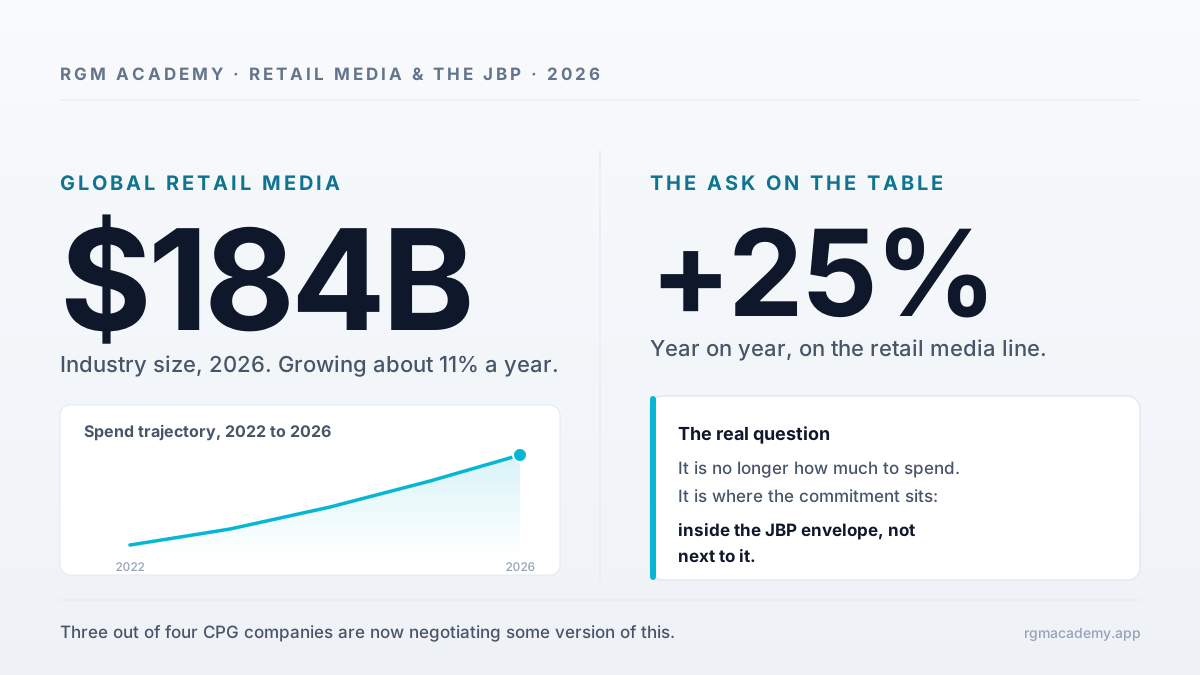
- Retail media reached about 184 billion dollars worldwide in 2025 and is forecast to roughly double by 2030. It is now larger than any single television, search, or display category in the major Western markets.1
- Retailers push it because advertising earns far more than groceries. At Walmart, advertising and membership together approached a third of operating income in one recent quarter, on under 1 percent of revenue.8
- So the retailer's 25 percent year-on-year ask is not a media question. It is a margin upgrade for them, and you cannot answer it with a budget number.14
- The money is already moving. In one survey of 100 United States consumer goods makers, 96 percent had run at least three retail media networks, and nearly half had run six or more.12
- My position: negotiate retail media inside the Joint Business Plan, never as a side channel, and choose how it sits, substitution, addition, or absorption, before the retailer chooses for you.
- The number that settles every case is incrementality, not attribution. The two can differ threefold, and only the incremental one is worth committing against.
You walk out of the annual Joint Business Plan meeting with one number ringing in your ears: 25 percent. That is the retailer's ask on the retail media line, year on year, and it arrives not as a question but as the price of staying a strategic supplier.
What 184 billion dollars actually means
In October 2025 Forrester forecast worldwide retail media spend at 184 billion dollars for the year, growing to 312 billion by 2030 at about 11 percent a year.1 By the end of that run it would reach roughly twice the level of global television advertising. GroupM, measuring the same worldwide pool, lands near 177 billion.2 eMarketer, counting only the United States, sees about 59 billion in 2025 on its way to nearly 70 billion in 2026.3 The three disagree by tens of billions because they scope and count differently. They agree on the thing that matters: retail media is now larger than any single television, search, or display category in the major Western markets.
Two features of that pool shape every plan. It is concentrated. About 81 percent of the world's retail media spend sits in China and the United States, with Europe and Latin America growing faster from a smaller base.4 And the growth is shifting off-site. The slice powered by the retailer's shopper data but served away from its own app, on connected television, social, and programmatic display, is growing two to three times faster than on-site sponsored placements.5 Off-site is no longer the new layer. It is the growth layer.
Why every retailer is now an ad seller
Walmart shows why the retailer can never let the subject drop. Its advertising business reached 4.4 billion dollars in the fiscal year ending January 2024, up 27 percent.6 Two years later the global advertising line was near 6.4 billion, up 46 percent, a figure that now includes its Vizio acquisition.7 That business sits at under 1 percent of Walmart's revenue. Yet in one recent quarter, advertising and membership together approached a third of the company's operating income,8 because the margins are not remotely alike. The grocery business around it earns perhaps 3 to 4 percent at the operating line; the advertising business reportedly runs a gross margin of 70 to 80 percent.9
That gap is the whole story. A retailer reading it off its own accounts treats every extra advertising dollar as close to pure profit, so it keeps asking for more. Walmart is the clearest case, not the only one. Amazon's advertising business cleared 56 billion dollars in 2024.10 Kroger's "alternative profit" streams, retail media among them, delivered about 1.5 billion in operating profit.11 Tesco, Carrefour, and Target run the same play at smaller scale. For the brand, the uncomfortable part is this: the retailer is now in a business with far better margins than the one it has done with you for thirty years, and every list-price concession it trades for a retail media commitment is, on its side, a margin upgrade.
How much of your money is already moving
This is no longer a test budget. In one survey of 100 United States consumer goods makers, 96 percent had run at least three retail media networks in the prior year, and nearly half had run six or more.12 A separate study put 81 percent of advertisers calling retail media very or extremely important to their mix.13 Nielsen's 2025 marketing report found 65 percent of marketers worldwide planning to give it a bigger role, with three in four North American marketers saying it already mattered more than a year earlier.5
The money has to come from somewhere. Take a Consumer Packaged Goods (CPG) brand with 2 billion dollars in sales putting 3 to 5 percent of that into retail media: 60 to 100 million dollars a year, spread across six or more networks. In a mature cost structure that is almost never new money. It is pulled from trade investment, or from brand advertising, or from both. Which one you raid, and whether the move pays back, is the real decision, and it is rarely made on purpose.
When the line item becomes the relationship
So the strategic question is no longer how much retail media to buy. It is how the commitment sits inside the Joint Business Plan (JBP) you negotiate with each major retailer. As one retail media lead at the platform company Skai put it, what was once a tiny test budget has become one of the most significant line items to negotiate in the annual plan.13 The pressure is real. Trade press reported Walmart pushing brands for 25 percent year-on-year increases in retail media, with buyers saying they could not simply walk away given how much of their business runs through the retailer.14
Inside a negotiated plan, the commitment shows up in one of three shapes. Substitution swaps retail media in for trade money, so net spend stays about flat. Addition stacks it on top, so net spend rises. Absorption folds it into the gross-to-net (GTN) deductions, like a listing fee. All three lift the retailer's margin. They part company on what they do to the brand.
In every shape the real question is the same: does the retail media commitment generate enough incremental volume to pay for itself? That question rarely gets a rigorous answer at the table, because the measurement has not caught up with the spend.
Two cases where the math works
Two recent launches show what good looks like. Before PepsiCo bought it in 2025, the prebiotic soda Poppi ran a Black Friday online push that sold out in under a day. The interesting part was not the stockout. Walmart Connect's shopper data during the launch showed taste-led messaging pulling ahead of health-benefit messaging, and the team moved its creative inside the window to match.15 The spend was wired to a feedback loop, so it did more than buy shelf-tags.
Mondelez ran a different shape of test through Albertsons Media Collective, for Sargento Cheese Bakes, a cracker its Nabisco team developed with the Wisconsin cheesemaker Sargento. The campaign paired in-store retail media with matched-market measurement and reported a 14 percent in-store sales lift and 2.41 dollars of incremental Return on Ad Spend (ROAS).16 The lift is not the point. The matched-market design is, because it could tell incremental volume from the base the brand would have sold anyway.
Why 2.41 is the number that counts
A standard return on ad spend on a retail media platform often reads three to five dollars, but it counts sales to people who were always going to buy. The 2.41 dollars in the Albertsons test is a matched-market figure, net of the base that would have sold regardless. It is smaller because it is real: the money the brand made that it would not have made without the ad. In a plan negotiation, the incremental number is the only one worth committing against.
Both cases share a shape. The spend was tied to measurement that could separate real lift from cannibalised base, and the creative could move while the campaign ran. Strip out that integration and retail media is just expensive shelf-tagging.
The four questions before you commit
The Revenue Growth Management (RGM) leader's job is not to decide whether to commit retail media. It is to commit it in a way that survives three years of annual review. Four questions get you there.
Incrementality versus attribution
A retail media platform reports attributed sales: every purchase by someone who saw the ad gets credited to it. Incrementality is different. It measures only the lift against a holdout group that never saw the ad, so it strips out the shoppers who would have bought anyway. The two numbers routinely differ by a factor of two to three. Attribution is the number the platform shows you. Incrementality is the number that defends the spend.
On-site versus off-site retail media
On-site means sponsored placements on the retailer's own app and website, where the shopper is already close to buying. Off-site means the retailer takes its first-party shopper data and buys ads for you elsewhere, on connected television, social, and programmatic display, reaching people before they have chosen a store. A penetration brand usually needs both. All off-site and no on-site buys awareness you cannot convert; all on-site and no off-site misses the earlier decision.
One: are you measuring incrementality, or just attribution? If all you have is attributed sales, you cannot have a defensible budget conversation. Start with a small matched-market test, the design Mondelez used, then make incrementality the default frame for any commitment above a sensible threshold.
Two: is the off-site and on-site split matched to where your brand sits in the shopper's journey? A penetration brand living only on-site leaves reach on the table; a challenger pouring everything into off-site pays for awareness it never converts.
Three: which shape is the commitment taking, substitution, addition, or absorption? Choose it on purpose. A useful rule is that whoever owns trade terms also owns the retail media commitment, so no one is tempted to win one line by quietly losing the other.
Four: what is the chain back to baseline? Retail media campaigns and promotions overlap, and both sides will claim the same lift unless the measurement nets it out. If neither does, the return on both is overstated, and the commitment that follows is built on double-counted air.
What to do Monday
The reflex when you see a 184 billion dollar forecast is to ask how much to spend. That is the wrong question. The right one is how much of your existing trade money, brand advertising, and innovation budget should be reorganised around retail media, which retailer commitments deserve which shape, and what measurement standard you will hold them to.
Monday morning, do three things. Put the retail media commitment on the same page as trade investment, owned by one team rather than split across two. Insist on incrementality, not attribution, for anything above a real threshold. And review the commitment inside the annual plan with the same seriousness you give listing fees and promotional support. The 184 billion is real and the growth is real. For any single brand, the answer is not one number. It is a portfolio of six or more decisions, made on purpose.
References
- Forrester, Global Retail Media Forecast, 2025 to 2030: worldwide retail media spend grows from 184 billion dollars in 2025 to 312 billion by 2030 at an 11 percent compound annual rate, reaching about twice global television ad spend by 2030. Published 9 October 2025. forrester.com
- GroupM (WPP Media), This Year, Next Year 2025: worldwide retail media estimated near 177 billion dollars in 2025. wppmedia.com
- eMarketer, US retail media ad spending: about 59 billion dollars in 2025 and nearly 70 billion in 2026. emarketer.com
- eMarketer, China and the US account for about 81 percent of worldwide retail media ad spend, March 2025 forecast. emarketer.com
- Nielsen, 2025 marketing report: off-site retail media is expected to grow two to three times faster than on-site (citing eMarketer); 65 percent of marketers worldwide planned a bigger retail media role, and 74 percent of North American marketers said it had grown more important than a year earlier. nielsen.com
- Marketing Brew, Walmart's advertising business reached 4.4 billion dollars in the fiscal year ended January 2024, up 27 percent. marketingbrew.com
- Walmart, fourth-quarter and full-year fiscal 2026 earnings release: global advertising grew 46 percent to nearly 6.4 billion dollars, including Vizio. stock.walmart.com
- Modern Retail, in Walmart's third quarter of fiscal 2025 advertising and membership combined approached a third of quarterly operating income (6.7 billion dollars), November 2024. modernretail.co
- Sherwood News and Reuters, Walmart CFO: advertising gross margins reportedly run in the 70 to 80 percent range (2023 guidance). sherwood.news
- AdExchanger, Amazon advertising revenue reached about 56 billion dollars in 2024, with 17.3 billion in the fourth quarter. adexchanger.com
- Kroger annual report (Form 10-K), fiscal 2025: the alternative profit businesses, including retail media, delivered about 1.5 billion dollars in operating profit. Kroger Form 10-K, fiscal 2025
- Marketing Charts, citing NielsenIQ and Coresight Research: in a survey of 100 US consumer goods manufacturers, 96 percent had used at least three retail media networks in the prior year and 46 percent six or more (reported early 2024). marketingcharts.com
- Skai, Joint Business Plan and retail media: 81 percent of advertisers rated retail media very or extremely important, and the retail media line is now one of the most significant in the annual plan to negotiate. skai.io
- Digiday, Walmart reportedly pushed brands for 25 percent year-on-year retail media increases; buyers cited the scale of their Walmart business as the reason they could not walk away, March 2025. digiday.com
- Winning With Walmart, Poppi ran a Black Friday online launch that sold out in under a day and used Walmart Connect shopper data to adjust creative mid-launch; PepsiCo completed its acquisition of Poppi in May 2025. winningwithwalmart.com; pepsico.com
- Marketing Dive, Mondelez measured a Sargento Cheese Bakes campaign through Albertsons Media Collective using matched-market design: 14 percent in-store sales lift and 2.41 dollars of incremental return on ad spend. Sargento Cheese Bakes is a Nabisco and Sargento collaboration. marketingdive.com
Keep going
Pair this with the lessons that build the muscle behind the four questions, and with the sister pieces on trade money.
More from the blog
On-Invoice or Off-Invoice Trade Money. The gross-to-net mechanics underneath the absorption pattern, and why where a dollar sits changes who it really helps.
The Case for Ending Half Your Promo Plan. Why so much trade money fails its ROI test, which is exactly the budget retail media is now competing for.
Why CPG Promotions Destroy Value. The three metrics that separate real lift from volume you would have sold anyway, the same incrementality test that decides a retail media commitment.