The Consumer Came Back. They Came Back Different
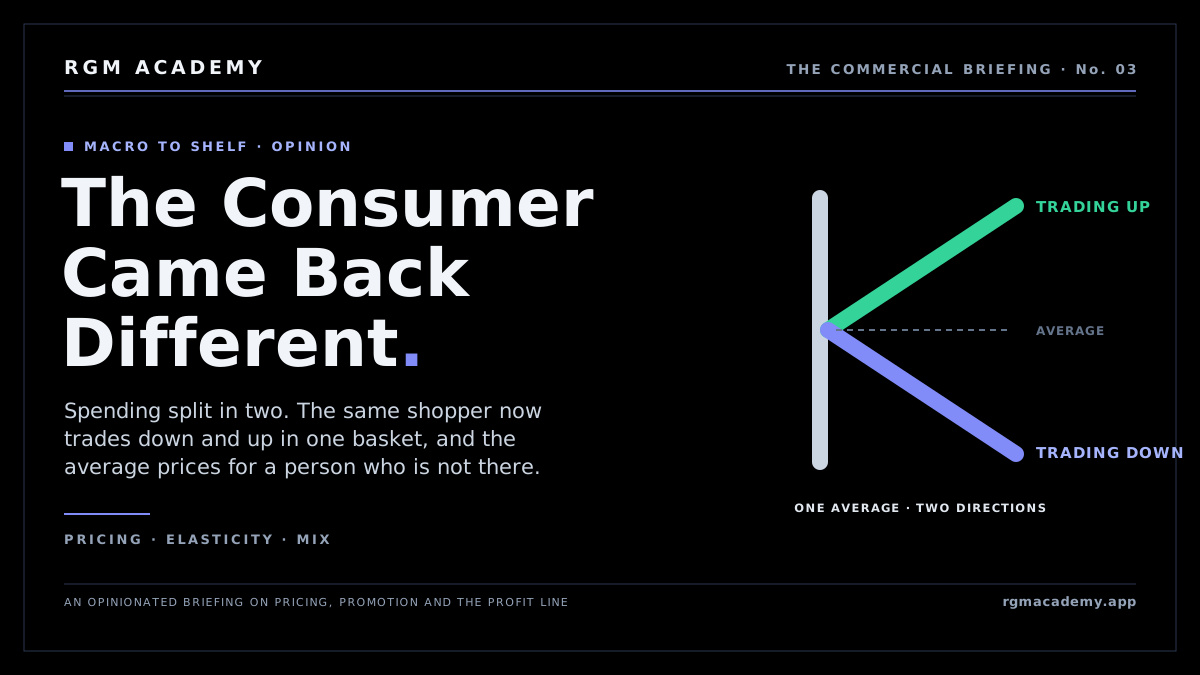
Spending split in two, and managing your brand to the average shopper now bleeds profit.
The short version
- The consumer did not recover, the consumer split. By late 2025, US households earning 150,000 dollars or more were growing their spending by close to 20 percent, while households under 50,000 dollars were flat or going backwards.1 Total spending still rose, which is exactly what hides the problem.
- This is not two tidy groups. The same shopper now trades down and up in one basket: the discounter's own-label staples in the trolley, and a real premium treat sitting next to them. Managing your brand to the average shopper means pricing for a person who does not exist.
- The blended elasticity on your category model is the average of two demand curves moving in opposite directions. It overprices the cohort that will walk and underprices the cohort that would happily pay more.
- Broad promotion makes it worse. You fund a deal for shoppers who would have bought anyway, and you teach your most loyal buyers to wait for the next one.
- The danger hides behind a flat volume line: units can hold steady while the mix slides down-tier and profit drains. Mondelez grew organic revenue 4.3 percent in 2025 while adjusted operating income fell 15.5 percent.3
- My position: stop managing to the average. Re-segment the commercial model by income tier, price and promote to each, and give one person the mix line. The matching move on the shelf is the barbell, and that is its own piece.
The consumer came back. Why does the average tell you nothing?
For two years the trade press asked when the shopper would come back. They came back, and the question turned out to be the wrong one. Spending did not bounce evenly. It bent into two lines heading opposite ways.
By late 2025 the top of the income range was pulling away. Households earning 150,000 dollars or more grew their spending by close to 20 percent year on year, while households under 50,000 dollars were flat or falling.1 Read only the category total and you see gentle growth and relax. Underneath it, one population is premiumising and another is in retreat, and your brand is selling to both as if they were one person.
That averaging is the trap. A category that grows 2 percent can be a premium tier up double digits sitting on a value tier shedding shoppers, netting to a number that describes nobody. The Minneapolis Fed, reviewing the evidence, noted that some of the data looks more like an E than a sharp K, with a stretched middle as a third lane.2 Fair. The exact shape is still argued over. The single-number consumer is not coming back either way.
Two shoppers, or one shopper in two moods?
Some of the split runs between households. Stretched families hold the value end while comfortable ones premiumise. But a lot of it runs through the same person on the same trip. They drop the own-label pasta in the trolley without a second thought, then pay properly for the coffee they actually care about. They are not so much trading down or up as walking away from the middle in both directions at once.
You can hear it in how the operators describe their own demand. Mondelez told investors that in its US biscuit business, shoppers are shifting toward value and club channels at one end while higher-income cohorts drive premiumisation at the other, in the same quarter.3 Procter and Gamble described the comfortable shopper buying bigger club packs to chase value, and the squeezed one running the kitchen cupboard down to empty before buying again.4 Two coping strategies, often in the same trolley, and a single average price aimed at neither.
The premium shopper left the premium aisle
The split is not only what people buy, it is where. The affluent shopper you picture in the upmarket grocer is increasingly standing in the discounter. Aldi's US store visits rose 8 percent in 2025 while the grocery sector grew about 3 percent, and the share of grocery spend going to traditional supermarkets fell 7 points among households earning over 100,000 dollars.5 Walmart, for its part, said the majority of its recent share gains came from households earning more than 100,000 dollars.6 If your channel plan still assumes premium buyers live in premium stores and value buyers in value stores, it is built on a map that no longer exists.
Why your elasticity number is wrong
Most pricing models carry one elasticity per category, a single figure for how much volume you give up when price goes up. In a split market that figure is a blend of two curves that barely resemble each other.
Elasticity, in plain words
Elasticity is just how sharply your sales fall when you raise the price. An elasticity of minus 2 means a 1 percent price rise costs you about 2 percent of your volume. The catch is that it is an average. A stretched shopper might sit near minus 3, quick to drop you for the own-label right beside you. A committed premium shopper might be minus 0.4, barely noticing. One category number blends them into a shopper who is not actually in the aisle.
Price to the average and you collect the worst of both ends. The rise is too steep for the value shopper, who leaves faster than your model predicted, straight into the arms of private label, which has already crossed half of all grocery units sold across Europe's six biggest markets.7 The same rise is too timid for the premium shopper, who would have paid more for the thing they chose for reasons that were never mainly about price. You lose volume at one end and leave money at the other, and the blended number reported that everything was on track.
Your promotions are funding the wrong shopper
When the value cohort gets touchy, the reflex is to promote. It is the most expensive reflex on the table. Across those six European markets, 34 percent of branded units now sell on deal, against 14 percent for private label.7 Brands are discounting at more than twice the rate of the own-label they are trying to hold off.
The trouble is who the deal reaches. A broad price-off is paid to everyone who buys on it, including the loyal shopper who would have paid full price, and only a fraction of the extra volume is ever genuinely new. Run that calendar for a few years and you have taught your best buyers to wait for the discount and taught the stretched ones that your brand is worth having only when it is cheap. That is volume rented from one cohort and margin given away to the other, in a single mechanic.
The danger hides in a flat volume line
It shows up cleanly in the accounts, and it is easy to miss. When the mix slides down-tier, total volume can hold steady while profit quietly drains. Mondelez is the clean real case: organic revenue up 4.3 percent in 2025, adjusted operating income down 15.5 percent.3 The top line looked healthy. The mix underneath did the damage.
Volume, price, and mix
Three things move your revenue: how many units you sell (volume), what you charge (price), and which products in your range sell (mix). The first two are easy to see, and most dashboards track them. Mix is the quiet one. If shoppers shift from your premium pack to your value pack, you can sell exactly the same number of units at exactly the same prices and still earn less, because the money is in which units sell, not only how many.
The mechanism is worth doing in numbers, because it reconciles and you can rebuild it yourself.
Take a brand selling 100 units across three tiers: 30 premium at 2.00 on a 50 percent margin, 50 mainstream at 1.50 on a one-third margin, and 20 value at 1.00 on a 25 percent margin. That is 155.00 of revenue and 60.00 of gross profit. Now hold total volume flat at 100 units, hold every price exactly where it is, and let only the mix slide as shoppers split: 10 units move from premium to value. Premium falls to 20, value rises to 30, mainstream holds at 50. Revenue is now 145.00 and gross profit is 52.50.
Nothing moved on volume. Nothing moved on price. Yet revenue fell about 6 percent and gross profit fell 12.5 percent. Split it the way the accounts should be read and the volume effect is zero, the price effect is zero, and the entire 7.50 of lost profit is mix. A dashboard watching volume and price, as most do, would show two green lights over a profit leak.
Who owns premium growth versus value defence?
This is where it stalls, and the blocker is rarely the analysis. Marketing owns the brand, sales owns the promotion calendar, finance reports price and volume but rarely mix, and nobody owns the income-tier split. So the model defaults to the average, because the average is the only thing with an owner. Premium launches die in business cases built on cannibalisation no one measured, and the deal calendar drifts to the biggest mid-tier pack because that is where the uplift is easiest to buy.
The fix is structural before it is analytical. Give one person the mix line, revenue and margin per unit across the portfolio, and have them defend it every quarter with the seriousness of the annual price round. Then split the job in two and mean it: someone accountable for premium growth, someone accountable for value defence. One team chasing both will quietly fund the easier half and call it strategy.
What would make me wrong?
If real wages climb and hold positive for the bottom half for a couple of years, and the inflation-scarred memory of paying far more for the weekly basket fades,1 the two lines could converge and the average could mean something again. It is possible. But the value habit has outlasted the inflation that taught it, private label keeps taking share through good periods and bad,7 and no measurement house is forecasting the convergence. I would not plan a portfolio around it.
What would I do on Monday?
Three moves. First, split your category volume and share by income cohort, not just by brand, before the next pricing or promotion round, so you can finally see the two curves your average is hiding. Second, price and promote to each: protect the value shopper with pack and entry economics rather than blanket discounts, and give the premium shopper a real reason to pay more rather than a nervous little rise. Third, put the mix line in front of the board the way you would put currency exposure there, with one owner and a number, every quarter.
The shopper who bought your brand on autopilot, somewhere in the comfortable middle, is the one who left. What remains is two shoppers who want opposite things. You can keep pricing for the average of them, or you can serve them both. Only one of those keeps the profit.
References
- NielsenIQ, Decoding America's Great Consumer Split: Inside the New K-Shaped Economy, January 2026: spending growth approaching 20 percent for households earning 150,000 dollars or more while those under 50,000 dollars were flat or declining; essential baskets cost more than 40 percent above 2021. nielseniq.com
- Federal Reserve Bank of Minneapolis (Jeff Horwich), Have US consumers gone K-shaped? A review of the data, March 2026: the divergence may be more E-shaped than K-shaped; the highest-earning 30 percent of households account for more than half of consumer spending. minneapolisfed.org
- Mondelez International fourth-quarter and full-year 2025 prepared remarks, February 2026: organic net revenue up 4.3 percent, adjusted operating income down 15.5 percent in constant currency; in the US biscuit category, a shift toward value and club channels with premiumisation led by higher-income cohorts. ir.mondelezinternational.com
- Procter and Gamble first-quarter fiscal 2026 results, October 2025: less-constrained shoppers buying larger club packs to find value while paycheck-to-paycheck shoppers exhaust pantry inventory before buying again. cnbc.com
- Aldi US expansion and AlixPartners grocery survey, reported January 2026: Aldi store visits up 8 percent in 2025 against about 3 percent for the sector; a 7 percentage point drop in the share of grocery spend going to traditional supermarkets among households earning over 100,000 dollars. cnbc.com
- Walmart fourth-quarter fiscal 2026 earnings call, February 2026: the majority of share gains came from households earning more than 100,000 dollars. fool.com
- Circana, Private label reaches record 50 percent unit share across Europe's six biggest grocery markets, April 2026: 34 percent of branded units on promotion versus 14 percent of private label. circana.com
Keep going
Pair this with the decision guide and the lessons that drill the moves behind it.
Playbook
End or shrink a promotion. The decision guide behind the promotion section here: how to tell when a deal is renting volume from the wrong shopper, and how to wind it down without handing back the shelf.
More from the blog
The Squeezed Middle. The shelf consequence of this demand split, and the portfolio fix: rebuild the middle as a barbell.
Eating the Tariff. The other force hitting the same accounts this year, this time from the cost side.