How to Choose Between Cutting a Price and Improving the Product: The Case of Kraft Heinz
Holding is not free: its cost is the bar a cut or relaunch must clear.
The short version
- Kraft Heinz is spending about 700 million dollars of extra money in 2026, most of it on product and marketing. It cuts base prices only "on case-by-case basis", where prices had passed price points that shoppers notice.
- The Academy's value map shows whether shoppers see enough quality in a brand to support its price. Its scoring rule then judges a price cut, a relaunch and holding the price against one yardstick: what holding costs.
- Holding is not free, and its cost lowers the bar for the other two routes. In a worked example it costs 1.3 million dollars of contribution over three years, and each route then rests on one belief that can add or take away millions of dollars.
- Before choosing, a team should measure what holding loses, write down the belief behind each route and score all three over the same horizon.
What is Kraft Heinz choosing between?
On 11 February 2026 Kraft Heinz paused its planned split and announced "a $600 million investment across Marketing, Sales, and R&D as well as product superiority and select pricing".1 On the results call that day, the chief executive said that across the industry, because of input cost inflation, "we busted through four or five levels of price points in a very accelerated fashion, and the consumer was left very disappointed in that". He spoke of "earning price in the marketplace giving consumers a reason to pay more", according to a transcript of the call.2
Six months on, in the second quarter of 2026, Kraft Heinz's net price rose 1.3 points and its volume and mix fell 2.6 points. The company put Easter timing at about one point of the fall, and an inventory pull-forward at about 0.8 points in the other direction. It raised the year's extra investment to "approximately $700 million".3
In February 2026 the finance chief said "the majority" of the 600 million dollars would go to "more marketing, more R&D, investments in the product and packaging" and to sales staff, with "a portion" for price, according to a transcript of the call. Base price cuts, he said, were for "very selected places" where "we crossed some thresholds".2 For price, the August 2026 results deck lists three moves: better returns on promotions, a "Relentless focus on opening price points" and "Selective base price adjustments on case-by-case basis". For 2026 as a whole it expects a "Slightly positive contribution from price".4 This article deals with the base price.
Kraft Heinz is putting most of its extra money into product and marketing and cutting base prices only where they passed a price point, so the choice it faces, brand by brand, is the one the Academy's value map is built to score.
Where does a brand sit on the value map?
The Academy's lesson on competitive positioning draws the value map: each brand's price against the quality shoppers see in it. Costs explain a price and set its floor, but what shoppers will pay sets the price, and the value map measures that. A brand above the fair value line, the line that shows the price each level of quality supports, asks more than its quality earns, and it tends to lose share slowly.
The value map in two formulas
Fair Value Index = a + b x shopper quality rating. The index is the price a brand's quality earns, as a percentage of the category's average price. Here a is the line's starting level and b is its slope: the index points that one more quality point is worth. Deviation = Actual Price Index - Fair Value Index, where the actual price index is the brand's price as a percentage of the category's average. Within 5 points either side of the line, a brand is at fair value; between +5 and +10 the lesson calls it slightly overpriced, and beyond +10 overpriced. The lesson's own line uses a = -8 and b = 17, and it says the bands are a judgment call to set from a category's own data.
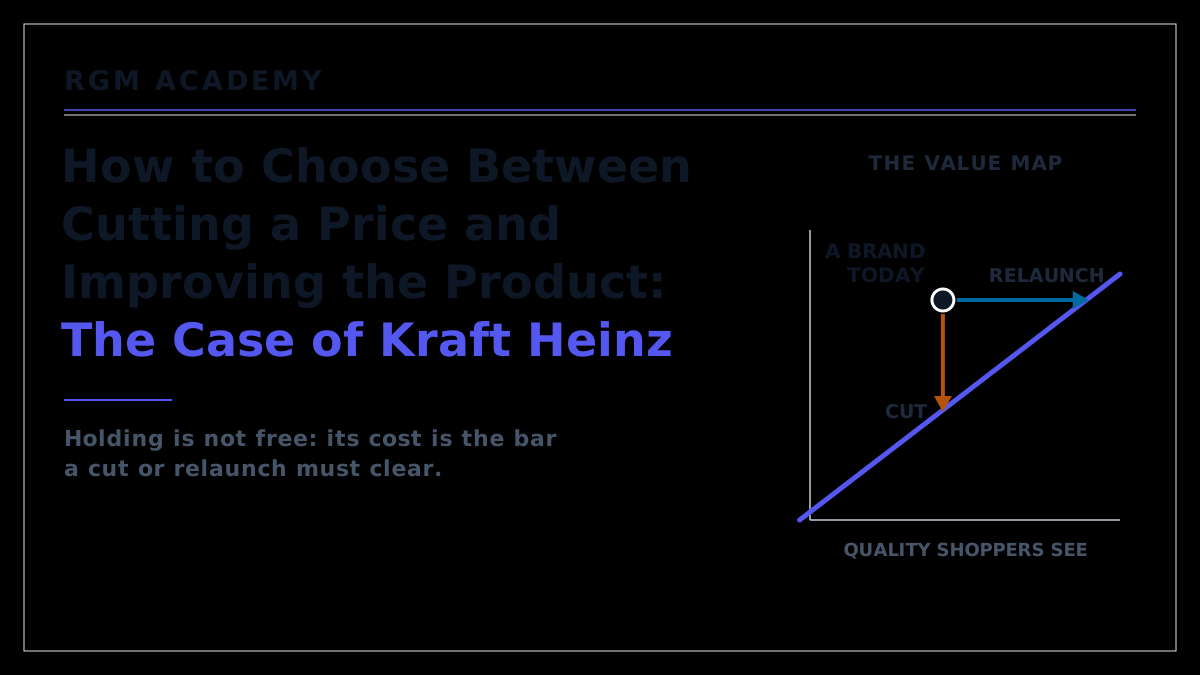
The chief executive's diagnosis reads like a value map: prices rose faster than the quality shoppers saw. The lesson gives a brand in that position three routes: cut the price, which moves it down; relaunch, which moves it right by giving shoppers more quality at the same price; or hold, which leaves it where it is. No source places any Kraft Heinz brand above a line, so the worked example uses an invented brand.
Take a sauce brand with a shopper quality rating of 7.0. On the lesson's line its fair value index is 111 (-8 plus 17 times 7.0). Retailers price it at an index of 122 against the category average, an assumption about their shelf prices, which are each retailer's decision. Its deviation is +11 (122 less 111), one point into the band the lesson calls overpriced.
The value map turns "our price is too high" into a measured distance from the line, which a cut closes by moving down and a relaunch by moving right.
What does holding cost?
Scoring each route against holding
Value of a route = contribution with the route - contribution if you hold. Contribution a year = (net price - cost to make and deliver a pack) x packs - relaunch spend. Holding keeps the price and spends nothing, but in the lesson's model a brand above the fair value band loses a share of its packs each year, and that loss is what the other two routes must beat.
The sauce brand sells 10,000,000 bottles a year at a list price of 3.00 dollars, the price the manufacturer sets and charges retailers. Trade terms take 20 percent, so its net price is 2.40 dollars (3.00 times 0.80). Making and delivering a bottle costs 1.30 dollars, which leaves 1.10 dollars of contribution a bottle, or 11,000,000 dollars a year.
Holding loses 2 percent of bottles a year, the lesson's starting belief: 9,800,000, then 9,604,000, then 9,411,920. Three years of contribution come to 31,697,512 dollars (28,815,920 bottles times 1.10), against 33,000,000 if volume stayed flat. Over three years, holding costs 1,302,488 dollars.
Holding is the yardstick because it has a cost, and that cost is a belief a team can check against its own share data before it chooses.
When does a cut pay?
A 5 percent cut takes the list price to 2.85 dollars and the net price to 2.28 (2.85 times 0.80), so each bottle contributes 0.98. Passing the cut through is each retailer's decision. If retailers pass it through in full, and the category average stays where it is, the brand's index falls to 115.9 (122 times 0.95). Its deviation falls to +4.9 (115.9 less 111), just inside the fair value band, where the lesson's model has the slide stop.
Against standing still, meaning the brand keeps selling 10,000,000 bottles a year at today's price, an outcome holding does not deliver, the Academy's break-even sales change asks for 12.2 percent more bottles. Its formula is cut / (contribution margin - cut). The contribution margin is 45.83 percent (1.10 divided by 2.40), and the 5-point cut leaves 40.83 percent, so 0.05 divided by 0.4083 gives 12.2 percent. Against holding, the bar is lower, because holding is losing bottles anyway. To match holding's 31,697,512 dollars, the cut needs 10,781,467 bottles a year (31,697,512 divided by 0.98 a bottle, then by three years), 7.8 percent above today.
Suppose the nearest rival holds its list price and shoppers respond with a price sensitivity of 1.8, an assumption meaning 1.8 percent more bottles for each 1 percent off the price. Bottles rise 9.0 percent (5 percent times 1.8) to 10,900,000. Three years at 0.98 a bottle earn 32,046,000 dollars, 348,488 ahead of holding, though still 954,000 short of standing still. If the rival matches, take the worst case: the cut wins no bottles, the brand stays as far above the line as before, the slide continues at the lower margin. The cut ends 3,457,910 dollars behind holding (28,815,920 bottles times 0.98, against holding's 31,697,512). One rival's match leaves the other brands' prices where they were, so the real loss would usually be smaller.
The evidence on rivals runs both ways. Across more than 400 consumer product categories, the commonest response to promotion and advertising attacks was none, and a reaction, when it came, was "usually retaliatory in the same instrument".5 That study did not cover list-price cuts. In a Dutch price war started by the retailer Albert Heijn in 2003, "every major competitor carrying the same lines had matched or exceeded the reduction" within two days, but they were other retailers cutting shelf prices, not manufacturers answering a list-price cut.6 Each manufacturer sets its own list price, so the rival's response is a belief to estimate from its public record.
In the example the cut's worst case, if the rival matches, is ten times its gain if the rival holds, so the cut is a bet on one rival's choice.
When does a relaunch pay?
A relaunch moves the brand right on the map: a better recipe, a better pack and stronger claims. In the lesson's model, quality that shoppers have noticed works on volume like a price cut of the same value, through the same sensitivity of 1.8, while the brand keeps its 1.10 dollars a bottle. One quality point is worth 17 index points, 13.9 percent of this brand's shelf price (17 divided by 122). As the brand moves right, its yearly loss of bottles shrinks, and it stops inside the band. A cut pays its discount on every bottle, while the lesson models the relaunch's cost as a fixed budget, here 1,000,000 dollars a year. A better recipe that costs more to make would also take part of the 1.10 on every bottle, and that cost belongs in the contribution line.
Stopping the slide alone does not pay for that budget. Even if the relaunch saves every bottle holding would lose, three years earn 30,000,000 dollars (33,000,000 less 3,000,000 of spend), 1,697,512 behind holding. To break even with holding, it must sell 1,543,193 more bottles over three years than today's level (1,697,512 divided by 1.10 a bottle), about 5.1 percent a year. A relaunch this size has to grow the brand.
Suppose the relaunch adds 0.5 quality points once shoppers have noticed all of it. At the lesson's Medium speed, shoppers notice half in the first year, three quarters in the second and all by the third. Worked through the lesson's scoring formula year by year, the relaunch ends 1,195,775 dollars ahead of holding after a costly first year. At the lesson's Slow speed, they notice a fifth in the first year and about half by the third, and the relaunch ends 986,465 dollars behind. The lesson's break-even quality gain, the quality the relaunch must add to match holding over three years, is 0.35 points at Medium speed and 0.74 at Slow.
Slow is what the research finds on average. Across 241 products in 46 categories over 12 years, "only about 20% of the total effect" of a quality change showed up in the first year, and the full effect took "about six years". The same study found that "high-reputation brands are rewarded three years quicker for an increase in quality".7
A relaunch avoids paying a discount on every bottle, but how fast shoppers notice decides how much better the product must be, and at the slow speed the research finds on average, the quality the relaunch must add doubles.
Is a three-year scorecard fair to a relaunch?
The strongest objection is that three years is too short for a relaunch whose benefit takes six years to arrive in full. Because the lesson stops at three years, extend its slow path in a straight line, this article's own assumption, until shoppers notice all of the gain by year six, as the study found. The relaunch then goes from 986,465 dollars behind holding over three years to 1,567,809 ahead over six, with the spend running all six years. If the spend stops after year three and the better product stays on the shelf, it ends 4,567,809 ahead (the 1,567,809 plus the 3,000,000 not spent). The objection is right about the slow case.
A longer horizon also helps the cut, because holding keeps losing bottles: over six years, with a passive rival, the cut's lead over holding grows from 348,488 dollars to 2,561,043. Counting money that arrives later as worth less, at 8 percent a year, trims the slow relaunch's six-year lead to about 805,000 dollars and the cut's to about 1,759,000. The relaunch loses more of its lead, because its gains arrive late.
Lengthening the scorecard helps every route that stops the slide, so the fair comparison puts all three routes on one horizon, long enough for the slowest, with later money counted at less and the relaunch spend stated as one-time or recurring.
What should a team settle before it chooses?
The lesson's advice is to name the belief each route depends on and ask its owner to commit to it. Sales owns how the nearest rival will respond to a cut, brand and marketing own how much the relaunch adds and how fast shoppers notice, and finance owns what holding costs each year.
Each belief has its own check. The one behind the cut that is easiest to measure is how much holding really loses: if holding loses nothing, the cut ends 954,000 dollars behind it, and if holding loses 4 percent a year, the cut ends 1,616,304 ahead. Kraft Heinz's own deck, using store scanner data, puts the weighted average change in its US retail dollar share at minus 0.68 points in 2025 and minus 0.35 points in 2026 up to 28 June 2026.4 Share has several causes, so the trend is a starting point for the holding belief, not proof of a price problem.
The rival's likely response is read from its public record: the price moves it has announced, and how its prices moved after past cuts in the category's sales data. The relaunch's gain can be tested before the money is spent. A product or concept test that comes back under the break-even quality gain is an early warning.
The lesson adds a reason to prefer the product route when the evidence supports it: rivals take longer to copy a better product than a lower price. Kraft Heinz's mix of routes fits that logic: base price cuts where a price point was crossed, and product and marketing where a strong brand can earn its price. The quality study above found such brands are rewarded three years quicker for a quality gain. Its product route so far runs through new campaigns behind Heinz and Philadelphia and product improvements in Lunchables.48 The list price is the manufacturer's to set, but how much of a cut reaches the shelf is the retailer's decision, so the case for any cut should treat pass-through as an assumption.
A brand above the line can cut, relaunch or hold, and the route worth taking is the one whose belief survives a check, scored against what holding costs over a horizon long enough for the slowest of the three routes to pay back.
References
- Kraft Heinz, "Kraft Heinz Reports Fourth Quarter and Full Year 2025 Results", 11 February 2026: "we believe it is prudent to pause work related to the separation"; "we are today announcing a $600 million investment across Marketing, Sales, and R&D as well as product superiority and select pricing." news.kraftheinzcompany.com
- Kraft Heinz fourth quarter 2025 earnings call, 11 February 2026, transcript published by The Motley Fool: "we busted through four or five levels of price points in a very accelerated fashion, and the consumer was left very disappointed in that"; "the importance of earning price in the marketplace giving consumers a reason to pay more, through innovation, through product, through, performance."; "We do have very selected places where base price makes sense."; "we crossed some thresholds"; "the majority of $600 million is really deployed about"; "more marketing, more R&D, investments in the product and packaging"; "there is a portion of the investment that is geared toward price". fool.com
- Kraft Heinz, "Kraft Heinz Reports Second Quarter 2026 Results; Updates 2026 Full Year Outlook", 5 August 2026: "Price increased 1.3 percentage points versus the prior year period"; "Volume/mix declined 2.6 percentage points versus the prior year period ... a shift in Easter timing, which had an approximate 100 basis point impact"; "Adjusted Operating Income decreased 18.4 percent versus the year-ago period to $1.0 billion, primarily due to increased advertising expenses, unfavorable volume/mix, inflationary pressures in manufacturing and logistics costs, and higher variable compensation expense."; "we are also increasing our incremental investments by $100 million, to approximately $700 million in 2026." news.kraftheinzcompany.com
- Kraft Heinz, second quarter 2026 results presentation, 5 August 2026: "Selective base price adjustments on case-by-case basis"; "Increasing marketing to at least 6% of net sales"; "Increasing R&D to ~0.9% of net sales, supporting innovation, renovation, and productivity"; "Slightly positive contribution from price"; "Strengthening equity through new campaigns on brands like Heinz and Philadelphia"; weighted average US retail dollar share change (0.68) points in 2025 and (0.35) points in 2026, data ending 28 June 2026. North America organic net sales, price and volume/mix: fourth quarter of 2025, 0.0 and (5.4) points (results release, 11 February 2026); first quarter of 2026, +0.4 and (1.5) (results release, 6 May 2026); second quarter of 2026, +1.1 and (3.8) (results release, 5 August 2026). seekingalpha.com; first quarter of 2026
- Steenkamp, Nijs, Hanssens and Dekimpe, "Competitive Reactions to Advertising and Promotion Attacks", Marketing Science, 2005: "in over 400 consumer product categories over a four-year time span"; "the most predominant form of competitive response is passive in nature. When a reaction does occur, it is usually retaliatory in the same instrument". ideas.repec.org
- Van Heerde, Gijsbrechts and Pauwels, "Winners and Losers in a Major Price War", Journal of Marketing Research, 2008: "Albert Heijn planned and executed the cut in complete secrecy. Within two days, every major competitor carrying the same lines had matched or exceeded the reduction." eresearch.ozyegin.edu.tr
- Debanjan Mitra and Peter N. Golder, "How Does Objective Quality Affect Perceived Quality? Short-Term Effects, Long-Term Effects, and Asymmetries", Marketing Science, 2006: "We examine the relationship between objective and perceived quality for 241 products in 46 product categories over a period of 12 years."; "not fully reflected in customer perceptions of quality until after about six years. In the first year after a quality change, only about 20% of the total effect over time is realized."; "High-reputation brands are rewarded three years quicker for an increase in quality". ideas.repec.org
- Kraft Heinz second quarter 2026 earnings call, 5 August 2026, transcript published by The Motley Fool: "We made some product improvements in Lunchables as well, which is showing early encouraging signs as well." fool.com
Keep going
Pair this with the playbook and the lessons that teach the methods behind it.
Playbook
Respond to private label growth. The same choice when the pressure comes from a store brand, including the option to hold the list price and invest in the brand.
More from the blog
When matching a competitor's price cut destroys value, and when it saves your share. The rival's side of the cut route: whether to follow, and what following costs.
The squeezed middle. Why brands priced between premium and value are losing shoppers on both sides.
Three ways brands are fighting back against private label. Its three plays are holding the list price and investing in the brand, reworking price and pack, and premiumizing, with Heinz UK's results from 2022 to 2024.
Lessons inside the course
Competitive positioning →The value map, the fair value line and its bands, and the three routes back to the line scored against holding, all used in this article.Start the lesson → Break-even sales analysis →The volume a cut must win to keep contribution level, the 12.2 percent this article's 5 percent cut needed against standing still.Start the lesson → WTP and consumer value →How the quality shoppers see sets their willingness to pay (WTP), the quality axis of the value map.Start the lesson →Try it free
Willingness-to-Pay Calculator. This link opens it on the tool's own example, a biscuit, with the shelf price raised from its usual 4.29 dollars to 5.29. At a functional quality score of 6, that price sits above what shoppers will pay. The tool shows a surplus (the most they will pay less the price) of minus 0.39 dollars, its version of a dot above the line. This second link raises the quality score to 8, the relaunch route: the most shoppers will pay rises to 5.37 and the surplus turns positive. Free and without sign-up.
Break-Even Calculator. This link opens it on the article's cut: 5 percent off at a 45.8 percent margin needs 12.2 percent more volume against standing still, and a sensitivity of 1.8 delivers 9.0 percent. Free and without sign-up.