What Does a Fifth of Sales in Trade Spend Buy?
A one-page check per customer shows how much of the money is really conditional.
The short version
- Trade spend is typically a manufacturer's largest cost after the goods themselves, yet the accounts make it look like lower prices. The discounts, rebates and promotion money paid to retailers came to about a fifth of gross sales in America on a 2017 estimate.1
- Retailers manage the same money as profit. In 2016 Britain's grocery regulator reported that Tesco had asked suppliers for payments to protect its margin target whether or not sales had grown as planned.2
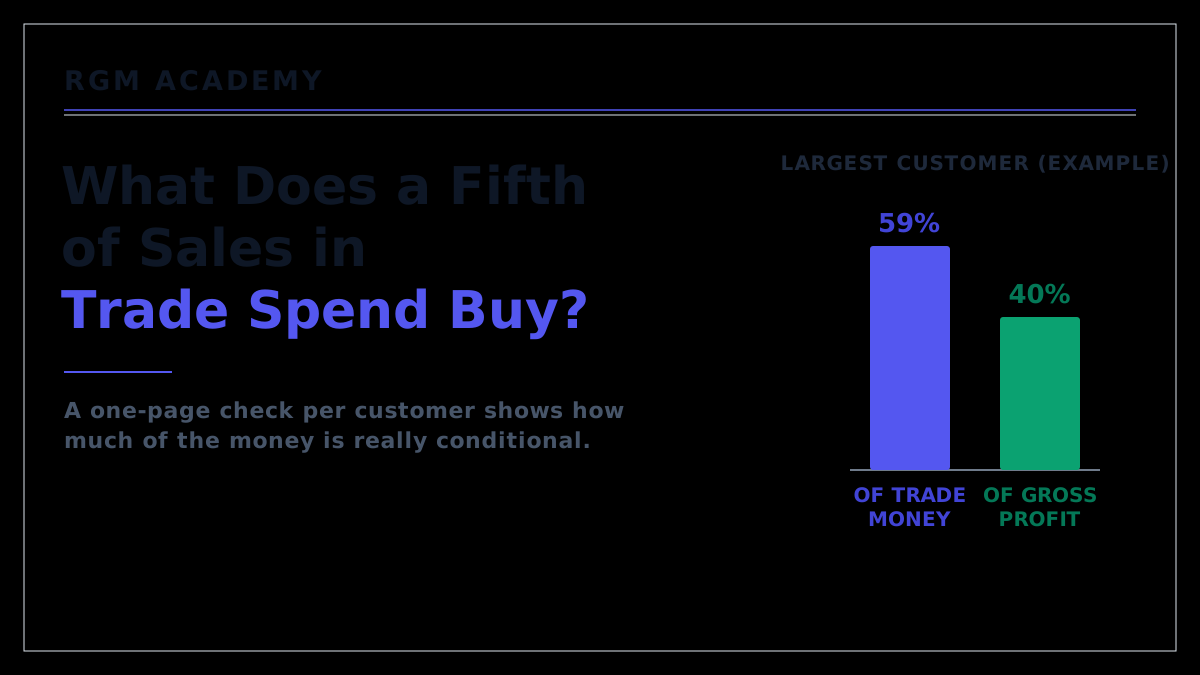
- Money labeled conditional can be paid in full year after year. In the worked example, the biggest customer accounts for half of sales, takes 59 percent of the trade money and earns the manufacturer 40 percent of its gross profit. None of its conditional money has been withheld in three years.
- A one-page check per customer shows what each payment buys. France and Germany treat payments that buy nothing as a legal problem, and Britain's grocery code limits what the biggest grocers may ask suppliers to pay for. The sales team needs the answers before the 2027 negotiations.
How much do manufacturers spend on trade, and who checks it?
For many consumer goods manufacturers, which retailers and regulators call suppliers, payments to retailers are the largest cost after making the products. In 2017 Strategy&, a consultancy, put American trade spending at more than 200 billion dollars a year, about 20 percent of gross sales. In its 2016 survey, 63 percent of executives called their trade spending unsustainable. Only 19 percent had cut it as a share of sales over the previous two years.1
Part of the reason is how the money is booked. Under American accounting rules, a payment to a customer reduces revenue unless it buys a distinct good or service, and PwC's guide concludes that a fee for a prominent shelf position does not count as one.3
In the quarter to May 2026, General Mills' North American retail business reported flat organic net sales, which exclude acquisitions, disposals and currency effects. Price and mix added 2 points and volume took 2 points off. Over the same quarter, Nielsen's measure of its retail sales fell 4 percent. The company attributed the gap to a 2-point benefit from trade expense timing and to changes in retailers' inventories. The same timing added 9 points to the segment's operating profit growth of 7 percent. Without it, profit would have fallen 2 percent (7 less 9).4 The release does not say the timing and the price gain are the same money, but the timing of trade money can move reported sales and profit as much as a pricing decision does.
In the accounts trade spend looks like a lower price rather than an investment, and its return is not shown beside it.
How does the retailer treat the same money?
Retailers book most trade money as a cut in the cost of the goods they buy, so the money goes straight into their gross margin.
In 2016 Britain's Groceries Code Adjudicator reported on an investigation into Tesco. It found that a percentage margin target was a key element of many of the joint business plans (JBP) Tesco negotiated with suppliers. It also found that Tesco had asked for payments to maintain that target "regardless of whether the planned growth had been achieved and regardless of whether Tesco had delivered on its own JBP commitments".2 The case concerns one retailer, but any manufacturer can look for the same pattern in its own agreements: conditions that bind only the manufacturer.
Bain, another consultancy, found in 2021 that only 27 percent of joint annual plans in Europe had grown profit for both manufacturer and retailer over the previous five years. In nearly a quarter, margins fell for both. In the rest, margin moved from one side to the other, more often to the retailer.5
Retailers treat trade money as part of their margin, and most joint plans have not grown profit for both sides.
When is conditional money really conditional?
Conditional and unconditional money
Unconditional money, such as a base discount on the invoice, is paid whatever the retailer does. Conditional money is paid only when the retailer does something agreed. A term is really conditional only if the condition is written down, checked, and set where the retailer could miss it, so that money is withheld when the retailer misses the condition.
An invented biscuit manufacturer with three customers has a list price of 20.00 euros a case. Each case costs 12.00 euros to make, so its gross margin at list price is 40 percent (8.00 euros of 20.00). All its terms are a percentage of the list price.
A national grocer, customer A, buys 500,000 cases a year and receives 25 percent of the list price in four payments: a base discount of 9 percent, a logistics allowance of 3 percent, a growth rebate of 4 percent and promotion funding of 9 percent. A discounter, customer B, buys 300,000 cases and receives 19 percent, almost none of it conditional. A regional chain, customer C, buys 200,000 cases and can earn up to 18 percent, of which 11 percentage points depend on conditions.
In all, the manufacturer pays 4.26 million euros of trade money on 20 million euros of gross sales, which leaves 15.74 million of net sales. Its gross-to-net (GTN) rate, gross sales less net sales divided by gross sales, is 21.3 percent (4.26 divided by 20).
A receives 2.5 million (25 percent of its 10 million euros of sales), B 1.14 million (19 percent of its 6 million) and C 0.62 million. C's figure is 15.6 percent of its 4 million euros of sales rather than the full 18, because C missed some of its conditions.
A accounts for half of gross sales but takes 59 percent of the money and produces 40 percent of the gross profit (1.5 million of 3.74 million euros). C accounts for a fifth of sales, takes 15 percent of the money and produces 26 percent of the profit. Both profit shares are measured before the cost of serving each customer, which could narrow C's lead.
On paper, about half of A's money is conditional: the growth rebate and the promotion funding make up 13 of its 25 points (4 plus 9). The rebate is paid if A buys at least 95 percent of the previous year's cases, a target below what A buys in a normal year; the Academy's lessons call this fake conditionality. The promotion money is paid on every case A buys in promotion weeks, with no check that a display went up. Both have been paid in full for three years.
C's rebate, 5 percent of the list price, depends on its sales to shoppers growing at least as fast as the category, checked each quarter. Its promotion money, 6 percent, depends on displays that the manufacturer checks in store. C earned the rebate in three quarters out of four and passed four display checks out of five. It therefore received 8.55 of its 11 conditional points (three-quarters of 5 plus four-fifths of 6). Its payout rate is 78 percent (8.55 divided by 11).
The payout rate
The payout rate is the money paid on a conditional term divided by the most it could have paid. A rate of 100 percent year after year is a warning sign: usually the condition is set below what the customer would do anyway, or nobody checks it.
The same share, estimated in advance, is the earn rate: the probability that the condition is met. The Academy budgets a conditional term at its expected cost: its full value multiplied by the earn rate.
Best-case ROI
The Academy's best-case return on investment (ROI) is gross profit divided by trade money. It assumes that without the money no case would have sold, so it is the most the money could have earned. For A it is 60 percent: 1.5 million euros of gross profit divided by 2.5 million of trade money.
Even so, A's money pays for itself only if fewer than 37.5 percent of its cases would have sold anyway. With the money, every case earns 3.00 euros (20.00 less 12.00 of cost and 5.00 of trade money). Without it, only the cases that would have sold anyway earn, at 8.00 each. The totals are equal when those cases are 3 in every 8 (3.00 divided by 8.00, or 37.5 percent); above that share, the money loses.
For C the best-case ROI is 157 percent (978,000 euros of gross profit divided by 622,000 of trade money). Where it is below 100 percent, the money pays only if fewer than half the cases would have sold anyway. It falls below 100 percent whenever trade money exceeds half the gross margin at list price. Here that means more than 20 percent of gross sales (half of the 40 percent margin), as at A.
Money is conditional only if the retailer could miss the condition and lose the money.
What does a change in list price do to trade money?
Terms set as a percentage of the list price move with it. If the manufacturer raises its list price by 5 percent and A's terms stay at 25 percent, A receives 125,000 euros more a year (25 percent of the extra 500,000 euros of gross sales) for the same cases and the same activity. Its logistics allowance rises from 0.60 to 0.63 euros a case (3 percent of 20.00 and of 21.00). Full-pallet deliveries save the manufacturer freight and handling costs, and that saving does not rise with the list price.
The rule works in reverse when the manufacturer cuts its list price. A 5 percent cut takes it to 19.00 euros. With A's terms still at 25 percent, each case sold to A earns the manufacturer 2.25 euros instead of 3.00 (19.00 less 12.00 of cost and 4.75 of terms). To earn the same gross profit it must sell a third more cases to A, because 3.00 divided by 2.25 is 1.33.
If A insists on keeping its 5.00 euros of trade money a case, its rate rises to 26.3 percent (5.00 divided by 19.00). Each case then earns 2.00 euros (19.00 less 12.00 and 5.00). The manufacturer must sell 50 percent more (3.00 divided by 2.00 is 1.5). Those extra cases depend on shoppers, and the shelf price is A's decision: A may pass on all of the cut, part of it or none.
Percentage terms give the retailer more money with every list-price increase, and a cut costs the manufacturer most when the retailer keeps its euros per case. Restating each term in euros per case, at the current and the planned list price, shows what a change hands to the retailer.
Why are regulators paying attention?
Regulators now ask what each payment to a retailer buys. French commercial law makes a company liable if it obtains a benefit and gives nothing, or clearly too little, in return,6 and a law of August 2026 requires a retailer that asks for a price cut to back the request with objective evidence.7 In 2018 Germany's Federal Court of Justice upheld the main points of the competition authority's case against Edeka, a grocer that had asked manufacturers to help pay for refurbishing stores it had bought.8
Britain's grocery code bars the biggest grocers from making suppliers pay for a listing or for a better shelf position. The exceptions are promotions and, for listings, genuinely new products.9 The rules differ by country and mainly govern how retailers behave.
A manufacturer that can say what each payment buys is answering the question the regulators now ask.
What should a manufacturer check before the 2027 negotiations?
Many manufacturers do not see their whole bill, partly because it is negotiated at several tables. German retailers now negotiate at regional, national and international level, and a consultant said in August 2026 that manufacturers can lose several points of margin this way without seeing the total.10 One page per customer, covering every level, brings it together. It runs the gross-to-net bridge (gross sales at list price, all trade money on and off the invoice, net sales). It then shows gross profit and the cost to serve, the customer's share of sales, money and profit, the payout rate on each conditional term and the best-case ROI. The key account manager should take it into the negotiation.
At A, the page shows where to act: each payment can be tied to something A does. The rebate would be paid only when A's sales to shoppers grow at least as fast as the category and the agreed displays and leaflet features have run. The promotion money would be paid on displays the manufacturer has checked and on the units shoppers bought during the event, with no link to the price A charges on its shelf, which is A's decision.
On the Academy's planning assumptions, close to C's record, the rebate's earn rate would be 70 percent and the promotion money's 80 percent. The rebate's full value is 400,000 euros a year (4 percent of A's 10 million euros of gross sales) and the promotion money's 900,000 (9 percent). At those earn rates the expected costs are 280,000 and 720,000 euros (full value times earn rate). That saves the manufacturer about 300,000 euros a year (1.3 million less 1.0 million). Returning a third of that to A as higher rates on the conditional terms, the Academy's rule of thumb, leaves 200,000 euros. A's best-case ROI rises from 60 to 74 percent (1.7 million euros of gross profit divided by 2.3 million of trade money), still below 100 percent. The rest of the gap to 100 percent comes from A's base discount, which is a question about list price and channel rather than about conditions.
The strongest objection is that much trade money buys access rather than performance: a discounter's base discount, such as B's, is the price of being on its shelves, and retailers rarely accept conditions on it. Conditions also cost money to run and to dispute, and retailers value conditional money below money they can count on, which is why A gets a third of the saving back. The case for conditions is strongest where, as at A, the money is large and the conditions weak.
In France, suppliers with worldwide sales under 350 million euros must, on a trial basis, close their 2027 negotiations by 31 January 2027.7 Those talks, and the annual rounds elsewhere, are likely to depend more on what each payment buys.
A manufacturer that has tested its trade money customer by customer, and given its sales team the one-page check, can negotiate over activities both sides can verify rather than over percentages.
References
- Strategy&, "Zero-based trade for CPG leaders", 2017: "In the U.S. alone, CPG trade spending exceeds $200 billion annually"; trade spending "is typically the second-largest line item on their P&Ls (behind the cost of goods sold), and it consumes about 20 percent of their gross sales"; 63 percent of executives surveyed in 2016 said their levels of trade spending are unsustainable; "only 19 percent of them reported being able to reduce trade spending as a percentage of sales over the past two years". strategyand.pwc.com
- Groceries Code Adjudicator, Investigation into Tesco plc, final report, 26 January 2016: "A percentage margin target was a key element of many of the Joint Business Plans ("JBP") which Tesco negotiated with suppliers"; "Payments to maintain the margin target were requested from suppliers by Tesco regardless of whether the planned growth had been achieved and regardless of whether Tesco had delivered on its own JBP commitments." gov.uk
- PwC Viewpoint, Revenue from contracts with customers, section 4.6, consideration payable to a customer (ASC 606-10-32-25): consideration payable to a customer is a reduction of the transaction price "unless the payment to the customer is in exchange for a distinct good or service"; in the slotting-fee example, "Producer does not receive a good or service that is distinct in exchange for the payment to Retailer." viewpoint.pwc.com
- General Mills, fiscal 2026 fourth-quarter and full-year results, 1 July 2026: North America Retail fourth-quarter organic volume -2 points, organic price/mix +2 points, organic net sales flat; "the gap driven by a previously expected 2-point benefit from trade expense timing as well as a benefit from changes in retailer inventory"; "Favorable trade expense timing was a 9-point benefit to operating profit growth in the quarter", with segment operating profit up 7 percent. businesswire.com
- Bain & Company, "Growing the Joint Profit Pool of Retailers and Manufacturers in Europe", 11 January 2021: "Only 27% of joint annual plans actually grew the profit for both consumer goods companies and retailers in the past five years"; "nearly 25% of joint annual plans actually resulted in lower margins for both. In the rest of the situations, margin gains merely moved from one to the other, more often to the benefit of the retailer." bain.com
- CMS, on French Commercial Code article L442-1 and the Constitutional Council's October 2022 decision: liability for obtaining or trying to obtain "un avantage ne correspondant à aucune contrepartie ou manifestement disproportionné au regard de la valeur de la contrepartie consentie". In French. cms.law
- French law no. 2026-796 of 18 August 2026, as summarized for the 2027 negotiations: a distributor requesting a price reduction must support it with "éléments objectifs justifiant cette demande"; for suppliers with turnover under 350 million euros, the deadline moves to 31 January 2027 on a trial basis. In French. avocat.fr
- Bundeskartellamt, 29 January 2018, on the Federal Court of Justice decision of 23 January 2018 (KVR 3/17), which confirmed key points of the authority's decision: the court "also regarded the company's demands on the sparkling wine manufacturers to share the costs" for "the refurbishment of outlets by way of a 'partnership reimbursement' as an abuse of bargaining power"; the authority's president: "Hard bargaining is admissible but the abuse of market power is prohibited." bundeskartellamt.de
- Groceries Supply Code of Practice, paragraphs 9 and 12: a retailer "must not directly or indirectly Require a Supplier to make any Payment as a condition of stocking or listing that Supplier's Grocery products unless such Payment" is "made in relation to a Promotion" or is made for products not stocked, displayed or listed by that retailer "during the preceding 365 days in 25 per cent or more of its stores"; nor require a payment "in order to secure better positioning or an increase in the allocation of shelf space ... unless such Payment is made in relation to a Promotion." gov.uk
- Lebensmittelpraxis, "Jahresgespräche 2026", 11 August 2026: retailers negotiate prices and terms "regional, national in den Zentralen und international über mächtige Einkaufsbündnisse"; a consultant: manufacturers lose "mehrere Prozentpunkte Marge, ohne dass ihm der gesamte Umfang überhaupt bewusst ist". In German. lebensmittelpraxis.de
Keep going
Pair this with the playbook and the lessons that teach the methods behind it.
Playbook
On-invoice or off-invoice. Which form of trade money can be taken back, and which turns into a permanent price cut. The first question to ask of every line on the one-page check.
More from the blog
On-invoice versus off-invoice trade money. Where trade money lands in the retailer's accounts, and why money with no condition tends to build retailer margin rather than lower shelf prices.
How promotions destroy value. The three numbers that show whether a promotion paid back. Promotion funding is one line of the bill this article adds up.
The case for ending half your promotion plan. Which events to cut, shrink or keep, once you can see what each one earned.
Lessons inside the course
Trade investment ROI →The best-case ROI, the earn rate and the traps, fake conditionality among them, that make conditional money work like a discount.Start the lesson → Trade terms anatomy →Conditional against unconditional money, and how money paid for a reason drifts into money paid by habit.Start the lesson → Gross-to-net and the value split →The waterfall from list price to net sales, the GTN rate, the expected cost of a conditional term, and who takes most of the trade money, customer by customer: the first part of the one‑page check.Start the lesson → Customer P&L and profit pool →Each customer's share of sales against its share of profit, with the cost to serve added.Start the lesson →Try it free
Gross-to-Net Waterfall. Opens on customer A's terms as the tool's four families: Structural 9 percent (the base discount), Efficiency 3 (the logistics allowance), Performance 4 (the growth rebate) and Promotional 9 (the promotion funding). It shows A's GTN rate of 25.0 percent and the 75.0 percent of the list price the manufacturer keeps. The tool works per unit in dollars on its own example product, listed at 2.80 dollars, so only the percentages are the article's. The same model the Trade Terms lesson on the gross-to-net bridge uses, free and without sign-up.