How Far Can a Brand's Prices Differ Across Europe Before Someone Moves the Goods?
By the cost of moving a case, measured on the price anyone can buy at.
The short version
- The European Commission is preparing rules on what it calls territorial supply constraints, "practices by certain large manufacturers that restrict retailers or wholesalers from purchasing goods in one EU country and reselling them in another, without objective justification". It lists "wholesale price differentiation" among the most frequent practices that could be considered such constraints. Its public consultation runs until 4 December 2026, and a proposal for a regulation is planned for the second quarter of 2027.
- The Academy's corridor is the most a brand's prices can differ between two markets before someone moves the goods: the full cost of moving a case. The price that counts is the exportable price, the list price less the money any buyer gets simply for taking the goods.
- In a worked example, a coffee brand with the same list price in two markets lets a trader, who buys goods in one market to resell them in another, make up to 17,160 euros on every truckload. The cause is how the brand pays its trade terms in one of the two markets.
- The manufacturer can close the gap with its own terms: it keeps the same face value, the total trade money on offer, and turns part of the money paid for taking the goods into money paid for work in the retailer's own stores. If the retailer earns 70 percent of the money for store work (the earn rate), the fix also costs less than the terms it replaces.
What is the European Commission preparing?
On 5 March 2026 the European Commission asked for evidence on "territorial supply constraints", which it defines as "practices by certain large manufacturers that restrict retailers or wholesalers from purchasing goods in one EU country and reselling them in another, without objective justification".1 Its call for evidence names "packaging and labelling differentiation, wholesale price differentiation and refusal to supply" as "the most frequent practices that could be considered territorial supply constraints", and says that "product and price differentiation may sometimes be justified".2
The work is moving toward law. The Commission's public consultation runs from 28 May to 4 December 2026, and its page plans the adoption of a "Proposal for a regulation" in the second quarter of 2027.3 According to the law firm Van Bael and Bellis, six national competition authorities, from Austria, Belgium, Czechia, Greece, the Netherlands and Portugal, expressed, in a letter dated 15 July 2026, "strong support" for legislation that defines prohibited practices.4 Clifford Chance, another law firm, notes that the target is unilateral conduct "by non-dominant suppliers in the fast-moving consumer goods (FMCG) sector that fall outside the current scope of EU competition law".5
Where conduct does fall inside competition law, the Commission has already fined companies for hindering trade between EU countries. In May 2019 it fined AB InBev 200.4 million euros for abusing a dominant position in Belgium by hindering cheaper imports of its own beer from the Netherlands. In May 2024 it fined Mondelez 337.5 million euros for hindering cross-border trade in chocolate, biscuits and coffee.67 AIM, the European brands association, says there is "no credible evidence to justify new EU regulation" and warns that intervention "could lead to higher prices, reduced promotions, or less choice in lower-price markets".8 This article describes these rules and positions as their sources state them; it is not legal advice.
The question of how far a brand's prices may differ across EU countries is moving from competition cases toward a planned regulation, so a manufacturer needs to know which of its price differences it can explain.
What price can a trader actually buy at?
The Academy's lesson Trade Investment ROI (return on investment) has a section called The Corridor: "how far two markets can drift apart before somebody moves the goods for you".
The corridor
Exportable price = list price - the money a buyer receives simply for taking the goods. The lesson calls that money access money: "a structural discount, a logistics allowance, settlement terms". The trade is live, meaning a trader can profit, when exportable price (expensive market) - exportable price (cheap market) > the cost of moving a case. So corridor width = the cost of moving a case: the most two exportable prices can differ before goods start to move. Money a retailer earns by doing work in its own stores never reaches a trader, so, as the lesson puts it, "your corridor is set by your access money on its own".
The test is whether a buyer gets the money just for taking the goods. Whether the money is labeled conditional, that is, paid only when a condition is met, is a different question. A prompt-payment discount is paid to any buyer who pays on time, including a wholesaler who sells on to a trader, so it travels with the goods. A company's trade-terms report can still class it as conditional; the Academy's own Trade Terms Optimizer does so by default. Money paid for agreed work in the retailer's own stores, such as getting the product onto its shelves, displaying it and promoting it to shoppers, stays in that market, because a trader does none of that work.
The price that decides whether goods move is the exportable price, so the money a buyer gets simply for taking the goods, prompt payment included, sets the gap a trader can use.
How wide is the corridor?
The lesson counts the full cost of moving a case: freight, duty, relabeling for the local language, working capital tied up in transit and the trader's own margin, measured "lane by lane", that is, for each route between two markets, and kept current. That can be several times the freight. In a 2020 report, Oliver Wyman compared consumer prices before value added tax (VAT) for health and beauty products across countries. It noted that price differences above 20 percent generally bring a marked rise in cross-border buying, with transport usually costing 2 to 4 percent.9 A 2020 study of these constraints for the Commission assumed extra costs, such as logistics, of "up to 10%" on the cheapest purchase price.10
In points of list price (one point is 1 percent of the list price), corridor = cost of moving a unit / list price, so value per unit sets how narrow the corridor is. At a moving cost of 10 cents a unit, a 1.00-euro product has a corridor of 10 points, a 5.00-euro product 2 points and a 25.00-euro product 0.4 points. Light, valuable products such as coffee sit near the narrow end. Anything that lowers the cost of moving, from cheaper freight to simpler labeling rules, narrows the corridor further.
The corridor is the full cost of moving a case, so in points of list price it is narrowest for valuable products, where a small difference in access money is enough to open a trade.
How much does an access gap hand to a trader?
Take an invented coffee brand that sells the same jar in two neighboring markets at the same list price, 5.00 euros a unit, with all terms as percentages of list price. In market A the retailer receives 30 points of trade money. Of these, 22 points are access money: a structural discount, a logistics allowance and 3 points of prompt-payment discount. The other 8 points are performance money, paid for work in its stores. In market B the retailer receives 22 points: 9 of access money and 13 of performance money. Moving a unit from A to B costs 10 cents all in, and a truck holds 31,200 units. Shelf prices play no part: they are each retailer's decision.
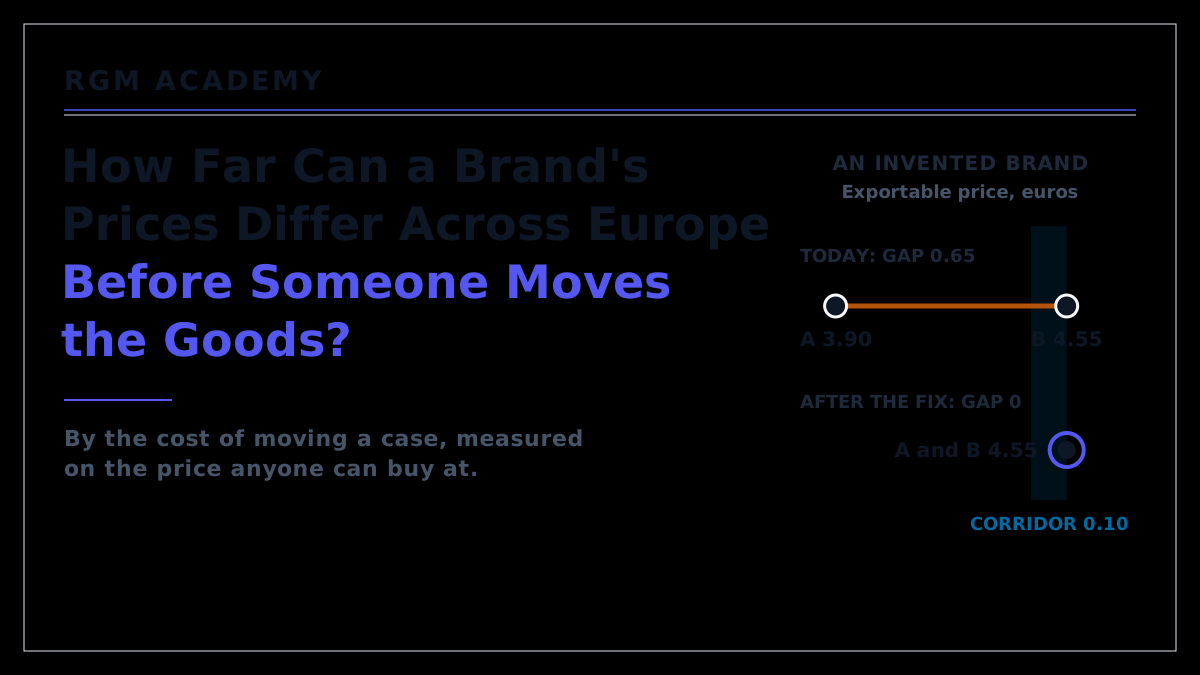
The exportable price is 3.90 euros in market A (5.00 less 22 percent) and 4.55 euros in market B (5.00 less 9 percent). The gap is 0.65 euros a unit, against a corridor of 0.10, so the trade is live. A trader can keep up to 0.55 euros a unit (0.65 less 0.10), on top of the margin already counted in the 0.10. That is 17,160 euros on a truck (0.55 times 31,200). The lesson calls this arbitrage rent, to be split "between the trader and whoever buys from them". The load costs 121,680 euros to buy (3.90 times 31,200), so the rent is 14.1 percent of the purchase price (17,160 divided by 121,680).
The manufacturer's own loss depends on market B's terms. A unit sold there would have brought it 4.55 euros less the performance money paid on it. If the retailer earns 70 percent of its 13 points, that is 4.095 euros (5.00 less 9 percent, less 13 percent times 0.70). So each diverted unit costs the manufacturer about 0.195 euros (4.095 less 3.90), 6,084 euros a truck.
The corridor here is 2 points of list price (0.10 divided by 5.00). A difference of up to 2 points of access money, 11 against 9, would leave a trader nothing after the cost of moving. The actual difference is 13 points, 22 against 9. The example keeps the corridor narrow on purpose, at the low end of the public measures in the previous section. A wider corridor leaves less for a trader but does not close the gap. At the 2020 study's 10 percent of the cheapest purchase price, the corridor is 0.39 euros a unit (10 percent of 3.90), and 0.26 euros a unit is still left (0.65 less 0.39), 8,112 euros a truck.
A 13-point difference in access money opens a 0.65-euro gap against a 0.10-euro corridor, and part of the trader's margin comes out of what the manufacturer would otherwise net in the higher-priced market.
How can a manufacturer close the gap with its own terms?
The lesson's fix leaves the retailer's face value unchanged. The manufacturer offers market A's retailer the same 30 points, but moves 13 points of the structural discount and logistics allowance into performance money paid for agreed work in the retailer's own stores; the 3 points of prompt payment stay. Access money falls to 9 points (22 less 13), so the exportable price in market A rises to 4.55 euros (5.00 less 9 percent), the same as in market B. The gap closes to zero, so the trade stays closed even if the cost of moving a unit falls.
The offer is the manufacturer's to make, and the retailer decides whether to sign it. It is the hardest kind of conversion to sell. After the fix, market A's retailer pays 4.55 euros a unit before any performance money, against 3.90 today, 16.7 percent more (0.65 divided by 3.90). It can earn the 13 points back only once the work is done and checked. In the lesson's own example on the earn rate, a large account will not accept conditions on access money at all, so market A's retailer may ask for the change in steps, with a first-year condition it can meet.
The new money pays for work done in the stores, whatever happens to the goods afterwards. The Commission's 2022 Guidelines on vertical restraints list "refusing or reducing bonuses or discounts if the buyer sells to such customers" among the "indirect measures to induce the buyer not to sell" to particular territories or customers.11 So the terms do not reduce any customer's money because goods were resold or exported.
What the fix costs
The lesson's section Conditionality and the Earn Rate prices conditional money: Expected Cost = Face Value x Earn Rate. Access money is always paid. Performance money is paid only when the work is done, at an assumed earn rate of 70 percent. After the fix, market A costs 9 + (21 x 0.70) = 23.7 points of list price, against 30.0 today if all its money is paid in full. That saves 6.3 points (30.0 less 23.7), or 0.315 euros a unit (6.3 percent of 5.00 euros). Of those, 3.9 points come from the 13 points converted (13 x 0.30, the share left unpaid at a 70 percent earn rate), and 2.4 from paying the existing 8 points of performance money only when the work is done (8 x 0.30). If those 8 points already pay out at 70 percent, the cost today is 27.6 points (22 + 8 x 0.70), and the corridor fix alone saves 3.9.
The retailer loses certainty, and the lesson's section Pricing the Conversion prices that too: budget "about a third of the earn-rate gap as a sweetener", an extra payment that compensates the retailer for that loss. Here the earn-rate gap is the 3.9 points the conversion saves, so the sweetener is 1.3 points. The lesson's one-third rule assumes the retailer marks money at risk down by one seventh, so each point of value that reaches the retailer as performance money costs the manufacturer 7/6 of a point. Paid as performance money, the 1.3 points cost the manufacturer about 1.5 points (1.3 x 7/6). Face value rises by about 2.2 points (1.52 divided by 0.70). The manufacturer still nets about 2.4 points (3.9 less 1.5). On the full 6.3-point saving, a third is 2.1 points. That costs the manufacturer about 2.45 (2.1 x 7/6) and leaves it about 3.85 (6.3 less 2.45).
Paid as access money instead, the sweetener would lower market A's exportable price again. The 1.3 points would reopen a gap of 0.065 euros (1.3 percent of 5.00). The 2.1 points would reopen one of 0.105 euros (2.1 percent of 5.00), above the 0.10 cost of moving a unit. A sweetener paid this way, the lesson warns, "re-inflates the access wallet".
The Academy's free Trade Terms Optimizer, linked under Try it free below, shows the earn-rate side of this fix on its own example portfolio, in dollars.
A manufacturer can close the gap without cutting face value or touching supply or packs, by paying for work in the stores, and at a 70 percent earn rate the fix costs less than the terms it replaces.
What does the fix leave unchanged?
The strongest objection is that closing the gap raises what the retailer in the cheaper market pays the manufacturer on average, and that shelf prices there could follow, much as AIM warns that EU intervention could raise prices in lower-price markets. The fix keeps all 30 points on the table, 21 of them for work in the retailer's stores, but the retailer does lose two things. Unless it does more of the work, its expected income falls by what the manufacturer saves, and money it could count on becomes money it has to earn. The sweetener pays only for the second loss. What happens to the shelf price is the retailer's decision. Leaving the gap open is not free either: besides the rent it leaves to traders, market B's own customers are offered the goods below the 4.55 euros they pay; in the lesson's words, "they want to know why".
The fix leaves a trader nothing to gain, and it does not change what an international retailer compares. The lesson notes that international customers "earn their own rebates, so what they compare across borders is the whole pocket price", the price left after every deduction. In the example, with every point earned, the pocket price is 3.50 euros in market A (5.00 less 30 percent) and 3.90 in market B (5.00 less 22 percent). Simon-Kucher reported in May 2024 that 87 percent of consumer goods manufacturers say their profit is at risk from international retailers and buying groups, while over 60 percent do not proactively manage their net prices at European level.12
In negotiation with an international retailer, the manufacturer's answer is a pocket-price difference it can explain by the work each market's stores do. The Commission's call for evidence gives two examples of when differentiation may be justified: "the need to comply with national regulatory requirements (e.g. on labelling)" and "a company's short-term commercial strategy (e.g. launching a new product)". Whether other reasons count is not settled: the call for evidence sets out four options, from a code of conduct to legislation identifying prohibited practices "and when these practices may be justified".
Shelf prices are likely to keep differing between countries whatever the terms. A study of euro-area scanner data from January 2009 to October 2011 found that producer competition, retail structure, local costs and consumer habits "explain a significant part of branded product price differences across countries", while income levels "are unimportant".13 A trader compares the manufacturer's exportable price, and a shopper the retailer's shelf price.
Narrowing unexplained differences in the exportable price leaves traders nothing to gain. Any difference that remains needs a reason the manufacturer can explain, such as the work it pays for in each market.
References
- European Commission, "Commission seeks views on territorial supply constraints", 5 March 2026: "Territorial supply constraints are practices by certain large manufacturers that restrict retailers or wholesalers from purchasing goods in one EU country and reselling them in another, without objective justification." single-market-economy.ec.europa.eu
- European Commission, call for evidence for an impact assessment, Ares(2026)2422469, 5 March 2026: "the most frequent practices that could be considered territorial supply constraints are packaging and labelling differentiation, wholesale price differentiation and refusal to supply."; "However, product and price differentiation may sometimes be justified. For example, they may be justified by the need to comply with national regulatory requirements (e.g. on labelling) or due to a company's short-term commercial strategy (e.g. launching a new product)."; options from a code of conduct to "Legislation identifying prohibited practices and when these practices may be justified". ec.europa.eu
- European Commission, Have your say, initiative 15252, "Single market: tackling unjustified territorial supply constraints", read 16 October 2026: "Consultation period 28 May 2026 - 04 December 2026"; "Commission adoption ... Planned for Second quarter 2027"; "Type of act Proposal for a regulation". ec.europa.eu
- Van Bael and Bellis, 14 August 2026: six competition authorities (Austria, Belgium, Czechia, Greece, the Netherlands and Portugal), letter dated 15 July 2026 and published on 13 August 2026: "The six competition authorities expressed their 'strong support' for the fourth option, which is the legislative path that defines prohibited practices." vbb.com
- Clifford Chance, 17 March 2026: the call for evidence concerns "unilateral conduct by non-dominant suppliers in the fast-moving consumer goods (FMCG) sector that fall outside the current scope of EU competition law." cliffordchance.com
- European Commission, press release IP/19/2488, 13 May 2019: "The European Commission has fined AB InBev [EUR] 200 409 000 for breaching EU antitrust rules", for abusing its dominant position in Belgium by hindering cheaper imports of its beer from the Netherlands. ec.europa.eu
- European Commission, press release IP/24/2727, 23 May 2024: "The European Commission has fined Mondelez International, Inc. (Mondelez) [EUR] 337.5 million for hindering the cross-border trade of chocolate, biscuits and coffee products between Member States". ec.europa.eu
- AIM (European Brands Association), 28 April 2026: "no credible evidence to justify new EU regulation"; "intervention could lead to higher prices, reduced promotions, or less choice in lower-price markets." aim.be
- Oliver Wyman, report on cross-country arbitrage in consumer goods, published July 2020 (German edition), exhibit 2 of the report's PDF, which compares consumer prices for beauty and healthcare products: "Preisunterschiede >20% fuehren in der Regel zu einem deutlichen Anstieg grenzueberschreitenden Einkaufs (Transportkosten i.d.R. zwischen 2-4 %)" (price differences above 20 percent generally lead to a marked rise in cross-border buying; transport costs usually 2 to 4 percent); consumer prices before VAT. oliverwyman.de
- European Commission (DG GROW), Study on territorial supply constraints in the EU retail sector, by VVA and London Economics, 2020: savings estimated "under the assumption that possible additional costs (such as logistics costs) would increase the actual purchase price by up to 10% relative to the cheapest purchase price". op.europa.eu
- European Commission, Guidelines on vertical restraints (2022/C 248/01), paragraph 204, among the "indirect measures to induce the buyer not to sell to such customers": "(b) refusing or reducing bonuses or discounts if the buyer sells to such customers or making compensatory payments to the buyer if it stops selling to such customers". eur-lex.europa.eu
- Simon-Kucher, 29 May 2024: "87 % of consumer goods manufacturers say that their profit is at risk from international retailers and buying groups that are trying to exploit net price differences. But still over 60 % of consumer goods manufacturers don't proactively manage their net prices on a European level." simon-kucher.com
- H. Dixon, T. Kosma and P. Petroulas, "Explaining the Endurance of Price Level Differences in the Euro Area", Open Economies Review, 2024: "producer market competition, the retail market structure, local costs and consumer habits explain a significant part of branded product price differences across countries"; "income levels (GDP per capita) and unemployment are unimportant"; data from January 2009 to October 2011. link.springer.com
Keep going
Pair this with the playbook and the lessons that teach the methods behind it.
Playbook
On-invoice or off-invoice. Where a trade term lands, on the invoice or after it, and what that decides about the price a buyer pays.
More from the blog
On-invoice or off-invoice: where the trade dollar actually lands. How the contract wording decides where trade money lands, on the invoice or after it; this article adds that the work the money pays for decides whether it travels.
What is revenue growth management? Trade terms as one of six commercial levers, and how they work with pricing, promotion and the rest.
Lessons inside the course
Trade investment ROI →The corridor, the exportable price, the earn rate and how to price a conversion, all used in this article.Start the lesson → Trade terms anatomy →The families of trade money a manufacturer pays, where each sits on or off the invoice, and which of them the retailer has to earn.Start the lesson → Gross-to-net and value split →How list price walks down to invoice price and pocket price, and how the retailer's margin splits around them.Start the lesson →Try it free
Trade Terms Optimizer. This link opens it with the two structural terms switched to conditional at the same face value, on the tool's own example portfolio in dollars: the conditional share rises to 79.6 percent and the expected cost falls to 18.6 percent of gross sales, against a face value of 24.5 percent of gross sales. The tool has no second market, so it shows the cost side of the fix, not the corridor. Free and without sign-up.