Why Promotion Money Buys Less as an Everyday Low Price
The same money buys a fraction of the volume, and is harder to take back.
The short version
- Large grocery retailers are putting more into lower everyday shelf prices. Woolworths had lowered the standard shelf price of 1,035 products in Australia by August 2026, and Tesco launched Everyday Low Prices on 3,000 branded products in Britain in January 2026.12
- Shoppers respond little when a whole category's everyday prices fall. In tests across 86 Chicago supermarkets, published in October 1994, a 10 percent cut raised unit sales by 3 percent.3
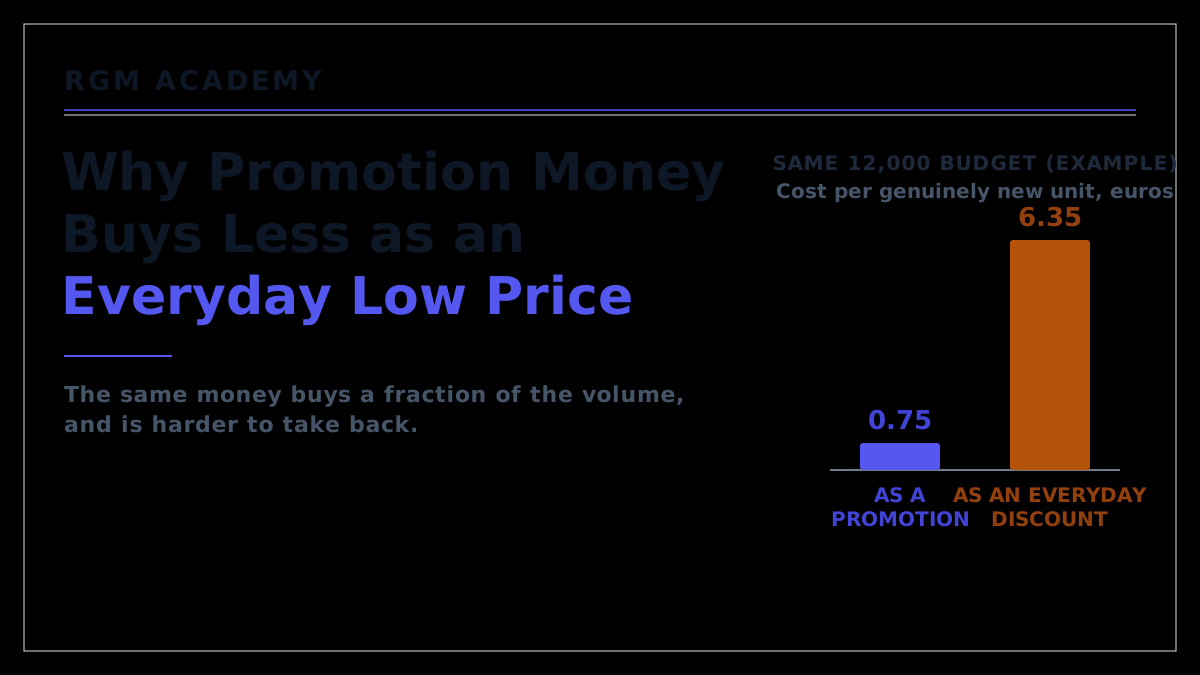
- The same promotion budget buys far fewer new units as a lower everyday cost price, and fails the break-even test. In the worked example, 12,000 euros of a manufacturer's money buys each genuinely new unit for 0.75 euros as a promotion. As an everyday discount, each costs 1.57 to 6.35 euros, depending on whether the retailer lowers rival brands' shelf prices too. That discount needs 14.3 percent more volume to pay for itself and gets 1.6 to 6.8 percent.
- A discount on the invoice is also hard to take back. If the retailer will take the money no other way, a manufacturer that agrees is paying for security rather than volume, and should decide it as a permanent change to its price.
Which retailers are putting more into everyday prices?
Several large grocery retailers lowered standard shelf prices in 2026, a policy known as everyday low prices (EDLP). On 24 August 2026 Woolworths said it would take its Lower Shelf Price program in Australia to 1,035 products that week, on average 16.4 percent below their previous standard shelf price.1 It calls the program its own investment and does not say whether manufacturers contribute. Tesco launched Everyday Low Prices on 3,000 branded products in Britain on 5 January 2026.2 In Australia, a training flyer for manufacturers listed Woolworths' and Coles' ambitions to "Simplify promotions, with a shift toward EDLP".4
The shelf price is the retailer's decision. A manufacturer decides its list price, the discounts it grants on that price and the promotions it funds. A lower everyday cost price for the retailer means a permanent discount on the invoice in place of money paid for specific promotions.
Retailers are cutting standard shelf prices, so a manufacturer needs to know what its promotion budget buys as a lower everyday cost price.
How much do shoppers respond to a permanent price cut?
By its authors' account, the first tightly controlled test of everyday low prices ran in all 86 stores of Dominick's, a Chicago supermarket chain, and was published in October 1994.3 The retailer cut everyday prices across whole categories, moving every brand by the same factor, so shoppers had little reason to switch between brands. A 10 percent cut raised unit sales by 3 percent. About a third of volume was already sold on deal, so the cut lowered the average price shoppers paid by only about 7 percent. That is an elasticity of about -0.4 (3 percent more units for prices 7 percent lower). The effect did not grow over more than 40 weeks.
The cuts were not advertised, so the tests could not show what a branded program does to store traffic, the gain retailers want. For a manufacturer, a shopper who switches stores mostly buys the same pack somewhere else.
The Academy's lesson on price elasticity explains the small response by keeping two measurements apart: shelf price elasticity, the response to a permanent change, and promotional elasticity, the response to a temporary deal. For the same product, the lesson says, promotional elasticity usually runs two to five times higher. A deal prompts shoppers to stock up, switch from rival brands and add unplanned purchases; a permanent price change does none of these to the same degree.
Shoppers respond to deals far more than to permanent price cuts, so a budget moved from one to the other buys much less volume.
What does the same money buy in each form?
Take an invented snack pack. Its manufacturer sells it to one retailer at a list price of 2.00 euros, with no other terms, and it costs 1.20 euros to make, so each unit earns 0.80 euros of gross profit (2.00 less 1.20). The retailer's regular shelf price, its own decision, is 2.50 euros. Without deals the pack sells 120,000 units a year at this retailer. The manufacturer's promotion budget there is 12,000 euros a year, its own money, against its list price.
As a promotion, the manufacturer funds 0.30 euros a unit off its list price on the units shoppers buy in promotion weeks, paid on scanned sales, with a display the retailer has agreed to run. If the retailer passes it all on, its decision, the shelf price falls to 2.20 euros, 12 percent off. Those weeks would normally sell 20,000 units and with the deal they sell 40,000, so the funding uses exactly the budget (40,000 times 0.30).
The Academy's promotion lesson then takes the extra 20,000 units apart, in the steps it calls the net incremental profit bridge. Of those units, 4,000 were not new: they came off the brand's other packs, from shoppers who would have bought in another store, or from purchases brought forward. The other 16,000 are the net incremental volume, the units that are genuinely new. They earn 12,800 euros of incremental gross profit (16,000 times 0.80). After its 12,000-euro cost the promotion makes 800 euros. That is its net incremental profit, and a return on investment (ROI) of 6.7 percent (800 divided by 12,000), which the Academy calls promo ROI.
Paying on scanned sales matters. Forward buying, a retailer stocking up at the deal price, can be 20 to 40 percent of what a retailer buys in during a deep deal on a long-life product, the Academy's promotion lesson warns. It is the strongest case for a lower everyday price, because a discount on every unit all year gives the retailer nothing to stock up for. Even if the 0.30 euros were paid on everything the retailer ordered and 30 percent of that were forward buying, the retailer would order 57,143 units to sell 40,000 (40,000 divided by 0.70), costing 17,143 euros. This promotion would return minus 25 percent (12,800 less 17,143, divided by 17,143), a smaller loss than the everyday discount below.
As a lower cost price, the same 12,000 euros becomes a discount on every unit: 0.10 euros off the list price (12,000 divided by 120,000 units), or 5 percent. If the retailer passed all of it to shoppers, which is its decision, the shelf price would fall from 2.50 to 2.40 euros, or 4 percent. If the retailer lowered the whole category's shelf prices together, as Dominick's did in 1994, the elasticity of about -0.4 applies. Volume rises by 1.6 percent (0.4 times 4), to 121,920 units. Even if all 1,920 extra units are counted as genuinely new, they earn only 1,536 euros of gross profit (1,920 times 0.80). The discount, paid on every unit, costs 12,192 euros (121,920 times 0.10). The promo ROI is minus 87.4 percent (1,536 less 12,192, divided by 12,192).
The Academy's measure for comparing the two is trade spend per incremental unit. As a promotion it is 0.75 euros (12,000 divided by 16,000). As an everyday discount it is 6.35 euros (12,192 divided by 1,920), about eight and a half times as much when the whole category moves.
Over the year the manufacturer's gross profit at this retailer is 96,800 euros with the promotion (120,000 units at 0.80 euros, plus the promotion's 800). With the discount it is 85,344 euros (121,920 units at 0.70 euros, the 0.80 less the 0.10 discount). The same budget leaves it 11,456 euros worse off in the second form.
Trade spend per incremental unit
In the Academy's promotion lesson, promo ROI is incremental gross profit less the promotion's cost, divided by that cost, and trade spend per incremental unit is the cost divided by net incremental volume. Together they give promo ROI as the gross profit per unit divided by the trade spend per incremental unit, less one. The money pays only while each genuinely new unit costs less to win than the 0.80 euros it earns.
The same 12,000 euros buys a genuinely new unit for 0.75 euros as a promotion and for 1.57 to 6.35 euros as an everyday discount, depending on whether the retailer lowers rival brands' shelf prices too. The discount costs more because it is also paid on every unit the pack would have sold anyway.
How much extra volume would an everyday cut need?
The Academy's lesson on break-even sales analysis gives the same answer from the price side. Its break-even sales change (BESC) is minus the price change, divided by the contribution margin plus the price change, both written as percentages of the price. With no other cost that moves with volume, the 0.80 euros of gross profit is also the contribution, so the contribution margin is 40 percent of the 2.00-euro list price. A 5 percent cut therefore needs volume to rise by 5 divided by 35 (40 less 5), or 14.3 percent. With the retailer's shelf price 4 percent lower, that takes an elasticity of about -3.6 (14.3 divided by 4), roughly nine times what the 1994 study measured.
The Academy's pricing lessons start from -1.7, a common planning figure for one brand's own price before anything is measured. Because it is a brand-level figure, it counts the shoppers a brand wins from rivals, which makes it the fairer match for the promotion. Even then volume rises only 6.8 percent (1.7 times 4), or 8,160 units. On all 128,160 units the discount costs 12,816 euros. Each genuinely new unit costs 1.57 euros (12,816 divided by 8,160), about twice the promotion's 0.75. The discount returns minus 49.1 percent (6,528 euros of gross profit on the new units, less 12,816, divided by 12,816).
The example's promotion pays, but more than half of a typical promotion calendar does not, the Academy's promotion lesson says. At -1.7 the discount loses 6,288 euros (12,816 less 6,528), as much as a promotion returning minus 52 percent (6,288 divided by 12,000). Events that lose more than that would lose less as an everyday discount, and less still if they were simply stopped.
Reading the break-even sales change
The break-even sales change says how much volume must change for a price move to leave profit where it was. For a cut the answer is positive: the volume the manufacturer must gain, in the example 5 divided by 35, or 14.3 percent. A deeper cut or a thinner margin raises it quickly, which is why cuts are harder to pay for than rises.
The 1994 study ran the same formula for a retailer funding the cut from its own margin. At a 25 percent gross margin, a 7 percent cut in the prices shoppers paid needed unit sales to rise by about 39 percent to keep the retailer's profit whole (7 divided by 18, which is 25 less 7). The stores got 2 to 3 percent.3 Savings on operating costs do not close the gap: with a 3 percent volume gain, the paper calculated, operating costs would have to fall by 27 percent. Its conclusion, a warning to manufacturers against pushing everyday low prices on retailers, was that "eventually the manufacturer will have to pay for retailers' lost profits".
An everyday discount pays only if volume rises far more than shoppers have been shown to deliver, for whichever side pays for it.
Why is a lower cost price hard to take back?
A promotion that stops paying can be dropped at the next planning round, but a discount on the invoice is harder to withdraw. The Academy's lesson on trade terms explains why: it lowers, for good, the price the retailer records as its cost of buying the product, and a percentage point of discount given to one retailer can spread to others "within a negotiation cycle or two". The gross-to-net lesson therefore treats discounts on the invoice as permanent commitments, and keeps anything that might need adjusting within 18 months off the invoice.
The 1994 authors kept the cost price and the shelf price apart in the same way. A manufacturer's lower price to the retailer, which they called value pricing at the back door, "does not require EDLP pricing at the front door", meaning the shelf price.3 If the retailer in the example keeps its shelf price at 2.50 euros, its decision, volume does not move and the 12,000 euros becomes retailer margin.
A promotion can be stopped when it stops paying, but a discount on the invoice usually stays, so it should be judged as a permanent price.
What should a manufacturer ask for in return?
The strongest case for paying for everyday prices is that it builds the baseline, the sales a brand makes without deals, over years. The 1994 tests, which ran from 16 to more than 40 weeks, were too short to rule it out. A manufacturer that pays on this argument can ask to see the gain in its own baseline sales before it makes the payment permanent.
A targeted cut can work where a whole budget converted at once does not: the manufacturer lowers its list price, with a recommended retail price as direction only, and the retailer may choose to take its shelf price below a price point shoppers notice. General Mills' chief executive said in July 2026 that where the company "invested to get our base prices below key cliffs or narrow the gap to competition", base volume went from a 10 percent decline in fiscal 2025 to 1 percent growth in the fourth quarter of fiscal 2026.5 The company has not said how the investment was funded or whether it paid in profit. The Academy's test applies to any such cut: work out the break-even sales change on the funding, divide it by the expected move in the shelf price, and compare the elasticity that result would need with the one measured at that price point.
If the retailer will take the money only as a lower cost price, and refusing puts the listing at risk, the manufacturer is buying security. In the example that costs 10,656 euros a year against spending nothing (the 12,192 euros of discount less the 1,536 euros of gross profit it brings). In Britain, the Groceries Supply Code of Practice limits when a retailer may require a payment as a condition of listing; other markets have their own rules.6
Money spent knowing it will not pay back can still be the right decision. The Academy's promotion lesson asks that every such case be conscious, documented, time-limited and approved at the right level. For everyday support, that means stating the expected loss as a number. The Academy's trade terms lesson says never to move promotion money onto the invoice. If a retailer will take it no other way, the manufacturer should place there only what it is prepared to give permanently, and pay the rest off the invoice for a set period. That money stays conditional only if, by the same lesson's test, the manufacturer can hold the payment back when the retailer fails to deliver a named, measurable counterpart, something agreed in return. The shelf price stays out of the conditions, because it is the retailer's decision.
A manufacturer that pays for everyday prices should test the money as a permanent price, count it as the cost of a secure listing, and keep on the invoice only what it would give for good.
References
- Woolworths Group, media release distributed by Medianet, 24 August 2026: "taking the total to 1,035"; "on average 16.4% lower than their previous standard shelf price"; "Unlike temporary promotions, Lower Shelf Price offers longer-term reductions on standard shelf prices."; "Woolworths has continued its multi-million dollar investment." medianet.com.au
- Grocery Gazette, 5 January 2026: "Tesco has announced a price slash to 3000 branded products, as part of its Everyday Low Prices scheme launching today"; "close to three times more brands included in the promotions and discounts this year." grocerygazette.co.uk
- Stephen J. Hoch, Xavier Dreze and Mary E. Purk, "EDLP, Hi-Lo, and Margin Arithmetic", Journal of Marketing 58, no. 4, October 1994, pages 16 to 27: "a 10% EDLP category price decrease led to a 3% sales volume increase"; "About one-third of unit volume was sold with some form of promotional support"; "an average elasticity of about -.4"; "the results remained unchanged over periods of more than 40 weeks"; "An EDLP policy reduced profits by 18%, and Hi-Lo pricing increased profits by 15%."; "unit sales would have to increase over 39% to make the same dollar profit after a 7% net reduction in everyday prices"; "an order of magnitude lower than necessary to breakeven profitwise"; "EDLP would need to be accompanied by a 27% decrease in operating costs"; warehouse, shipping and inventory holding costs are "13%-17% of operating costs"; "value pricing at the back door does not require EDLP pricing at the front door"; "it may not be in the best interests of the retailer to pass through 100% of these wholesale price cuts"; a retailer could instead "fund more aggressive promotional activity internally"; "eventually the manufacturer will have to pay for retailers' lost profits." doi.org
- Australian Food and Grocery Council with NextGen Group, training flyer on the 2026 major-retailer range reviews, May 2026, listing the retailers' ambitions, among them "Simplify promotions, with a shift toward EDLP". afgc.org.au
- Food Business News, July 2026, quoting General Mills' chief executive: "in categories where we invested to get our base prices below key cliffs or narrow the gap to competition, we drove a significant improvement in our base volume, which reflects everyday consumer purchases, from a 10% decline in fiscal '25 to 1% growth in the fourth quarter of fiscal '26." foodbusinessnews.net
- Groceries Supply Code of Practice, paragraph 9: "A Retailer must not directly or indirectly Require a Supplier to make any Payment as a condition of stocking or listing", except in relation to a promotion or a new product. gov.uk
Keep going
Pair this with the playbook and the lessons that teach the methods behind it.
Playbook
On-invoice or off-invoice. Which form of trade money can be taken back, and which turns into a permanent price cut. The playbook favors the invoice for everyday-price retailers; this article adds the test to run first.
More from the blog
Why BOGO is dying, and what works instead. The case that everyday support builds the baseline over years, which this article tests against the field evidence.
On-invoice versus off-invoice trade money. Where trade money lands in the retailer's accounts, and the story of Procter & Gamble's move from deals to lower list prices in the 1990s.
The case for ending half your promotion plan. What to do with money from events that do not pay, rather than moving it onto the invoice.
Lessons inside the course
Promo ROI fundamentals →The bridge this article runs twice, from net incremental volume to return on the money, plus trade spend per incremental unit and the rule for money that loses on purpose.Start the lesson → Break-even sales analysis →The break-even sales change behind the 14.3 percent of extra volume the everyday discount needs. It is the formula the 1994 Dominick's study used.Start the lesson → Trade terms anatomy →Why a discount on the invoice lowers the retailer's recorded buying price for good, and how to tell money you can hold back from money you cannot.Start the lesson → Price elasticity →Why a temporary deal sells far more than the same cut made permanent, and how to keep shelf price and promotional elasticity apart.Start the lesson →Try it free
Promo ROI Calculator. Build a promotion's net incremental profit, from the gross profit of its genuinely new units down to what the deal costs, as this article's promotion does. Free and without sign-up.
Break-Even Calculator. Opens on this article's everyday discount, a 5 percent cut on a 40 percent margin, and shows the 14.3 percent of extra volume it needs. The tool's break-even elasticity of -2.86 divides by the 5 percent cut, where the article divides by the 4 percent fall in the shelf price. Free and without sign-up.