Why Frequent Promotions Are Becoming a Legal Problem as Well as a Pricing One
Shoppers and regulators now ask of a deal: how real is the full price?
The short version
- Shoppers and regulators are converging on the same question: did the full price really apply? Under EU law an announced price cut must be measured from the lowest price of the 30 days before it, and Britain plans to consult in autumn 2026 on whether to ban fake "was" prices and misleading recommended retail prices.12
- One number, the share of weeks on deal times the average depth, sets both how expensive the regular price feels and how fast full-price sales wear down. Depth is the percentage off the regular price. In the worked example, a busy calendar leaves the full-price baseline 7.3 points lower after 24 months than a spaced one, worth about 1.13 million euros a year of the manufacturer's sales at list price, on the Academy's illustrative settings.
- In the EU, the gap before each deal decides whether it can be advertised as a saving at all. On a weekly cycle a two-week deal needs five full-price weeks before it, so if every deal is to be advertised as a saving, two-week deals can fill at most 28.6 percent of the year.
- The manufacturer controls the deal weeks it funds and its own recommended retail price. The shelf price and the saving claim are the retailer's.
What has changed in the law on price claims?
Since May 2022, a retailer in the EU that announces a price reduction must show the lowest price it charged in at least the 30 days before. In September 2024 the Court of Justice of the European Union ruled, in a case against the German discounter Aldi Sud, that the announced reduction itself must be measured from that lowest price.1 Aldi Sud had advertised bananas at 1.29 euros a kilo with 1.69 struck through and "-23%", while its lowest price in the previous 30 days had been 1.29. Measured from that price, the reduction was zero; the German court decides the case itself.3
Britain has no 30-day rule. On 30 July 2026 the High Court in London refused a request from the Competition and Markets Authority (CMA) to require the mattress seller Emma to sell at least one product at its advertised full price for every two sold at a discount. Emma had admitted some breaches, and the terms of any order await a further hearing. The judge did accept that "the longer the mattress is advertised" at the discount, "the less realistic" the advertised full price becomes.4 On 9 August 2026 the government announced a consultation for autumn 2026 on whether to add "fake 'was' prices, invented discounts and misleading recommended retail prices (RRPs)" to the practices banned outright.2
The retailer decides the shelf price and makes the saving claim, so under the rule the claim is the retailer's. The manufacturer decides which deal weeks it funds and what recommended retail price it publishes, a direction the retailer is free to ignore.
Regulators now ask whether the regular price was really charged, and the calendar of deals a manufacturer funds goes a long way to deciding the answer.
Why do frequent deals lower the price shoppers expect?
The Academy's lesson on price thresholds treats the reference price, the price a shopper expects to pay, as a running average of the prices the shopper sees, in what it calls the adaptive reference model.
The adaptive reference model, in one line
The new reference price equals alpha times the price just seen, plus one minus alpha times the old reference. With alpha at 0.30, a shopper who expects 4.00 euros and sees 3.00 now expects 3.70 euros (0.30 times 3.00, plus 0.70 times 4.00). Once a pattern of deals settles, the lesson shows, the reference repeats a cycle whose average equals the average price the shopper paid, "at any adaptation rate". Alpha changes only how quickly the reference gets there and how far it swings around that average.
To find the average price a shopper sees, multiply the share of weeks on deal by the average depth, and reduce the regular shelf price by that fraction. So that one number, the share of weeks on deal times the depth, sets how far below the regular price a shopper's expectation sits. The Academy's reference price gap measures how much more expensive the regular price then feels: the actual price less the reference price, divided by the reference price.
The price shoppers expect settles at the average price they see, so the share of weeks on deal times the depth decides how expensive the regular price feels.
What does a busy calendar cost the brand?
Take an invented biscuit pack that sells 100,000 a week at the regular price. Its manufacturer sells it to the retailer at a list price of 3.00 euros. The retailer's regular shelf price is 4.00 euros and its deal price 3.00 euros, 25 percent off, both the retailer's decision. In deal weeks the manufacturer funds the 1.00-euro cut on every pack sold, so it receives 2.00 euros a pack; prices exclude value-added tax, and the funding split is this example's assumption.
The manufacturer compares two calendars of deals it could fund over a year. Calendar A has 13 two-week deals with two full-price weeks between them, so half the year is on deal. Calendar B has seven two-week deals with at least five full-price weeks before each, so 14 of 52 weeks, or 26.9 percent, are on deal.
The share of weeks on deal times the depth is 0.125 for calendar A (half the weeks times 25 percent) and 0.067 for calendar B (26.9 percent times 25 percent). The shopper's reference price therefore rests at 3.50 euros under A (4.00 times 1 minus 0.125, or 4.00 times 0.875). Under B it is 3.73 euros (4.00 times 0.933). At the 4.00-euro shelf price, the reference price gap is 14.3 percent under A (0.50 euros above 3.50, divided by 3.50) and 7.2 percent under B (0.27 above 3.73, divided by 3.73).
The Academy's lesson on baseline and incremental volume uses the same number to model what it calls reference price decay: how the full-price baseline, the volume sold in weeks with no deal, wears down month by month.
Reference price decay, month by month
Next month's baseline equals this month's baseline, reduced by k times the share of weeks on deal times the depth. Here k is the category's sensitivity to repeated deals. The lesson's range, 0.04 to 0.08 a month, is illustrative. To fit your own k, divide the share of the baseline lost each month by the share of weeks on deal times the depth. The lesson calls the formula a working approximation: it keeps compounding for as long as the calendar runs, which is why the example stops at two years.
At 0.06, the baseline falls by 0.75 percent a month under calendar A (0.06 times 0.125) and by about 0.40 percent under calendar B (0.06 times 0.067). Each month's fall compounds. After 24 months the baseline index, where 100 is today's level, stands at 83.5 under A (0.9925 to the power of 24) and 90.7 under B (0.99596 to the power of 24, using the unrounded 0.404 percent).
The 7.3-point gap in the baseline is worth about 1.13 million euros a year of the manufacturer's sales at the month-24 rate (7.27 percent of 100,000 packs a week for 52 weeks, at the 3.00-euro list price). The Academy's public Reference Price Erosion Projector values it the same way. It is a rough size rather than a forecast: it is revenue, not profit, and deal weeks, which sell several times a normal week, can lose more packs than it counts.
Calendar A's six extra deals also sell more packs, so whether calendar B earns more depends on what each deal week earns on the manufacturer's own margin. The baseline lesson puts the ceiling on deal weeks where the full-price volume lost over two years is worth more than the profit the extra deal weeks bring in.
A busy calendar has two costs that event reports do not show: a regular price that feels more expensive, and full-price volume that wears down faster. Both have to be weighed against what the extra deals earn.
When can a deal still be called a saving?
In the EU, a deal can be advertised as a reduction from the regular price only if the regular price applied for the 30 days before it. A deal lasting D days, with a saving from the regular price every time, can therefore run for at most D divided by (D plus 30) of all days.
If every deal starts on the same weekday, as flyer-led promotions often do, the 30-day gap rounds up to five full-price weeks, or 35 days. On that cycle, two-week deals that are each advertised as a cut from the regular price can fill at most 28.6 percent of weeks (14 days in every 49, or 2 divided by 7). That is slightly under the 30 percent the baseline lesson keeps as its planning ceiling, with no measurement behind it. The law itself sets no limit on deal weeks: it governs what the retailer may announce, and longer deals can fill a larger share. Member states may also set different rules for goods that perish quickly. The rule covers announced price cuts; the Commission places multi‑buys such as "buy one, get two" outside it, though still under the general law, so retailers may lean on those mechanics too, and a brand can plan the mechanics it funds with that in mind.5
The 30-day rule, step by step
For a deal the retailer announces as a reduction, find the lowest price it charged in the previous 30 days: the reduction is measured from that price. If an earlier deal fell inside those 30 days, its reduced price counts as a price charged, so a new deal at the same price has no reduction left to announce.5 A deeper deal can still announce the extra cut, measured from the earlier deal price. Under calendar A, each deal follows only 14 days at 4.00 euros, so the lowest price is the 3.00-euro deal price and none of the 13 deals can claim a saving. Under calendar B, each deal follows at least 35 days at the regular price, so all seven can.
The 30-day rule favors fewer, longer deals, because each deal needs only one 30-day gap before it. Long deals meet a second test in both the EU and Britain. The European Commission says the fairness of very long reductions, set against the time at the full price, is still judged under the general law.5 In the Emma case, the seller accepted that an advertised full price misleads unless the product was offered at it for at least as long as at the discount.4 A deal no longer than the 30 full-price days before it passes both tests; a longer one can pass the 30-day rule and still fail the second.
In the EU the gap before each deal now decides whether there is a saving to advertise, and on a weekly cycle a two‑week deal needs five full‑price weeks before it.
How much actually sells at the full price?
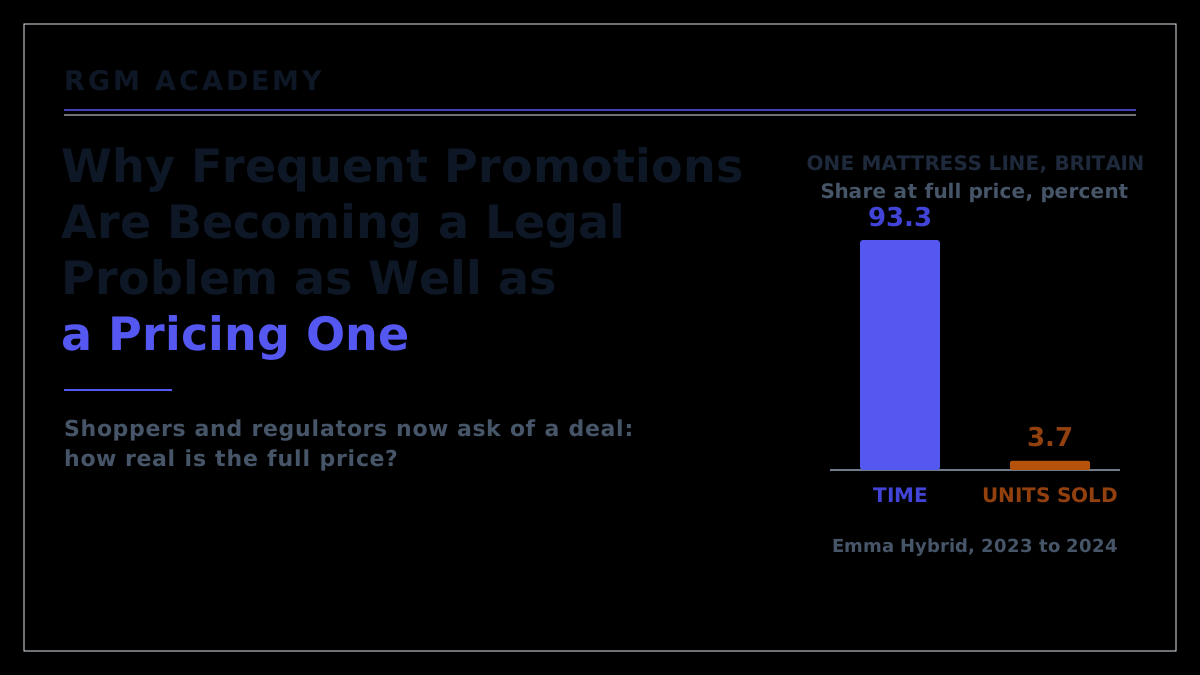
Time at the full price is not the same as sales at the full price. The Emma judgment printed both for four mattress lines in the six months to February 2024. Emma Hybrid sat at its full price 93.31 percent of the time but sold only 3.73 percent of its units there.4 These are mattresses sold online in Britain, and the court refused to turn a ratio of units into a fixed rule.
The manufacturer's own anchor is its recommended retail price. In the EU a retailer's comparison with that price falls outside the 30-day rule but remains fully subject to the general law on unfair practices, and a comparison that shoppers read as a price cut can breach the 30-day rule as well.5 The Academy's price-thresholds lesson makes the same point as a pricing rule: an anchor price is "only fair, and in many markets only lawful" when it is one the pack really sells at. In the EU and Britain, competition law forbids a manufacturer from making retailers charge its recommended price, so what remains in its hands is the recommendation itself.
A recommended retail price that almost nothing sells at is a weak anchor for shoppers and a weak basis for any retailer's comparison, and Britain may ban misleading ones. The manufacturer should check its own recommendation against real sales.
Is it worth funding fewer deals?
Cutting deals carries a risk. In January 2025 Emma began working to the CMA's one-for-two ratio. Its own analysis, cited in the judgment, says it had sold seven discounted mattresses for every one at full price in 2024. In the first three months of 2025 it sold one discounted mattress for every two at full price. The same analysis says its competitors had not changed their approach and that traffic to Emma's website fell. Emma estimated that its net revenue for the quarter fell by 40 to 60 percent. The judge could not find that the change caused the fall but said "there must be a risk that this was the cause".4
Emma changed its whole approach within a quarter, in a category where, the judge found, most shoppers can put off buying until a deal comes. The Academy's approach is gradual: cut the funded deal weeks first on the lines promoted most, expect sales to dip when the deals stop, get that dip approved before starting, and judge the recovery over 18 to 24 months. Calendar B in the example still funds seven deals a year. Part of the money saved can go into support that is not a price cut, such as a display or a place in the retailer's flyer, where a retailer sells that space on its own. That keeps the brand visible without teaching shoppers a lower price, and it needs no saving claim. The retailer can still run and fund any promotion it chooses.
The calendar a manufacturer funds now largely decides how much of the brand's volume sells at the regular shelf price, and in the EU whether the retailer has a saving to advertise, provided the retailer runs no deal of its own in the gaps.
A manufacturer that funds fewer deals should cut gradually, move part of the money into non-price support, and judge the result over two years rather than one quarter.
References
- Court of Justice of the European Union, press release on case C-330/23, Aldi Sud, 26 September 2024: "A price reduction announced in an advertisement must be calculated on the basis of the lowest price in the last 30 days"; the reduction "must be determined on the basis of the lowest price applied by the trader during a period not shorter than 30 days prior to the application of the price reduction."; "The Court of Justice does not decide the dispute itself." curia.europa.eu
- Prime Minister's Office, 9 August 2026: "If something is advertised as half price, it should actually be half price."; a consultation on "fake 'was' prices, invented discounts and misleading recommended retail prices (RRPs)". gov.uk
- Codozasady, note on the Aldi Sud judgment: "selling price EUR 1.29/kg, struck-out previous price EUR 1.69, stated reduction 23%, lowest price over the last 30 days EUR 1.29". codozasady.pl
- Competition and Markets Authority v Emma Matratzen GmbH and others, [2026] EWHC 1995 (Ch), 30 July 2026: "the longer the mattress is advertised at 'GBP 1,000 GBP 750' the less secure the conclusion above would become as the less realistic the GBP 1,000 Reference Price will become as a comparator"; "Imposing a 1:2 FVR would in my judgment involve a very real risk that the line is being drawn in the wrong place."; the time and units table at paragraph 64; "in 2024 Emma sold 7 discounted mattresses for every 1 mattress sold at an undiscounted price"; "Emma also estimated that its net revenue in the first quarter of 2025 fell by 40% to 60%"; "there must be a risk that this was the cause."; buying on discount "arises to a good extent because of the very nature of the product that Emma is selling"; customers "tend to buy a mattress on average every 7-8 years"; "use of a Reference Price is misleading if the product in question has not been offered for sale at the Reference Price for at least as long as it is being offered for sale at the discounted price"; Emma's paper suggested that "because Emma's competitors were not also adopting Emma's approach, there was a reduction in traffic on Emma's website"; "a further hearing in Michaelmas Term 2026 to dispose of these proceedings". gov.uk
- European Commission, Guidance on the interpretation and application of Article 6a of Directive 98/6/EC, Official Journal C 526, 29 December 2021: successive campaigns such as "'Black Friday', 'Cyber Monday' or Christmas sales campaigns"; "the 'prior' price for each successive price reduction is the lowest price during at least the past 30 days, i.e. including the reduced price during the previous promotions"; comparisons with "the manufacturer's recommended retail price" and conditional offers "are outside the scope of Article 6a of the PID but remain fully subject to the UCPD." "Article 6a does not deal with, and does not restrict in any way, price fluctuations and price decreases that do not involve a price reduction announcement"; "The fairness of excessively long price reduction periods in comparison with the time when the good is sold at the 'full' price remains to be assessed under the UCPD." The rules apply from 28 May 2022. Directive 98/6/EC, Article 6a(3): "Member States may provide for different rules for goods which are liable to deteriorate or expire rapidly." eur-lex.europa.eu; eur-lex.europa.eu (directive)
Keep going
Pair this with the playbook and the lessons that teach the methods behind it.
Playbook
End or shrink a promotion. A five-question guide to which promotions to stop and which to make smaller. Its shrink path, fewer windows with longer gaps between them, is the next step for a calendar whose deals can no longer be advertised as savings.
More from the blog
The case for ending half your promotion plan. How frequent deals wear down the price shoppers expect, and which events to cut first.
Why CPG promotions destroy value. The three measures that show what a promotion plan really earns.
Why BOGO is dying, and what works instead. The mechanics that lift volume without teaching shoppers a lower price.
Lessons inside the course
Price thresholds →The adaptive reference model behind this article, the proof that the calendar sets where the reference rests, and why an anchor price must be one the pack really sells at.Start the lesson → Baseline and incremental →The reference price decay formula, the 30 percent planning ceiling both calendars are measured against, and how to estimate your own category's sensitivity.Start the lesson → Promo mechanics selection →Why a temporary price cut wears down the reference price most, and which mechanics lift volume without cutting the price.Start the lesson → Promo ROI fundamentals →What one event really earns, and why more than half of a typical calendar loses money.Start the lesson →Try it free
Reference Price Erosion Projector. Opens on its own calendars, 12 deals against eight over 18 months. Set the horizon to 24 months and the events to 13 against seven, and it shows this article's baselines of 83.5 and 90.7, a gap of 7.3 points worth 1.13 million a year at the list price (the tool counts in dollars). Free and without sign-up.