Why Pack Ladders That Hold on List Price Break on Promotion
Unit-price labels now show shoppers when the bigger pack costs more per kilo.
The short version
- A pack ladder can be right on the price list and upside down on the shelf. In one American chain's year‑end prices, published in July 2003, 11.1 percent of pairs of pack sizes were inverted, with the bigger pack more expensive per unit of measure in the store. About 60 percent of those inversions did not exist at wholesale.1
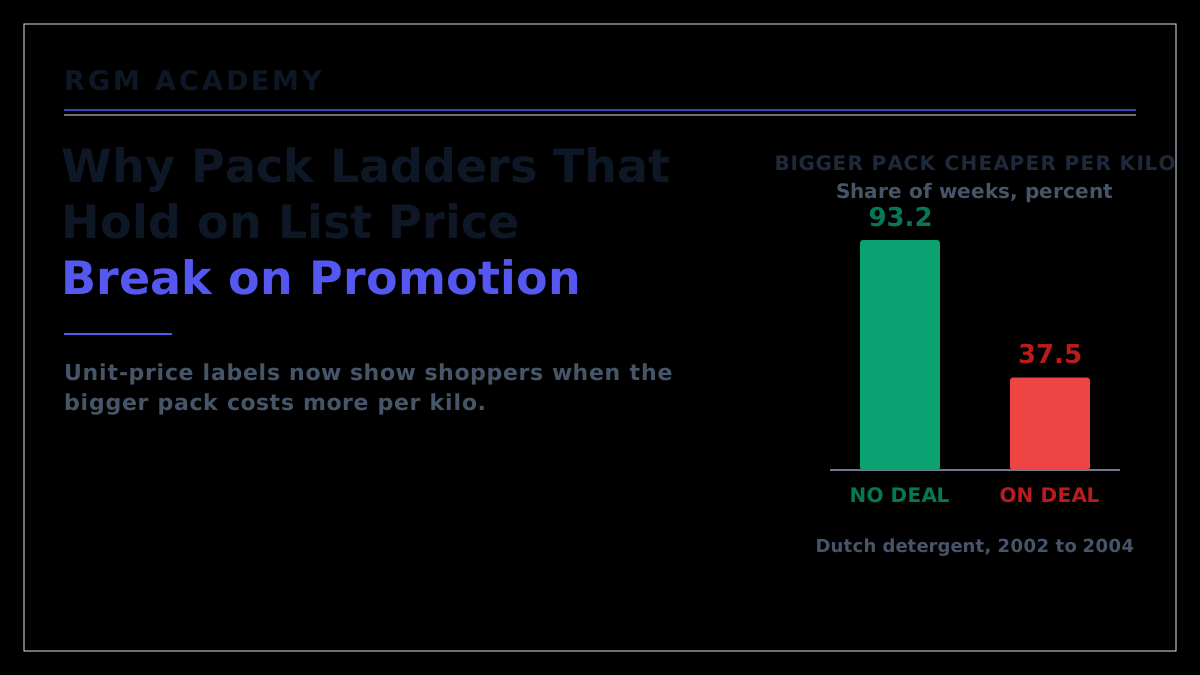
- Deal weeks produce the largest breaks. In one Dutch chain's laundry detergent prices for 2002 to 2004, a promotion on the small pack alone made the bigger pack more expensive per kilo in 97 of 100 cases.2
- Shoppers can now see it. Since 6 April 2026, British retailers must show a unit price, the price per kilo or liter, next to loyalty and multi‑buy prices.3
- The Academy's Incentive Index shows when a deal breaks the ladder, and how to fund one that holds. A deal on the small pack alone turns the ladder over once it is deeper than the bigger pack's saving per kilo. For the brand, meaning the manufacturer, equal money off per pack always narrows its own ladder; at least as much money per kilo on the bigger pack keeps it. The shelf price remains the retailer's decision.
Where do pack ladders break?
A pack ladder is the set of prices per kilo, or per liter, across a brand's pack sizes, and the bigger pack should cost less per kilo. A study of one American grocery chain's year-end prices, published in July 2003, found the bigger pack more expensive per unit of measure in the store in 11.1 percent of 1,247 pairs of pack sizes, across 800 brands. Of those inversions, 39.9 percent already existed in the wholesale price the chain paid. The other 60 percent were created at the shelf: 6.7 percent of all pairs (60 percent of 11.1 percent), or about one pair in fifteen.1
Those came from the retailer's own pricing: in the same study, price setters facing a cheaper competitor cut the price of their fast sellers, often the small pack, and left the bigger pack alone. The chain's margins show the cut: on small packs in inverted pairs it earned 12.5 percent of the shelf price, against 23.4 percent on small packs in pairs where the bigger pack had the lower unit price.1 The authors had no promotion data. They cite earlier one-day audits, which found about one inversion in seven on a temporary promotion, as showing that most are not promotional.1
For Dutch laundry detergent at the market-leading chain, a weekly price record from September 2002 to December 2004 catches every deal week and shows a different pattern. Promotion weeks were about 12 percent of the observations (176 of 1,497) but held 110 of the 200 breaks. When the small pack alone was promoted, 97 of 100 promotions left the bigger pack more expensive per kilo, by a median of 28.2 percent.2
Pack ladders break on the price list itself, and in two ways after it: in the retailer's everyday pricing, and in deal weeks, where the break is larger and the brand's promotion money usually pays for much of the discount.
Why are shoppers more likely to notice now?
Since 6 April 2026, larger shops in Britain have had to show "each selling price and each unit price applicable to the product" when it is offered at more than one price, which covers loyalty prices and multi-buys on identical packs.3
A consumer watchdog has also publicized inversions. On 14 September 2026 Hong Kong's Consumer Council reported on the online prices of three supermarket chains. In 7 of 15 same-brand pack groups, the bigger pack's unit price was 2 to 35 percent higher than the smaller one's "during certain periods". The council did not say whether promotions caused them.4
The authors of the Dutch study concluded that most shoppers did not notice such breaks: the bigger pack's sales fell by only 14.4 percent in the median case (20.5 percent in their model), and for premium brands by nothing measurable. Only value-brand shoppers switched.2 Unit-price labels lower the effort of noticing: a study of canned tuna, published in August 2026, found shoppers in American states that require them "three times more responsive to unit price changes" than shoppers elsewhere.5
Unit-price labels on loyalty and multi‑buy prices, required in Britain since April 2026, now show shoppers the moment a bigger pack becomes more expensive per kilo.
How does the Academy read a pack ladder?
The Academy's lesson on the incentive curve reads a ladder with one number, the Incentive Index, and says to run it "again at deal prices, because a ladder that is clean on shelf prices and broken on deal prices is broken for however much of the year the deal is live". The lesson reads shelf prices, which are the retailer's. A brand can answer only for its own prices, so it runs the same check on its list prices and on its deal-week prices: list price less the promotion money it pays per pack.
The Incentive Index, step by step
Price per kilo = pack price divided by pack weight in kilos.
Incentive Index = bigger pack's price per kilo divided by the reference pack's price per kilo, times 100.
Saving per kilo = 100 minus the index.
The reference pack, usually the everyday size, sits at 100. A bigger pack keeps its promise to the shopper, that it is cheaper per kilo, only while its index stays below 100; at 100 or above the ladder is flat or upside down. Run the check for each bigger pack against the pack one size down, on list prices and on deal-week prices, for every week of the promotion calendar.
Take an invented biscuit brand. Its 250-gram pack, the everyday size, has a list price of 2.00 euros, or 8.00 euros a kilo (2.00 divided by 0.25). Its 500-gram pack has a list price of 3.20 euros, or 6.40 euros a kilo (3.20 divided by 0.50). The bigger pack's Incentive Index is 80 (6.40 divided by 8.00, times 100). Its saving is 20 percent a kilo (100 minus 80).
That 20 percent is a choice about value: the saving a shopper needs before moving up a size. It is not a markdown worked out from the cost breakdown. Every price here is the brand's own price to the retailer; the shelf prices are the retailer's decision.
The Incentive Index has to be run on the brand's deal-week prices as well as its list prices, because a ladder can pass on list prices and fail in the weeks the brand pays for.
What does a deal on the small pack do to the ladder?
The retailer wants a promotion on the 250-gram pack, the fast seller, and the brand considers putting 0.50 euros a pack behind it, 25 percent of its 2.00 euros list price. On the brand's deal-week prices, the small pack now costs 1.50 euros (2.00 minus 0.50), or 6.00 euros a kilo (1.50 divided by 0.25), while the bigger pack stays at 6.40. The index rises to 106.7 (6.40 divided by 6.00, times 100). The ladder has turned over: two small packs cost the retailer 3.00 euros for 500 grams (two times 1.50), against 3.20 for one bigger pack. Funding the same money as a multi-buy changes nothing per kilo, and in Britain whatever multi-buy the retailer puts on the shelf now carries its unit price.
The index gives a general rule: a deal on the smaller pack alone turns the ladder over once its depth, as a share of that pack's price, is greater than the saving, 100 minus the index. Here the deal is 25 percent and the saving 20 percent. Ordinary deal depths are far larger than ordinary ladder savings: in the Dutch data, promotional discounts ran at "25-30%", while the bigger pack's median saving outside promotions was 6.3 percent.2 Even a ladder with a saving of a fifth per kilo, as here, is broken by most deals of ordinary depth.
To keep its own ladder, the brand has to keep its money behind the small pack alone below the per-kilo gap on its list prices: 1.60 euros a kilo (8.00 minus 6.40). On a 250-gram pack that is 0.40 euros (1.60 times 0.25 kilos), or 20 percent of the 2.00 euros list price, the same share as the ladder's saving. The pack roles lesson calls this line "the deepest discount the incentive curve survives". At exactly 0.40 the ladder is flat. A deal of 0.30 euros takes the small pack to 1.70 euros (2.00 minus 0.30), or 6.80 euros a kilo (1.70 divided by 0.25). The index rises to 94.1 (6.40 divided by 6.80, times 100). The bigger pack's saving of 5.9 percent a kilo (100 minus 94.1), though, is below the roughly 10 percent at which, by the incentive-curve lesson's rule of thumb, shoppers notice a saving without a unit-price label.
A deal on the small pack alone breaks the ladder once it is deeper than the bigger pack's saving per kilo, and ordinary deal depths often exceed that saving.
How should a brand fund the deal?
The Academy's lesson on the pack price matrix teaches a rule for price rises that also works in reverse, for a discount: "A flat percentage increase across all sizes leaves the ratios where they were. A fixed cash increase does not", because "the same coins are a bigger per-gram rise on the small pack".
Three funding plans keep the brand's deal-week ladder. Putting 0.50 euros on both packs cuts the bigger pack to 5.40 euros a kilo (2.70 divided by 0.50), so the index rises to 90 (5.40 divided by 6.00, times 100) and the ladder narrows. Taking the same share, 25 percent of list price, off both packs means 0.80 euros on the bigger pack, or 4.80 euros a kilo (2.40 divided by 0.50), and the index stays at 80 (4.80 divided by 6.00, times 100). Putting the same money per kilo on both means 2.00 euros a kilo (0.50 divided by 0.25), or 1.00 euro on the bigger pack (2.00 times 0.50). That takes the bigger pack to 4.40 euros a kilo (2.20 divided by 0.50). The index falls to 73.3 (4.40 divided by 6.00, times 100), steeper than designed. Equal money per pack has a limit: at 0.80 euros on both, each pack comes to 4.80 euros a kilo (1.20 divided by 0.25, and 2.40 divided by 0.50) and the ladder is flat.
Percentage and cash moves on a ladder
The same share off every pack lowers every price per kilo in the same proportion, so the index does not move. The same cash off every pack is a bigger share of the small pack's price, so the small pack falls further per kilo and the ladder narrows. The same cash per kilo is a bigger share of the bigger pack's lower price per kilo, so the bigger pack falls further in proportion and the ladder steepens. A brand that wants its own deal-week ladder to hold should put at least as much money per kilo on the bigger pack as on the smaller one. On the shelf the same holds wherever the retailer passes on the same share of the money on both packs; how much it passes on is its decision.
The safer plans cost more. For every 1,000 packs of each size sold in the event, the brand pays the money per pack on each size times 1,000, added together. That comes to 500 euros under the small-pack-only deal, 1,000 under equal money per pack, 1,300 under the same share of list price and 1,500 under the same money per kilo. Money on the bigger pack also pays for big packs that would have sold anyway, and a ladder steeper than designed, if the retailer passes it on, pulls sales toward the pack that earns the brand least per kilo.
Two fixes keep the ladder at no extra cost: a deal on the small pack alone kept inside the ladder's saving, or the 1,000 euros of equal money per pack spread over both packs as the same percentage of each list price instead. But both make the deal on the fast seller shallower than the 25 to 30 percent the retailer may expect, so the event may sell less, and the retailer can still go deeper at its own expense.
A brand that funds deals with at least as much money per kilo on the bigger pack keeps its own ladder intact; the same money per pack on both sizes narrows it.
What does the brand control?
The brand decides only what its own money pays for; the shelf price, and how much of that money reaches shoppers, are the retailer's decisions. If the brand's deal-week prices are upside down, its promotion money is buying a bigger cut per kilo on the small pack than on the bigger one, whatever the retailer then charges. The Academy's lesson on the incentive curve sets the same kind of funding rule for a bigger pack on deal: "The promoted price stays the retailer's decision, so it can go deeper at its own expense, but your money stops paying for the break." It also warns against turning such a rule into a contract clause that stops the retailer promoting below a set price, which competition law in the EU and Britain treats as resale price maintenance.
The brand's check covers only its own money: if the retailer's everyday shelf ladder is already flatter than the brand's list ladder, a deal inside the per-kilo gap on the list prices can still break the ladder on the shelf.
The shelf price is the retailer's decision, but the brand can make sure its own money never pays for a deeper cut per kilo than its ladder allows, now that shoppers can see a break.
References
- David E. Sprott, Kenneth C. Manning and Anthony D. Miyazaki, "Grocery Price Setting and Quantity Surcharges", Journal of Marketing 67, no. 3, July 2003: "The remaining data set comprised exactly 800 brands and 1247 brand-size pairs."; "the incidence of quantity surcharges was 11.1% at the retail level and 8.4% at the wholesale level"; "Of the surcharges occurring at the retail level, 39.9% also exist at the wholesale level."; "approximately 60% of the retail surcharges in the current data are discounts at the wholesale level"; "Retail price reflects the price the chain had set at the end of the 12-month sales volume collection period"; "The data did not include a promotion field"; "Previous research, however, indicates that the vast majority of surcharges are not created by temporary price promotions", with earlier field studies finding "14.6% of quantity surcharges were on temporary price promotion at the time of the study"; small packs in surcharged pairs carried a 12.5 percent retail margin, measured on the retail price, against 23.4 percent in pairs where the bigger pack had the lower unit price. doi.org
- Sofronis Clerides and Pascal Courty, "Sales, Quantity Surcharge, and Consumer Inattention", University of Cyprus Discussion Paper 2010-07, November 2010, later published in the Review of Economics and Statistics 99, no. 2, 2017: weekly Nielsen data for laundry detergent at the market-leading Dutch chain, September 2002 to December 2004; "% of time with quantity discount 93.2% 37.5%"; "Out of the 100 solo promotions of the small size, 97 result in a quantity surcharge."; "When the small pack is promoted, for example, the median surcharge for the large pack is 28.2%."; "Quantity surcharges occurring during non-promotion periods are substantially smaller, with a median of 5.0%"; "The depth of promotional discounts is in the range 25-30% and is very similar across firms."; Table 2, quantity surcharges in periods without and with promotions: "Quantity surcharge 90 110 200", with 176 of 1,497 observations in promotion periods; "Because quantity surcharges outside promotions are small and infrequent, we do not consider them further"; "the median quantity discount during non-promotion periods for the large pack is only 6.3%"; "sales of the large pack size during a quantity surcharge decrease by only 14.4% in the median case relative to the week preceding the surcharge. Formal econometric analysis yields the higher but still surprisingly low figure of 20.5%"; "For premium brands, however, there is no significant change in sales". ucy.ac.cy
- UK government, Price Marking Order 2004 guidance: "The amendments made by both these orders come into effect on 6th April 2026."; "each selling price and each unit price applicable to the product"; "The boxes are 4 each or 2 for 7 ... both the individual and the offer selling and unit price would need displaying." gov.uk
- Consumer Council, Hong Kong, online supermarket price survey, 14 September 2026: "the Consumer Council's survey on the online prices of 222 products sold by 3 major supermarket chains"; "for 7 product groups, the unit price of the larger pack was about 2% to 35% higher than that of the smaller pack during certain periods". consumer.org.hk
- Xibo Wan, Katherine Harris-Lagoudakis and John M. Crespi, "Shrinkflation, unit price disclosure, and consumer welfare: Evidence from canned tuna", Food Policy 142, article 103106, August 2026: "we show that consumers in regulated states are three times more responsive to unit price changes"; "Price per ounce elasticities are -0.07 in states without disclosure regulations, and -0.26 in states with regulations." doi.org
Keep going
Pair this with the playbook and the lessons that teach the methods behind it.
Playbook
Buy-one-get-one or a price cut. Which mechanic to fund, what each costs the manufacturer on the price it is paid for a pack, and what each does to the price shoppers expect.
More from the blog
Shrinkflation or a price rise. Why shoppers notice a price rise faster than a smaller pack.
The entry pack is the most under‑managed product. Why the smallest pack sets the first rung of the ladder.
Why BOGO is dying, and what works instead. Why the buy‑one‑get‑one lost its place in UK grocery, and what replaced it.
Lessons inside the course
Incentive curve →The Incentive Index this article runs on deal-week prices, the promise a bigger pack makes, and the funding rule, written for a bigger pack on deal, that stops the brand's money paying for a break.Start the lesson → Pack size and price matrix →Why the same percentage leaves a ladder alone while the same cash moves it, and why the ladder must be worked out at promoted prices as well.Start the lesson → Promo mechanics selection →Who decides the promoted price, who decides the money behind it, and how each mechanic lands on the shelf.Start the lesson → Pack roles →Where a bigger pack's index usually sits, and the deepest deal on the everyday pack that the ladder survives.Start the lesson →Try it free
Pack-Size Elasticity Calculator. Enter prices for a biscuit ladder of four pack sizes and read each pack's index. The tool holds no promotional prices, so work the deal-week check by hand, as this article does. Free and without sign‑up.