Why a Manufacturer Should Offer a Better Cut in a Range Review: The Case of Australia's Supermarkets
A retailer's chosen cut often costs the manufacturer most, so the manufacturer should offer another.
The short version
- Australia's two largest supermarkets are cutting ranges while they reset shelf prices, promotions and terms. An industry training flyer from May 2026 said this means suppliers "negotiating the full commercial relationship at once".1
- The line a retailer chooses to cut often costs the manufacturer more than it costs the retailer. When an item is missing, only the 19 percent of shoppers who switch to another product of the same brand in the same store keep the sale for both.2 In a range review the retailer picks lines whose shoppers will stay in its store.
- The cheapest line to lose is often not the slowest seller. Run once for each side, the Academy's delisting sum finds a swap in this article's worked example that saves the manufacturer 5,460 euros of gross profit a year and leaves the retailer 2,720 euros of margin better off.
- A manufacturer can estimate where shoppers will go before the review. The Academy's consumer decision tree, an out-of-stock test and an overlap check give a working answer.
What are Australia's supermarkets changing in 2026?
Woolworths and Coles are each cutting their ranges under separate programs: the Customer Offer Reset at Woolworths and Supplier Partnership at Coles. A flyer the Australian Food and Grocery Council posted in May 2026 for a paid training course called the reductions "significant" and said that for suppliers, as Australia's Food and Grocery Code calls manufacturers, this means "negotiating the full commercial relationship at once".1
Woolworths linked 7.1 percent growth in grocery food sales at its Australian supermarkets in the year to June 2026 to in-store execution, "including simplified ranges and availability alongside a shift towards Lower Shelf Prices".3
The changes are reaching the Code Mediator, whom each large supermarket must appoint under the Code to handle supplier complaints. In the year to June 2026, Woolworths' mediator advised 28 suppliers on topics including the conduct and outcomes of range reviews, the Customer Offer Reset and delisting decisions.4
Range, trade terms and promotions are being negotiated in one exercise while the retailer resets its shelf prices, so a manufacturer needs a view on which of its lines it can best afford to lose.
Why does the retailer's chosen cut usually cost the manufacturer more?
Researchers usually group what shoppers do when a product is missing into five responses. A composite of 29 studies of more than 71,000 shoppers in 20 countries, published in January 2005, gives the averages shown below.2
The retailer keeps everyone who buys something else in its store: 45 percent (19 who switch inside the brand plus 26 who switch brand). The manufacturer keeps everyone who stays with its brand, in that store or another: 50 percent (the same 19 plus 31 who buy the item at another store). Only the 19 percent who buy another of the brand's products in the same store keep the sale for both. The study counts the 15 percent who delay as buying later in the same store, an option a delisting removes, so the averages are a guide to direction rather than a measured rate for a delisting.
On these averages the manufacturer keeps slightly more shoppers than the retailer. A range review is not an average stock-out: the retailer picks the lines whose shoppers will stay in its store, often by moving to another brand or the store brand.
In Australia a manufacturer has few other places to sell at scale. A government review in June 2024 put the combined share of Woolworths and Coles at just over 65 percent and said delisting from a major chain "can have large commercial consequences".5
The retailer keeps every shopper who stays in its store and picks the cuts it will miss least, so the lines it picks usually cost the manufacturer more.
What does the same cut cost each side?
Take an invented cracker manufacturer with three lines at one retailer: Original (its best seller), Sea Salt (22,000 packs a year) and Rosemary (18,000, the slowest seller). To free one line's shelf space the retailer plans to cut Rosemary, and the manufacturer considers offering Sea Salt instead. The manufacturer earns 0.70 euros a pack on each line: its net price after trade terms, less the cost of goods sold (COGS). The retailer earns 0.80 euros of margin on any branded pack, including the trade money it receives and after handling costs, and 0.70 euros on its store brand, at shelf prices that are its own decision.
Stock-out records and loyalty-card data at this retailer give an estimate of where each line's shoppers would go. If Rosemary goes, 20 percent move to the manufacturer's other lines, 35 percent to other brands and 15 percent to the store brand, and 30 percent buy no crackers in that store. If Sea Salt goes, the shares are 70, 15, 5 and 10 percent.
Each line therefore has two transfer rates. The manufacturer's is the share that moves to its own lines: 20 percent for Rosemary and 70 percent for Sea Salt. The retailer's is the share that stays in its cracker section, whichever product it moves to: 70 percent for Rosemary (20 plus 35 plus 15) and 90 percent for Sea Salt (70 plus 15 plus 5).
One sum, run twice
The Academy's mix management lesson judges a delisting with its Rationalization Decision Framework: net impact = complexity released minus gross profit lost plus gross profit transferred. Complexity released is the cost that leaves the business with the line. Gross profit lost is the line's sales times its margin. Gross profit transferred is the share of those sales that moves to products that stay, times their margin. The lesson writes the sum for the manufacturer. The retailer's version uses its own margins, counts every product in its store as one that stays, and takes as complexity released the profit it expects from the freed shelf; the manufacturer can estimate it from shelf prices and its own terms, never from a competitor's.
For the manufacturer, complexity released is 1,000 euros a year of forecasting, ordering and merchandising for this customer. Cutting Rosemary loses 12,600 euros of gross profit (18,000 packs at 0.70) and transfers 2,520 euros (the 3,600 packs that move to its other lines, at 0.70). The net impact is minus 9,080 euros (1,000 less 12,600 plus 2,520). Cutting Sea Salt loses 15,400 euros (22,000 packs at 0.70) and transfers 10,780 euros (the 15,400 packs that move to its other lines, at 0.70): minus 3,620 euros (1,000 less 15,400 plus 10,780).
For the retailer, the freed shelf is expected to earn 5,000 euros a year whichever line goes. Cutting Rosemary loses 14,400 euros of margin (18,000 packs at 0.80). It transfers 9,810 euros: 9,900 packs, 55 percent of 18,000, move to branded crackers at 0.80, and 2,700 move to its store brand at 0.70. The net impact is plus 410 euros (5,000 less 14,400 plus 9,810). Cutting Sea Salt loses 17,600 euros (22,000 packs at 0.80). It transfers 15,730 euros: 18,700 packs, 85 percent of 22,000, move to branded crackers at 0.80, and 1,100 move to its store brand at 0.70. The net impact is plus 3,130 euros (5,000 less 17,600 plus 15,730).
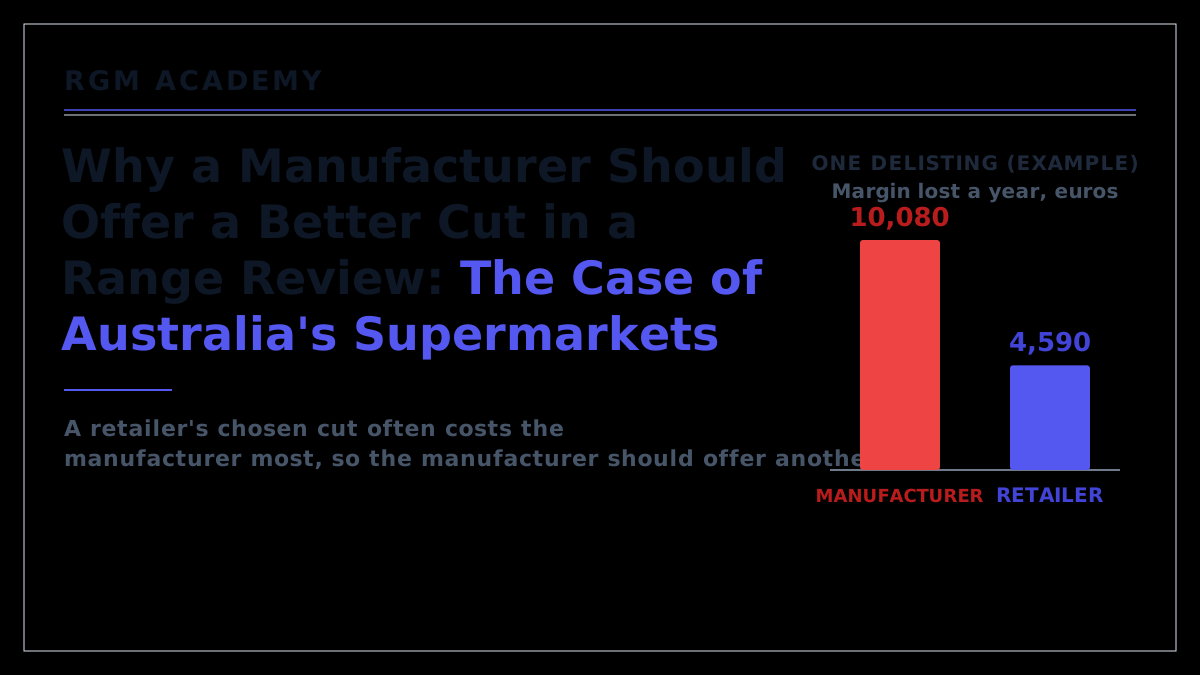
Before the freed shelf is counted, cutting Rosemary costs the retailer 4,590 euros of margin (14,400 less 9,810), less than half the manufacturer's 10,080 euros of gross profit (12,600 less 2,520). Original would have to absorb most of Sea Salt's shoppers and may need some of its space. The swap still pays the retailer while the shelf that cutting Sea Salt frees is worth more than 2,280 euros a year: the 1,870 euros of margin lost on Sea Salt (17,600 less 15,730) plus the 410 gained by cutting Rosemary.
The Academy's lesson on the dual profit and loss account (P&L) measures a proposal as each side's change from the plan on the table, and calls it a win-win when both changes are positive. Against the retailer's plan to cut Rosemary, cutting Sea Salt instead leaves the manufacturer 5,460 euros a year better off (a loss of 3,620 instead of 9,080) and the retailer 2,720 euros better off (3,130 less 410). Each side's other costs are the same under both options, so the change in margin is the change in profit.
Run the Academy's delisting sum once for each side: the cheapest line for both to lose is the one whose shoppers stay with the brand, which may be a different line from the slowest seller.
How can a manufacturer know where its shoppers will go?
The Academy's price pack architecture lessons give three ways to estimate transfer before the review. The first is the consumer decision tree, the order in which shoppers narrow a category down to one pack. In the Academy's words, a range review should "judge a product against its tree substitutes, not the full assortment". In the example, shoppers choose the flavor family first and the brand second. Sea Salt shares a family with Original, so its shoppers find a close substitute inside the brand. Rosemary is the only herb cracker, so its shoppers lose their whole branch, and most of them leave the brand or the section.
The second is the out-of-stock test: ask the retailer what shoppers bought when the line was missing. The lesson notes that this costs nothing, because "it is the retailer's data", and it checks the tree against what shoppers did. It is still an estimate, and least certain for the slowest line, because slow lines rarely run out.
The third is the overlap check: 85 percent of Sea Salt's shoppers also bought the brand's other lines, most of them Original, against 30 percent of Rosemary's. On the lesson's thresholds, below, Sea Salt is safe to cut and Rosemary is not. Sea Salt also stays the cheaper cut for the manufacturer unless fewer than about 35 percent of its shoppers move to the brand's other lines, half the 70 percent the stock-out records suggest. The swap stops paying once the gross profit transferred falls to 5,320 euros (Sea Salt's 15,400 less the 10,080 the manufacturer loses on Rosemary), which is 34.5 percent of 15,400.
The overlap check
Of the shoppers who bought a line in the past 12 months, what share also bought another of the brand's lines? The Academy's pack roles lesson treats overlap above 80 percent as safe to cut and 50 to 80 percent as a cut to make with care. Under 50 percent, it says, the line is "the reason those shoppers make the trip, or the only thing in the range that suits them".
A manufacturer can estimate each line's transfer rate before the review from its decision tree, the retailer's out-of-stock records and the overlap between its lines' shoppers, and a rough estimate is enough to choose the line to offer.
Will the retailer simply take both lines?
The obvious risk is that the retailer takes the offered line and still cuts the one it chose, or cuts a line it had not planned to. Where a review works to a target number of items, an offered line can count toward it and replace a planned cut. A manufacturer can ask how many items the review will consider; the Woolworths mediator's recommendations included one on how Woolworths communicates that share.4 The safer course is to offer a line only in place of a cut the retailer has signaled, in writing, as a swap: Sea Salt instead of Rosemary.
In the example both sums point to the swap, so the manufacturer is not asking for a favor. The two sums do not always agree. When a line's shoppers would move mostly to other brands or the store brand, the retailer gains from cutting it while the manufacturer loses most, and the manufacturer has to find something else in the wider deal to make a swap worth the retailer's while. Without evidence, the manufacturer is left with whatever rule the retailer applies: in the example, the slowest seller, at a cost of 9,080 euros a year instead of 3,620.
The rules set the timetable: Australia's Food and Grocery Code requires a large grocery business to give suppliers who might be adversely affected written notice of a range review's purpose and "the key criteria governing ranging decisions", and a reasonable opportunity to discuss before a final decision. A delisting, including a cut in distribution that has or is likely to have a material effect on the supplier, needs "genuine commercial reasons", reasonable written notice and a right to review by a more senior manager at the retailer.6 These are rights and processes, and each manufacturer should take its own legal advice.
An offered line works best as a written swap for a cut the retailer has signaled, when it leaves the retailer better off on its own figures and arrives during the discussion the Code provides for.
What should a manufacturer protect in a whole-deal reset?
Facings, the number of packs of a line showing at the front of the shelf, are the cheapest thing to give. Field experiments at the Dominick's chain in Chicago, published in 1994, found that location had a large effect on sales and the number of facings much less, "as long as a minimum threshold (to avoid out-of-stocks) was maintained".7 In a swap, that threshold includes the extra facings the best seller needs to carry shoppers from the cut line. Shelf position is worth defending first, and so is the best seller: its distribution, facings and position should be protected before any delisting is discussed, because the shoppers it brings to the brand do not show in any delisting sum.
A swap that already pays the retailer needs no extra trade terms, so the manufacturer's money is better kept for parts of the reset where it buys something the manufacturer can measure afterwards. The decisions on range and shelf price stay with the retailer. The manufacturer's part is to bring the evidence that lets the retailer make them with both sides' figures in view.
In a whole-deal reset, offer the line both sides can lose cheaply, defend shelf position and the best seller rather than facings, and keep trade money for what it can be shown to buy.
References
- Australian Food and Grocery Council with NextGen Group, training flyer on the 2026 major-retailer range reviews, May 2026: "Woolworths and Coles are progressing significant range reductions through the Customer Offer Reset (COR) and Supplier Partnership programs."; "For suppliers, this means negotiating the full commercial relationship at once, and at a scale and intensity not previously seen." The flyer advertises a paid training course. afgc.org.au
- Daniel Corsten and Thomas Gruen, "On Shelf Availability: An Examination of the Extent, the Causes, and the Efforts to Address Retail Out-of-Stocks", in Consumer Driven Electronic Transformation, January 2005, pages 131 to 149: "a worldwide study of more than 71,000 consumers that was conducted in a series of 29 studies across 20 countries"; the delay response is defined as "delay purchase (buy later at the same store)"; responses to an out-of-stock, average across 8 categories: "Buy Item at Another Store 31%"; "Delay Purchase 15%"; "Substitute -- Same Brand 19%"; "Substitute -- Different Brand 26%"; "Do not Purchase Item 9%". researchgate.net
- Woolworths Group, full-year results for F26, 26 August 2026, Woolworths Food Retail (Australian supermarkets): "Grocery Food sales grew 7.1% ... through a continued focus on in-store execution including simplified ranges and availability alongside a shift towards Lower Shelf Prices." woolworthsgroup.com.au
- Woolworths Code Mediator, annual report for FY26, 11 August 2026: "During FY26, I was contacted (by email or phone) by 28 suppliers of Woolworths."; topics included "the conduct and outcomes of range reviews, Woolworths Customer Offer Reset (COR) program and delisting decisions"; outcomes included "adjustments to range review outcomes and delisting decisions"; Woolworths took action on recommendations about its processes and communications, including "the volume / percentage of stock keeping units that would be under consideration in a range review". woolworthsgroup.com.au
- Independent Review of the Food and Grocery Code of Conduct, final report, June 2024: Woolworths and Coles "having a combined market share of just over 65 per cent"; "being delisted from a major supermarket chain can have large commercial consequences given the lack of alternative avenues for selling products at scale in Australia." pmc.gov.au
- Competition and Consumer (Industry Codes - Food and Grocery) Regulations 2024, in force from 1 April 2025, sections 32 and 39: "A large grocery business must not delist a supplier's grocery product" except "(a) in accordance with the terms of the relevant grocery supply agreement; and (b) for genuine commercial reasons"; a delisting includes a reduction in distribution that "has or is likely to have a material effect on the supplier"; "Before delisting a supplier's grocery product, the large grocery business must provide reasonable written notice"; the supplier's "right to have the decision to delist the product reviewed by the senior buyer"; range reviews require notice of "the key criteria governing ranging decisions" and "a reasonable opportunity to discuss the decision". Section 46: "Each large grocery business must: (a) appoint a person with appropriate qualifications, knowledge and experience to fulfil the Code Mediator's functions". legislation.gov.au
- Xavier Dreze, Stephen J. Hoch and Mary E. Purk, "Shelf Management and Space Elasticity", Journal of Retailing 70, no. 4, 1994: "We found that location had a large impact on sales, whereas changes in the number of facings allocated to a brand had much less impact as long as a minimum threshold (to avoid out-of-stocks) was maintained." repository.upenn.edu
Keep going
Pair this with the playbook and the lessons that teach the methods behind it.
Playbook
Respond to private label growth. A five-question guide for when the store brand gains share. In a range reset the store brand can take the freed shelf.
More from the blog
The squeezed middle. Why a brand caught between premium lines and the store brand enters a range review in a weak position.
Three ways brands fight back against private label. Why the store brand is where many shoppers of a delisted line land, and how brands respond.
On-invoice versus off-invoice trade money. The terms side of the same reset: where the manufacturer's money lands in the retailer's accounts.
Lessons inside the course
Mix management →The delisting sum this article runs twice, and the range score that asks first whether shoppers would miss a line.Start the lesson → Consumer decision tree →How to map the order in which shoppers choose, and the free out-of-stock test that shows where a missing line's shoppers go.Start the lesson → Pack roles →The overlap check behind this article's 80 and 50 percent lines, and why cuts should be phased so the manufacturer can measure what transferred.Start the lesson → Dual P&L and win-win analysis →How to read a proposal as a change for each side against the plan on the table, the test this article's swap passes.Start the lesson →Try it free
Shopper-Occasion Pack Matrix. Opens with shoppers choosing flavor first and brand second, the order in this article's example, on the tool's own chocolate-tablet range. Corvane Milk Hazelnut's shoppers are then most likely to switch to the same brand's Dark Hazelnut (18 percent), as Sea Salt's go to Original. Pick Corvane Milk Plain instead and its nearest substitute is the store brand's plain tablet. The 60 percent accuracy score compares the order with the tool's chocolate example, which puts type first. Free and without sign-up.
OBPPC Matrix Builder. OBPPC stands for occasion, brand, pack, price and channel. Remove listings one at a time and read what each is worth to your whole portfolio rather than on its own: your side of the delisting sum. Free and without sign-up.