Why a Base-Price Cut Needs a New Promotion Plan: The Case of General Mills
A lower everyday price also lowers every deal price, unless the promotion money changes.
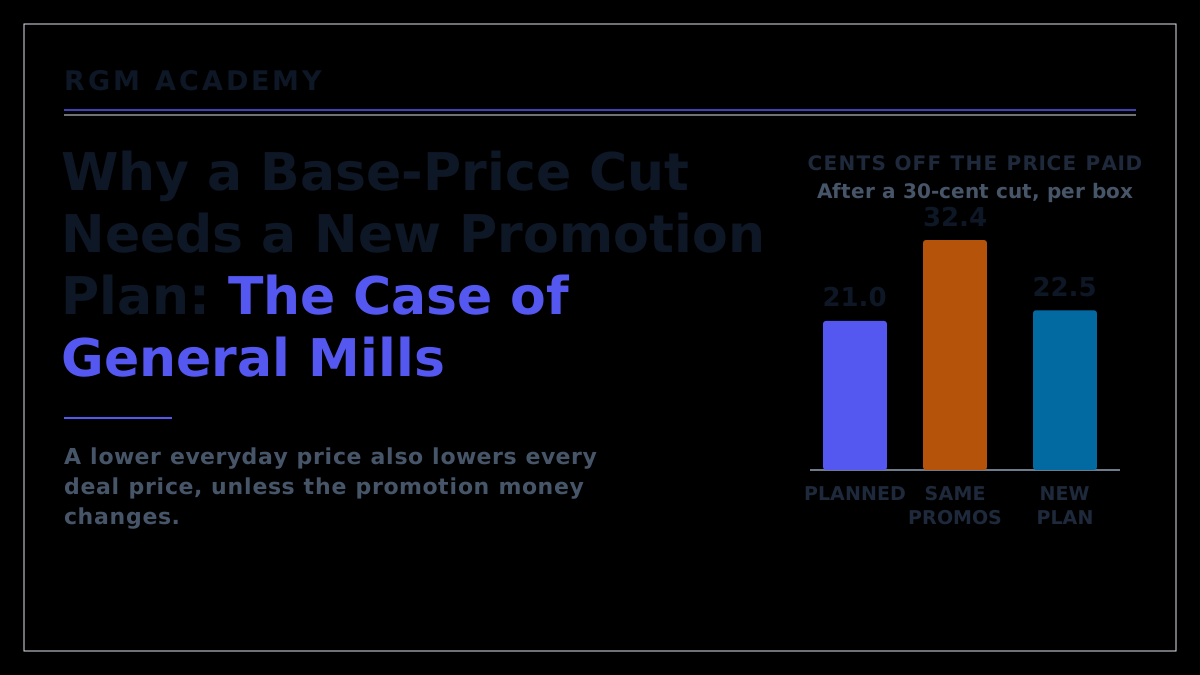
The short version
- In fiscal 2026, the year to 31 May 2026, General Mills lowered base prices on about two-thirds of its North American retail range and left its promotion plan as it was. Everyday volume came back, but adjusted operating profit fell 16 percent, with its price investments one of three causes it named.123
- The weighted average selling price (WASP), the price shoppers actually pay, shows why. In the worked example below, a cut meant to take 21 cents a box off it takes 32.4 cents, 54 percent more. The deal price following the everyday price down takes 9 cents, and stretched shoppers buying more on deal take 2.4.
- The business case for the cut leaves out the boxes sold on deal. In the example, once the deal boxes are counted, the cut costs the manufacturer 236,400 dollars a year, nearly twice the 120,000 the case planned.
- Setting the promotion money again from the new list price saves 108,900 dollars a year and brings the cut's own cost to 127,500, close to the case. It is worth doing unless the shallower deal loses three-quarters of its boxes.
What did General Mills change, and what did it leave alone?
In fiscal 2026 General Mills lowered base prices, the everyday prices its products sell at when not on deal, on about two-thirds of its North America Retail business "to get below key price cliffs and ensure gaps to competition were in a sustainable range".1 A price cliff is a price point, such as 4 dollars, above which shoppers sharply cut back.
By the company's account, it worked on everyday volume: in the categories where it invested, base volume, which the company calls "our most profitable volume", went from a 10 percent decline in fiscal 2025 to 1 percent growth in the fourth quarter of fiscal 2026.24
The promotion plan did not move with the base price. In December 2025 the company said lower- and middle-income shoppers were making "a greater proportion of their food purchases on promotion rather than at everyday prices". It said this had not come from more frequent or deeper promotions, its own or its competitors', and put it down "simply" to "stressed consumers finding ways to stretch their dollars further".35 In September 2026 its chief operating officer said the value had gone into base prices, not "through promotional tactics".4
The result, in the company's words, was "a less profitable mix of volume". In February 2026 it warned of a "higher cost of volume recovery than initially expected", and fiscal 2026 adjusted operating profit fell 16 percent in constant currency, with "the impact of our price investments" named among three causes.12
General Mills lowered its base prices and kept its promotion plan, so the cut also lowered every deal price, just as more shoppers were buying on deal.
What price did shoppers actually pay?
The Academy's lesson on cross-lever integration names the number that settles the question: the weighted average selling price, "the real test of whether pricing is working, because it blends shelf price and promoted price by volume".
The weighted average selling price, in one line
WASP = (baseline volume times shelf price plus promo volume times promo price) divided by total volume. Baseline volume sells at the everyday shelf price and promo volume on deal. The share sold on deal is VSOD (volume sold on deal), which counts the boxes that would have sold at full price anyway, not only the extra ones the deal won. WASP shows how much of a list price move reaches the shopper once promotions are counted.
An invented manufacturer sells 1,000,000 boxes of cereal a year to one retailer. Its list price is 3.00 dollars, its own decision, and with no other trade terms in the example that is also what it keeps. Its cost of goods sold (COGS) is 1.80 dollars, so it earns 1.20 on each box sold at the everyday price. The retailer's everyday shelf price is 4.29 dollars, the retailer's decision, and the example assumes the retailer keeps 1.29 a box. The manufacturer funds 0.80 dollars on each box sold on deal. If the retailer passes that on, the deal price is 3.49 dollars, 18.6 percent off (0.80 divided by 4.29). The manufacturer earns 0.40 on a deal box (3.00 less 0.80 less 1.80). Thirty percent of boxes sell on deal.
WASP before the cut is 4.05 dollars: 700,000 boxes at 4.29 plus 300,000 at 3.49, divided by 1,000,000.
The manufacturer then lowers its list price by 0.30 dollars to 2.70, 10 percent. If the retailer passes the cut on, the everyday price falls to 3.99, under the 4-dollar mark. The promotion money stays at 0.80 a box on the same weeks, so the deal price falls to 3.19. That is 20.1 percent off the new everyday price (0.80 divided by 3.99), a deeper deal than anyone planned. Shoppers short of money buy a little more on deal, 33 percent of boxes instead of 30. WASP falls to 3.726 dollars (0.67 times 3.99 plus 0.33 times 3.19), 32.4 cents a box lower (4.05 less 3.726).
The fall has three parts. The everyday price accounts for 21 cents (0.70 of the boxes times 30 cents), the part the cut was meant to do. The deal price following it down accounts for 9 cents (0.30 times 30 cents). The shift onto deal accounts for 2.4 cents (3 percent more boxes, each 80 cents cheaper), a part stretched shoppers would have caused without the cut.
These numbers hold the money per deal box in cents, a per-box allowance rolled over unchanged. Promotion depth, the discount on a deal, is more often held as a percentage off the everyday price. Then the money per box falls on its own to about 0.74 dollars (18.6 percent of 3.99) and the deal price to about 3.25. WASP still falls 30.6 cents, about 45 percent more than the cut was meant to (30.6 divided by 21.0).
The cross-lever lesson works the price-rise version in numbers, with list and shelf as one price. Lift it from 4.99 to 5.49 dollars, and holding a 3.99 promoted price needs a 27 percent discount instead of 20 (1.50 off 5.49, against 1.00 off 4.99). A cut runs the same pathway backwards, and so does the lesson's compensation trap. After a rise, "sales often deepens promotions to hold volume, which partly or fully cancels the pricing action". After a cut nobody has to deepen anything: the unchanged money already buys a deeper deal, so nobody decides to give the extra away and the cost shows up only in the results.
General Mills' Nielsen-measured price/mix in North America, which counts the mix of products bought as well as their prices, was down 3 points in the second quarter of fiscal 2026 and 1.5 points in the third.1 That shows the price shoppers paid falling, though not whether it fell by more than the cuts, whose size the company has not disclosed. With its promotion depth unchanged, however it was measured, its deal prices fell along with its base prices.
After a base-price cut, the manufacturer should compute WASP before and after, because an unchanged promotion plan carries the cut into every deal price.
What did the cut cost once promotions are counted?
The business case for a base-price cut is usually built on the everyday volume it is meant to win. In the example the case expects 100,000 more everyday boxes, 800,000 instead of 700,000, helped by the price landing under 4 dollars. The manufacturer gives up 30 cents on the 700,000 boxes it already sold at the everyday price, 210,000 dollars. It earns 90 cents (2.70 less 1.80) on each of the 100,000 new ones, 90,000 dollars. The direct effect is minus 120,000 dollars a year, an investment the case accepts.
Total impact, in one line
Total impact = the direct effects of each lever plus the interaction effects between them. The cross-lever lesson gives a rule of thumb: interactions typically take 15 to 30 percent off the gain a single-lever plan projects. The interaction effects, in the lesson's words, show how "a price change moves the share of volume sold on promotion".
The case left out two costs on the boxes sold on deal:
- The 300,000 boxes sold on deal also lose the manufacturer 30 cents each, because the promotion money did not change: minus 90,000 dollars.
- At 33 percent of 1,100,000 boxes, 363,000 sell on deal instead of the 300,000 the case assumed, so 63,000 boxes move from the everyday price to the deal price. Each earns the manufacturer 10 cents (2.70 less 0.80 less 1.80) instead of 90: minus 50,400 dollars (63,000 times 0.80).
The total is minus 260,400 dollars a year, 2.17 times the case (260,400 divided by 120,000). Not all of it is the cut's doing. In a year without the cut, the same 3-point shift onto deal would have cost the manufacturer 24,000 dollars (30,000 boxes each earning 80 cents less). So the cut itself costs 236,400 (260,400 less 24,000), nearly twice the case.
The lesson's rule of thumb is written for a plan that projects a gain. Here the plan projects a cost, and the deal boxes alone add 75 percent to it (90,000 divided by 120,000). The case left out 30 percent of the volume, and 30 cents is three-quarters of a deal box's margin. The cut takes the manufacturer's everyday margin from 1.20 to 0.90 dollars, a quarter, and its deal margin from 0.40 to 0.10.
The cost of a base-price cut belongs on the whole profit and loss account (P&L), deal boxes included, because the boxes sold on deal carry the thinnest margin and, when the money per box is held in cents, take the cut in full.
What should the promotion plan look like after the cut?
A new plan sets the promotion money from the new list price. The Academy's lesson on price thresholds gives the rule: "Start from the promoted price you will recommend, and set the funding at what the retailer needs to sell at that price on its usual margin, paid whatever promoted price the retailer chooses." In the example, 0.50 dollars a box lets the retailer sell at 3.49 on its usual 1.29 (2.70 less 0.50, plus 1.29). The deal is now 12.5 percent off 3.99 (0.50 divided by 3.99). The manufacturer earns 0.40 on a deal box (2.70 less 0.50 less 1.80), as before the cut.
WASP becomes 3.825 dollars (0.67 times 3.99 plus 0.33 times 3.49), 22.5 cents lower than before: the everyday cut of 21 cents plus 1.5 cents from the shift onto deal. The manufacturer's gross profit falls by 151,500 dollars a year instead of 260,400. The saving is 108,900 dollars (30 cents on each of 363,000 deal boxes). Against a year without the cut, the cut now costs 127,500 dollars (236,400 less the 108,900 saved).
A shallower deal may sell fewer deal boxes. The Academy's elasticity lesson notes that promotional price elasticity, how much volume responds to a deal price, "usually runs 2 to 5 times higher than shelf elasticity", the response to the everyday price. Each deal box lost outright costs the manufacturer 0.40 dollars; each one bought at the everyday price instead earns it 0.50 more (0.90 less 0.40). The saving is used up only if 272,250 deal boxes are lost outright (108,900 divided by 0.40), 75 percent of them.
The strongest objection is that the shift onto deals came from shoppers, not from the cut, and that cutting deal money hands promotion weeks to rivals. The first point is true, and it is the reason to re-plan: the more volume sells on deal, the more of the cut lands on boxes it was not aimed at. On the second, the retailer keeps the same 1.29 dollars a box on the shallower deal, and in the example 3.49 is still a price point where the category's volume gathers. Where a retailer needs a deeper deal for a feature slot, the answer is fewer, deeper events rather than the old money on every week.
According to a summary of General Mills' call on 23 September 2026, management expects price/mix to improve from the second quarter of fiscal 2027 "as the company laps base-price investments".6 A year-on-year price/mix line stops showing a cut once it is a year old, while shoppers keep paying the lower price. WASP in dollars, compared with the year before the cut, keeps the cut in view.
The base-price cut can be the right decision while the plan around it is wrong. Getting under a price cliff sets the price from what shoppers will pay rather than from a cost breakdown, and the volume came back.
A base-price cut needs its own promotion plan, with the deal funding set again from the new list price and paid whatever deal price the retailer chooses. Re-planned that way, the cut in the example costs the manufacturer about what the case said, 127,500 dollars a year against 120,000; with the old plan left in place, it costs nearly twice as much.
References
- General Mills, earnings call for the third quarter of fiscal 2026, 18 March 2026: "We made an important move to adjust base prices across two-thirds of our NAR portfolio to get below key price cliffs and ensure gaps to competition were in a sustainable range."; "NAR's Nielsen-measured price/mix improved from down three points in Q2 to down one-and-a-half points in Q3." General Mills, CAGNY release, 17 February 2026: "a slower pace and higher cost of volume recovery than initially expected". generalmills.com investor files; CAGNY release
- General Mills, earnings call for the fourth quarter of fiscal 2026, 1 July 2026: "For the full year, organic net sales finished down 2%, and adjusted operating profit and adjusted diluted EPS were down 16% in constant currency. These results reflected a still-challenging consumer backdrop, the impact of our price investments, and a headwind from our yogurt divestitures."; base volume "from a 10% decline in fiscal '25 to 1% growth in the fourth quarter of fiscal '26"; "we saw them buying more on promotion and less at everyday prices, driving a less profitable mix of volume through our P&L."; "the contributions made from trade optimization". generalmills.com investor files
- General Mills, earnings call for the second quarter of fiscal 2026, 17 December 2025: "We finalized base price adjustments across two-thirds of our North America Retail business"; "we've seen them make a greater proportion of their food purchases on promotion rather than at everyday prices. And this has not been driven by increased frequency or depth of promotions by General Mills or our competitors"; "It's simply a reflection of stressed consumers finding ways to stretch their dollars further." generalmills.com investor files
- Food Business News, 14 September 2026, reporting General Mills' presentation at the Barclays conference on 8 September 2026: "We didn't do it through promotional tactics or through frequency and merchandising, the way that some others in the industry did."; base pound volume "was down 10% at the close of fiscal 2025 but was up 2% going into fiscal 2027"; "Base volume is what happens when the consumer goes to the shelf and typically buys that product at full price ... It is our most profitable volume." foodbusinessnews.net
- General Mills, results release for the fourth quarter of fiscal 2026, 1 July 2026: "Organic net sales were down 2 percent, due in part to weaker consumer sentiment and significant volatility that weighed on category volume growth and drove a higher share of consumer purchases on promotion."; "With its base price investment actions completed in fiscal 2026". businesswire.com
- MarketBeat, summary of General Mills' earnings call for the first quarter of fiscal 2027, 23 September 2026 (the summary's wording, not the company's): "McNabb said General Mills expects price mix to improve beginning in the second quarter [of fiscal 2027] as the company laps base-price investments made in the prior year." marketbeat.com
Keep going
Pair this with the playbook and the lessons that teach the methods behind it.
Playbook
End the promotion or just shrink it? A five-question guide for the events a new promotion plan has to re-price: which to end, and which to shrink in depth, frequency, duration or mechanic.
More from the blog
The case for ending half your promotional plan. Which events to stop and which to shrink, once each one is judged on what it really adds.
Why BOGO is dying, and what works instead. How the choice of deal changes who takes the discount and how much of the uplift is new.
On-invoice or off-invoice. Where trade money lands, and why money meant for the shopper often builds the retailer's margin instead.
Lessons inside the course
Cross-lever integration →The weighted average selling price, the compensation trap and total impact as direct effects plus interactions: the methods this article runs on the example.Start the lesson → Price thresholds →Price cliffs, why 3.99 can beat 4.29, and how to fund a recommended promoted price while the retailer decides the price itself.Start the lesson → Price elasticity →Why promotional elasticity runs well above shelf elasticity, the number to test before making a deal shallower.Start the lesson →Try it free
Cross-Lever Impact Simulator. Price and promotion levers on one P&L, on the tool's own example product, free and without sign-up. The simulator sets promotion depth as a percentage of the list price, the way the cross-lever lesson caps it, so a price cut lowers the money per deal on its own. The case with the money held in cents is not in the tool. Open it with the price 10 percent lower and 33 percent of volume sold on deal: gross profit falls 12.7 percent, nearly all of it the price cut itself, and the Flywheel Coordination Band reads Aligned. Then lower promotion depth from 15 to 10 percent: gross profit falls 6.4 percent. The simulator keeps volume unchanged when a deal gets shallower, so read the second result as the favorable case.